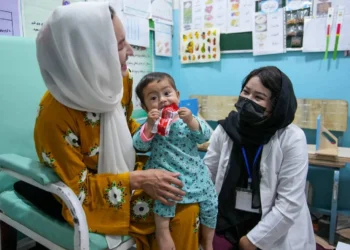

The United Nations Entity for Gender Equality and the Empowerment of Women (UN Women) has released the Afghanistan Gender Index for 2024. According to the report, this index represents the most comprehensive assessment of women’s empowerment and gender equality in Afghanistan since the Taliban’s takeover. The latest UN Women report indicates that women in Afghanistan have significantly fallen behind global human development standards. It states that nearly eight out of every ten young women in Afghanistan are deprived of education, employment, and vocational training opportunities.
The Afghanistan Gender Index, considered the most thorough evaluation of women’s empowerment and gender equality since the Taliban’s rise to power, reveals that Afghanistan has the second-largest gender gap globally, with a 76 percent disparity between the achievements of women and men in health, education, financial access, and participation in decision-making. The index also highlights that women in Afghanistan, on average, realize only 17 percent of their potential capacity to make choices and seize opportunities, compared to a global average of 60.7 percent.
Sima Bahous, Executive Director of UN Women, stated: “Afghanistan’s greatest asset is its women and girls.” She added, “Their potential continues to be overlooked, yet they persevere. Women in Afghanistan support one another, launch businesses, provide humanitarian aid, and raise their voices against injustice. Their courage and leadership, despite severe restrictions, have transformed their communities. We must stand with them to build a country that reflects their rights and the aspirations of all people of Afghanistan.”
According to the UN Women report, funded by the European Union (EU), 78 percent of young women in Afghanistan are neither engaged in education, employment, nor vocational training programs—a figure nearly four times higher than that for men in Afghanistan. Furthermore, with the ongoing ban on secondary and higher education for girls and women, including medical training, the secondary school completion rate for girls is on the verge of collapsing entirely, approaching zero.
Afghanistan continues to experience one of the widest gender gaps in the global labor market, with only 24 percent of women actively participating in the workforce, compared to 89 percent of men. Most women work from home, often in low-paying, unstable, and informal jobs.
Additionally, women undertake the majority of unpaid household work. According to the report, 74 percent of women spend a significant amount of time on household chores, while only 3 percent of men take on such roles.
The report also highlights a significant financial gap, noting that men are nearly three times more likely than women to have a bank account or use mobile financial services. Despite widespread restrictions on women’s employment, limited exceptions have been made in some sectors, and the report indicates that women in Afghanistan are entering the labor market in unprecedented numbers, primarily driven by the country’s chronic economic and humanitarian crises.
The report notes that by 2022, the number of women actively seeking work had quadrupled compared to the pre-Taliban era, and the number of women engaged in the labor market had doubled.
UN Women emphasized that no women hold positions in the Taliban’s cabinet or local administrations, a significant setback that severely limits women’s ability to influence policies and legislation affecting their lives. Despite their near-complete exclusion from public and political spheres, women continue to strive for inclusive governance and find ways to voice their concerns and demands at the national and local levels.
This index helps measure progress toward gender equality in Afghanistan and provides critical data to national and international stakeholders to address the ongoing women’s rights crisis effectively. UN Women continues its work within Afghanistan to ensure that the priorities and needs of women and girls remain at the forefront of global attention, enabling them to live with dignity and actively contribute to the country’s development.
Meanwhile, during the 59th session of the Human Rights Council, several women and girls described the human rights situation in Afghanistan as critical. Women’s rights activists, in their speeches, highlighted widespread human rights violations, asserting that the Taliban’s treatment of women in Afghanistan constitutes clear evidence of crimes against humanity and gender apartheid.
Nigara Mirdad, Deputy Ambassador of Afghanistan to Poland, emphasized during the session that what is happening in Afghanistan is not merely suppression but a systematically designed and implemented form of gender apartheid. She added that women in Afghanistan have not only been marginalized but completely erased from public life. Mirdad also noted that the lives, voices, and capacities of conscious women are being ignored not only by the Taliban but also by the slow mechanisms of international justice.
The diplomat called for the criminalization and legalization of gender apartheid, the imposition of gender justice-related sanctions, the establishment of a women-led international tribunal for Afghanistan, and a ban on recognizing regimes that systematically exclude women. Addressing the Human Rights Council, she warned that “your silence is not neutrality” and stressed that the cost of ignoring the current situation will be borne not only by women in Afghanistan but by every woman and man worldwide.
Meanwhile, Richard Bennett, the UN Special Rapporteur on Human Rights for Afghanistan, announced in a recent report on Monday that families in Afghanistan, due to extreme economic poverty and to prevent forced marriages of their daughters to Taliban members, are compelled to arrange marriages themselves. He stated that marginalized women in Afghanistan face multilayered discrimination, including gender-based, ethnic, and social discrimination. The report underscores that women and girls face systematic and overt suppression.
You can read the Persian version of this report here:
زنان فراموششده؛ افغانستان دومین شکاف جنسیتی بزرگ جهان را تجربه میکند