
Several women and girls living under Taliban rule have said on the occasion of World Social Justice Day that social justice and women’s human rights have become a bitter joke. According to them, the Taliban have systematically legitimized corporal punishment, educational deprivation, and even slavery through their laws, leaving women to die every day under a ruthless and organized domination, while their voices are silenced in the face of injustice. These women emphasize that even breathing, speaking, and trying to live a normal life are considered crimes, and the international community remains silent in the face of this oppression. Human rights activists also say that women’s access to justice faces structural blockages. According to them, “Justice for women is limited at the official level, unattainable in practice, and structurally discriminatory, reverting to patriarchal traditions.” UNAMA has also stated that social justice is impossible without women’s education and participation, while the United Kingdom’s Special Representative has said that they stand alongside the people of Afghanistan in striving for justice, dignity, and equal opportunities in the country.
On the occasion of World Social Justice Day, several women and girls said that the world commemorates this day while they are living under the Taliban in the darkest and most difficult period of their history. According to them, the Taliban have deprived women of the most basic human rights, turning life into a living hell. These women and girls said that through broad prohibitions and anti-women laws, the Taliban have institutionalized systematic repression and allowed male family members to beat and torture women, a situation that worsens every day.
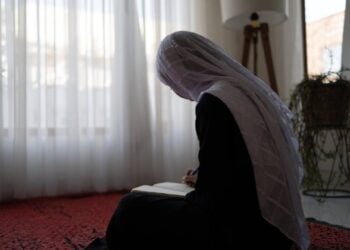
Forozan (pseudonym), a young woman in Kabul, says that in a geography like Afghanistan, it is impossible to speak of justice or rights. She says that every day, new restrictions or challenges are imposed on women by the Taliban, and currently, women are systematically and deliberately deprived of everything from employment and educational opportunities to arbitrary detentions and systematic exclusion from society. She emphasizes that in such circumstances, “women have neither the heart to stay nor the strength to leave.”
Adaalatkhah, a woman in Balkh, says that some popular proverbs about women take on a clear and tragic meaning. She refers to the famous proverb “Between a rock and a hard place (1) and adds that in Afghanistan, nothing is harder than being a woman. According to her, women in Afghanistan have no right to make choices. She continues: “Even if my clothes are black, my chador is black, and I wear a black mask over my face, I can only leave the house with extreme fear and anxiety. Studying is forbidden, sports are forbidden, recreation and laughter are forbidden, complaining is forbidden… I am a person who has lost my duties simply for being a woman and cannot even ask why I was removed from a position I had faithfully held for years.”
She emphasizes: “Breathing, speaking, and talking are crimes for a woman. Death has been defined for me, not in dying, but in living. I know well that a few streets away from our house, a young woman was shot dead by her father-in-law, without any wrongdoing, and because he was a Taliban commander, no one dared to prosecute him. The world must know that when women in Afghanistan are silent, it is not out of fear of death or beatings, but because of the humiliation and disgrace in Taliban prisons that force us to remain silent and endure.”
Adaalatkhah adds, “We are in a cage; there is no such thing as life. Breathing has never meant living. We are trapped in a forest surrounded by predatory animals, and if we move, we are mercilessly torn apart. No word can express the depth of our suffering.”
Meanwhile, Shahla Farid, a women’s rights activist and former professor at Kabul University, told the Hasht-e Subh Daily that currently, women’s access to justice is obstructed by structural barriers. She adds: “Justice for women is limited at the official level, unattainable in practice, and structurally discriminatory. Institutional inequality and structural gender discrimination against women exist.” According to her, the legal, political, and institutional structures under the Taliban have become the main obstacles to women accessing justice.
Farid says: “Women’s access to justice is hindered legally, institutionally, and structurally. Legally, the principle of equality before the law has been suspended. Previously, the constitution guaranteed equality of all citizens before the law, but now those laws have been suspended and replaced by Taliban laws; equality before the law is not enforced. The collapse of support mechanisms for women and the dissolution of institutions preventing violence against women mean that women have neither representation in institutions nor a haven for protection.”
She emphasizes that the rule of fear has made access to justice difficult for women, and currently, filing complaints is not only prohibited but may also result in punishment. Therefore, women cannot report violence, and many cases of abuse remain unreported. She points out that the current situation has led to male-centered justice under the Taliban regime, with dispute resolution left to traditional and patriarchal mechanisms, where decisions are made mainly in favor of families and men rather than ensuring women’s rights.
Several women’s protest movements have also stated on World Social Justice Day that justice is impossible without the meaningful participation of women in all areas of social life. They said that justice is realized when women can work freely, study, and live without fear. They emphasize that remaining silent in the face of oppression amounts to complicity in injustice.
The Afghan Women’s Freedom & Thought Foundation (AW-FTF) stated in a declaration that no society can achieve sustainable peace and genuine development without justice, equality, and human dignity. According to the movement, social justice is not just a theoretical concept or political slogan but gains meaning when women can work freely, study, and live without fear.
Meanwhile, the UN Assistance Mission in Afghanistan (UNAMA) stated on World Social Justice Day that social justice is impossible without women’s education and participation. According to UNAMA, no country can achieve social justice while half of its population is denied education. The office emphasized that sustainable peace is realized when women, youth, ethnic groups, and people with disabilities participate in decision-making, and all citizens of Afghanistan can access dignified work and earn an income without discrimination.
Richard Lindsay, the United Kingdom’s Special Representative for Afghanistan, stated that on Social Justice Day, he stands alongside the people of Afghanistan and strives for justice, dignity, and equal opportunities. He wrote: “Social justice depends on the protection of the rights of women and girls, ensuring media freedom, and making sure the most vulnerable members of society are not left behind.”
The United Nations also stated in a newsletter that worldwide, people continue to struggle with deep inequalities. According to the organization, social justice for all means access to quality education, decent work, and universal social protection. The UN added that advancing social development and social justice requires coordinated, fair, and inclusive policies that integrate social dimensions into macroeconomic, labor market, climate, digital, and industrial strategies.
This comes while the Taliban, in their Penal Code, have authorized corporal punishment of women and children. This code prohibits women from fleeing violence and structurally prevents their access to justice. The Taliban have allowed men to beat their wives as long as the beating does not result in broken bones or open wounds. The Penal Code classifies wife-beating as a discretionary “Ta’zir” punishment.
Article 34 of the Taliban law states that a woman who goes to her parents’ home without her husband’s permission, even to escape violence, may face up to three months in prison. Family members who shelter her are subject to the same punishment.
The Taliban Penal Code criminalizes criticism of the group’s decisions. Criticizing the ban on women’s education is currently classified in Taliban courts as a “legal” restriction. According to Article 23, insulting Taliban leaders carries a punishment of 20 lashes and six months in prison.
Under Article 24, anyone who witnesses “subversive activities of regime opponents” or knows about them but does not act or report them to Taliban authorities is considered guilty, and a judge may sentence the “witness” or “informed person” to two years in prison.
Article 59 of the Taliban Penal Code also criminalizes dancing and watching it. According to this article, “dancing for boys and girls, playing music, and even watching” is considered a crime, punishable by two months in prison for each participant.
Article 48 allows fathers to physically punish their sons from the age of 10, justifying the action as being in the “child’s best interest.”
Article 9 of the Taliban Penal Code divides society into four categories: “Ulema,” “nobility,” “middle class,” and “lower class.” According to this article, the type and severity of punishment for a crime are not determined by the nature of the crime but by the social status of the offender. For example, if a crime is committed by a religious scholar, only advice is given; if committed by a member of the nobility, a court summons and limited advice apply. However, if committed by the middle class, imprisonment is imposed, and for the lower class, both imprisonment and corporal punishment are applied.
The Taliban Penal Code also legitimizes slavery by using the term “slave” in several sections. For example, Article 15 states: “For any crime for which a ‘Hud’ punishment is not specified, Ta’zir punishment is applied, whether the offender is free or a slave…” In Clause 5 of Article 4, it is stated: “Ta’zir punishment may also be carried out by the husband and master.” Here, the use of the term “master” reduces women to the ownership of men and even to the status of “slave or concubine.”
Reference:
- The original Persian proverb ‘زمین سخت و آسمان دور’ has been replaced with the English equivalent ‘between a rock and a hard place’ for clarity for international readers.
You can read the Persian version of this report here:
از خشونت خانوادهگی تا «بردهگی قانونی»؛ طالبان بر سرزنان چه آورده است؟