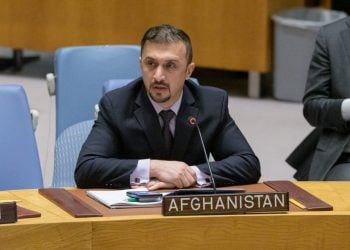
By Rahmatullah Najib, Deputy Minister of Interior for the Taliban and head of the group’s negotiating delegation in the first round of talks with Pakistan held in Istanbul, Turkey, recently addressed a press conference in Kabul, ostensibly about the ongoing dispute and dialogue with Islamabad. He stated that Pakistan’s demands are limited to two points: first, that members of the Tehrik-e-Taliban Pakistan (TTP) be relocated to Afghanistan; and second, that the Taliban’s supreme leader issue a religious decree (fatwa) declaring the war against Pakistan illegitimate. So far, the Taliban have neither clearly rejected nor accepted these two demands. Instead, their responses have been crafted with deliberate ambiguity, appearing on the surface to oppose Pakistan’s requests, yet leaving room for interpretation beneath the surface.
Regarding the first point, if Pakistan truly asked the Taliban to host TTP fighters in Afghanistan, it would implicitly mean that these fighters are not currently present in Afghan territory and that, until now, the Taliban have prevented their entry. But if that were true, then what has Pakistan’s years-long war with the Taliban been about? For the past four years, Pakistani officials have repeatedly claimed that TTP leaders and fighters are based in Afghanistan and launch cross-border attacks from there. If those claims are accurate, then this new “request for relocation” is meaningless and self-contradictory. Such conflicting statements from Pakistani officials could inadvertently lend legitimacy to the Taliban’s position; however, a more likely explanation is that the Taliban have distorted Pakistan’s actual demands to make their own stance appear more reasonable.
More importantly, the Taliban have not rejected the idea of relocating TTP fighters to Afghanistan outright; they have set a condition: that Islamabad must not label TTP members as terrorists, but rather as “good people.” Rahmatullah Najib stated this condition explicitly. The Taliban’s motive is transparent—they want these so-called “good people” to live in Afghanistan without being targeted by Pakistani airstrikes under the pretext of counterterrorism.
This raises deeper questions: By what authority do the Taliban intend to host thousands of foreign fighters on Afghan soil? Are they aware of the devastating consequences of transferring these militants and their families into Afghanistan? In which provinces will these armed groups be settled? Who will fund their living costs? Are the Taliban conscious of the demographic disruptions that will result from settling thousands of foreign families in Afghanistan? Even if Pakistan, for appearances’ sake, agrees to stop calling the TTP “terrorists,” does that suddenly make these militants harmless “good people”? What is clear is that the Taliban lack both the moral and legal legitimacy to take such actions, and any potential move in this direction would be invalid from the outset.
From Rahmatullah Najib’s statements, it appears that the Taliban seek to host TTP leaders and fighters, an attempt to keep both Islamabad and the TTP appeased. Thousands of these foreign fighters would likely be settled across northern, western, and central Afghanistan, paving the way for demographic engineering and the advancement of ethnic dominance policies. Najib’s apparent green light also stands in sharp contrast to the fiery remarks made just days earlier by Mawlawi Amir Khan Muttaqi, the Taliban’s foreign minister, who asked rhetorically: “Is Afghanistan insane to take on Pakistan’s headache?”
In response to Pakistan’s second demand, the Taliban have reportedly said that only “orders and directives” fall under the authority of their leader, not necessarily “fatwas.” Yet beneath this seemingly simple distinction lie two significant implications.
First: Rahmatullah Najib has unwittingly admitted that the key to controlling the TTP lies in the hands of the Taliban’s supreme leader, though he has so far chosen not to restrain the group. It is evident that a direct “order or directive” can be issued and enforced far more swiftly than a “fatwa,” which is the product of collective religious deliberation and involves complex procedures for issuance and enforcement. Hence, greater authority lies with the one who gives the command, not the one who issues a fatwa.
Second: the Taliban’s deputy interior minister introduced the concept of an institution called the “Dar al-Ifta” (Religious Edict Council), claiming that the issuance of fatwas falls under this body’s jurisdiction and that Pakistan may refer its requests to that institution. The purpose of this argument is to reduce the direct responsibility of the Taliban’s leader and to cloak political decisions in religious legitimacy. In other words, if the Dar al-Ifta were ever to issue a fatwa declaring the war in Pakistan illegitimate, the Taliban could then claim that the ruling came from an independent religious body, not from their leader himself. This reasoning is meant to shield the Taliban’s regime from accusations of fear or submission in the face of Pakistani pressure.
It is worth noting that the Taliban’s Dar al-Ifta has previously issued a fatwa stating that no Afghan is permitted to engage in jihad outside Afghanistan except by the emir’s command. That fatwa was issued at a time when suicide attacks in Pakistan were claiming numerous lives, and Pakistani authorities were accusing Afghans of involvement. The Taliban, apparently seeking to appease Pakistan, issued the ruling without explicitly declaring the war in Pakistan illegitimate. The fatwa received broad coverage in Pakistani media and was welcomed by religious authorities there. It is also notable that before that ruling, Mullah Mohammad Yaqoob Mujahid, the Taliban’s defense minister, had released an audio message stating: “At present, the emir’s order is this, and obedience to it is obligatory; if anyone leaves Afghanistan with the intention of jihad, that act shall not be considered jihad.” Shortly thereafter, Taliban spokesperson Zabihullah Mujahid clarified that what the defense minister had described as the emir’s order was, in fact, a fatwa issued by the Dar al-Ifta. In any case, that Taliban fatwa effectively aligned with Pakistan’s demands and implicitly declared the war in that country illegitimate.
But why do Pakistan and the mediators insist so strongly on the issuance of a fatwa? (The mediators’ insistence is particularly significant and warrants separate analysis.) The answer is clear: from an Islamic legal standpoint, TTP has pledged allegiance (bay‘ah) to the Taliban’s supreme leader, and therefore his command carries binding religious authority over the TTP’s leaders and fighters. For this reason, a fatwa issued directly by the Taliban’s leader could substantially influence TTP’s stance. By framing the issue around a fatwa, the Taliban are seeking a path to indirectly comply with Pakistan’s demand, for if they truly intended to reject it, they could simply have argued that their Dar al-Ifta has no jurisdiction over the TTP or the conflict in Pakistan, and that issuing such a religious ruling is not its mandate.
You can read the Persian version of this analysis here:
از انتقال تیتیپی تا صدور فتوا علیه آن؛ خواستهای پاکستان و پاسخهای پرابهام طالبان