
In the scorching desert plains of Nimruz, where thirst has claimed the lives of many, Hayatullah turned on his mobile phone to record his final message for his family. With dry lips, a voice barely audible from exhaustion, and a sentence born of the depths of despair: “Mother dear, pray for me, I am dying.” He was no longer speaking to be rescued, but to say goodbye. He asked his mother to forgive him, sought forgiveness from his family and friends, and left instructions that if his brother could, he should pay off his debts. These words are the final legacy of a young man who, amid the burning sands and thirst, bid farewell to his family and to life before he passed away.
Hayatullah, one of those who lost their lives in the plains of Nimruz, recorded this video in the final moments of his life as he said goodbye to his family. Having apparently lost hope of being rescued from the scorching plains of Nimruz, with dry lips and in a state of agony, he asks his family for forgiveness and asks everyone to pardon any claim they may have against him.
In this video clip, which has been widely shared on social media, he says to his mother: “Mother dear, pray for me, I am dying.”
Hayatullah, speaking in Pashto, says to his mother: “Pray for me, mother dear! I am dying. All of you pray. Take care of Haibati [likely his son]. I have no chance of survival. If this keepsake of mine reaches you, all of you forgive whatever right you have over me. I have fallen into a trap. I remember all of you. These are my final dying breaths.”
At the same time, during the conversation, his travel companion Mir Alam addresses him, saying: “Hayat!” Hayat responds: “Yes!” He then continues: “Pass on my message too, tell my mother to forgive me.” He then says: “I am leaving a message. Lift my head, I am departing this world.”
He then quotes Mir Alam, saying: “Mir Alam says: tell my mother to forgive me. Give my regards to all my relatives and tell them to forgive me. Tell my friends to forgive me too. This is the last meeting. God knows whether I will survive this thirst or not.”
He then says: “Whichever friend I owe a debt to, first my brother, if he is able, should pay off my debts; otherwise, they should forgive my debts.” At the end, letting out a sigh, he says: “I am dying… this is my last keepsake. Peace be upon you. Give my regards to Haibati.”
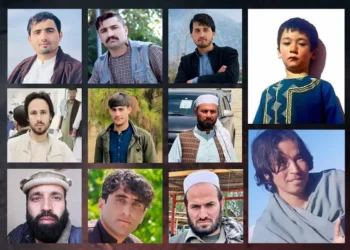
Last Friday, the bodies of 14 citizens of Afghanistan who had gone missing in Nimruz’s plains while being smuggled toward Iran were found. The Taliban had also confirmed that the bodies of these individuals were recovered from the “Reg-e Lalu” area in Nimruz province. Published images and videos show that these 14 people, after getting lost along the smuggling route, died as a result of extreme heat, thirst, and the harsh conditions of the desert.
Previously, sources had said that these individuals were residents of the “Qoliqi” area, a region that was formerly part of Bala Murghab district in Badghis province but now falls under the jurisdiction of Darah-ye Bum district in the same province. According to sources, these individuals had set out for Iran due to economic hardship, unemployment, and in search of work.
The Taliban transferred the bodies of these 14 citizens of Afghanistan to Darah-ye Bum district of Badghis province. Yesterday, their funeral prayers were held in this district with residents in attendance, after which the victims’ bodies were handed over to their families for burial.
Many citizens of Afghanistan, in resharing this video on social media, have described the country’s economic conditions and spreading poverty as alarming. They hold the Taliban responsible for the current situation and for the deaths of young people along smuggling routes to neighboring countries, saying that under this group’s rule, employment opportunities have disappeared, leaving thousands of young people without hope for their future in Afghanistan. According to them, this painful tragedy reflects a deep humanitarian crisis, widespread poverty, chronic unemployment, and growing despair about the future in Afghanistan. They emphasize that the continuation of this situation has forced many young people to choose dangerous smuggling routes in search of a better life.
The World Food Programme (WFP) has previously announced that alarmingly rising hunger has trapped millions of people in Afghanistan between a deepening crisis and dwindling hope. The organization has projected that one third of the country’s population, equivalent to 17.4 million people, will face acute food insecurity, of whom 4.7 million people will be in an emergency level of hunger.
You can read the Persian version of this report here:
«مادرجان، دعا کن میمیرم»؛ آخرین پیام حیاتالله از دشتهای سوزان نیمروز