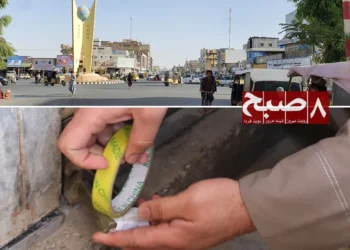
Herat residents say shopkeepers, street vendors and cart pushers are blocking sidewalks across the city, forcing many pedestrians into the road and sometimes causing traffic accidents. They are urging the Taliban to assign designated spots for vendors and carts and to require shopkeepers to keep their merchandise inside their stores.
Nima, a Herat resident, said blocked sidewalks have pushed many people into the street, a situation that has occasionally caused accidents. “On most sidewalks in Herat, you’ll find carts, street vendors, or shopkeepers’ goods spilling out onto the walkway,” he said. “That forces many people to cross through the street instead. Drivers sometimes complain and ask why we aren’t using the sidewalk, and in some cases this leads to accidents.”
Nima called on the Taliban to set aside specific areas for street vendors and cart pushers and to require shopkeepers to keep their goods inside their shops. “This has made it hard for people to get around. Women and children in particular struggle to pass through these routes,” he said. “Officials should designate specific spots for vendors and carts so they aren’t deprived of their livelihoods, while also telling shopkeepers to keep their goods inside.”
Jaber (pseudonym), another Herat resident, pointed to worsening traffic congestion in the city. He said street vendors and mobile carts along the roads, combined with population growth and a rising number of vehicles, are among the main drivers of the congestion. “Traffic in Herat city has gotten worse recently,” he said. “Vendors and carts operate along the roads, while population growth and more vehicles have compounded the problem. It’s become difficult for people to get where they’re going on time.”
He urged Taliban municipal officials to address the presence of street vendors and cart pushers to help ease congestion. “We’re calling on Taliban municipal officials in Herat to designate specific locations for vendors and carts, so they can keep working while also easing road congestion and addressing residents’ concerns,” he said.
Farzad (pseudonym), another Herat resident, complained that shopkeepers have blocked sidewalks by displaying their goods outside their shops. “Nearly every shop has put its merchandise out on the sidewalk, blocking the walkways entirely,” he said. “It’s become almost impossible for women or men to walk comfortably.”
Khadija (pseudonym), another Herat resident, said congestion in the city has worsened significantly since the Taliban’s return to power and the return of large numbers of migrants. She said many people who lost their jobs have turned to cart pushing and street vending, and that migrants returning from Iran have taken up similar work to cover their living expenses. Taliban officials, she said, have no clear plan for managing the situation.
“The growing number of vehicles, combined with carts and vendors crowding the roads and even the sidewalks, has made it seriously difficult for people to get around,” Khadija said. “Walking through the city, you run into a cart or a vendor almost every few steps. It’s created real difficulties for people’s movement, especially on sidewalks that were built for pedestrians.”
This comes as some Herat residents have also recently criticized a shortage of trash bins across many parts of the city, telling Hasht-e Subh Daily that the lack of adequate bins has led some residents to dump garbage in drainage channels, gutters, and public spaces instead.
You can read the Persian version of this report here:
پیادهروهای هرات در اشغال دکانداران و کراچیداران؛ عابران به جاده رانده میشوند