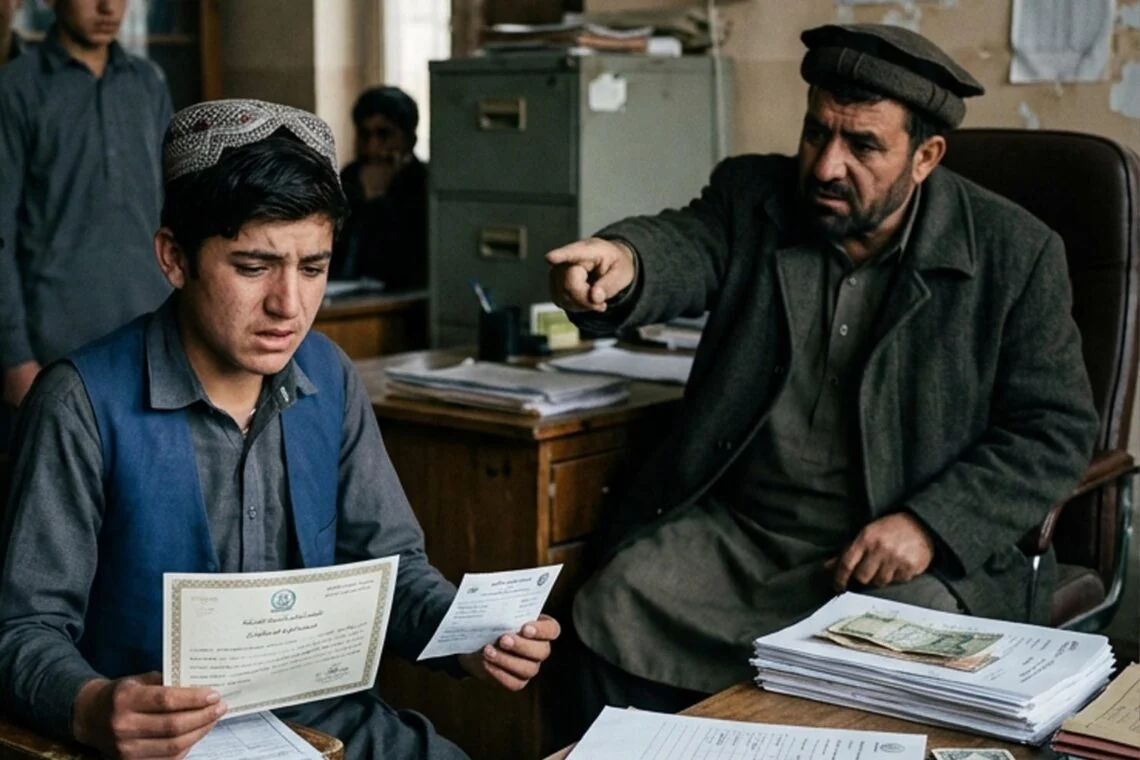
A number of students at private schools in Kabul are complaining about the extra money charged under various headings, the threats of lowered grades, and the restrictions on their right to file complaints against school administrations. They say some private schools charge students more than the announced fees, citing pretexts such as issuing certificates, printing grade transcripts, exam papers, exam cards, and graduation ceremonies. According to them, many families and students cannot afford these additional costs.
The students say some private schools charge 1,000 afghanis per student to issue a certificate, whereas, according to them, the Taliban’s Ministry of Education has set the price of this document at 200 afghanis. They add that when they object to these extra charges, they are threatened under various pretexts and forced into silence.
Ahmad (pseudonym), a 12th-grade student at a private school in District 8 of Kabul, says the administration of his school has demanded 1,000 afghanis from each student for issuing a certificate.
He adds that he works after daily classes to cover his education costs and help his family. He says he has repeatedly approached the school administration and explained that he cannot afford the payment, but his complaints have not been addressed.
Ahmad says: “I am a 12th grade student, and to earn a halal living, I work outside after school so that I can both pay my school fees and help my family. But our school administration collects money from students under any pretext. They have asked for 1,000 afghanis from each person for the certificate, while the announced rate is 200 afghanis. When we approach the administration and say we cannot afford to pay this amount, they threaten to ruin our grades and our certificates.”
Obaid, another student, says that students at private schools face threats when they object to the extra charges and are not even allowed to go to the district education office and file a complaint. According to him, monitoring delegations also fail to address students’ complaints when they visit schools.
This student says: “The delegation that comes for inspection is in league with the school administration and does not listen to our complaints. They do not even allow us to go to the district education office and complain. Many students stay silent because of the threat of failing, but this situation is very difficult for those who have no financial means.”
Obaid adds that, in addition to the certificate fee, the school administration collects money from students under various pretexts, including the graduation ceremony, exam papers, printing grade transcripts, and distributing Kankor registration forms. According to him, these costs, on top of school fees and the Kankor participation fee, have placed heavy financial pressure on students and their families.
The students also criticize the collection of the full fee for the month of Qaws (November-December), even though exams end on November 26 or December 1. They say the school administration cites the payment of teachers’ salaries as the reason for collecting the full fee, but according to them, a number of teachers have also reported not receiving their salaries this month.
One of the students, who does not want his name mentioned in the report, says Azmoon School charges each student 50 afghanis for an exam card, and students who do not pay this amount are not allowed to take part in the exams. According to him, the cards are also collected from students after the exams end, and if they fail to hand them in, students face improper treatment and psychological pressure.
This student stresses that many of his classmates cannot afford these costs because of financial difficulties, and that the continuation of such a situation could deprive them of continuing their studies and benefiting from educational opportunities.
These concerns are being raised as the condition of schools has consistently been reported as worrying during more than five years of Taliban rule. According to statistics presented, in just the first three years of their rule, the Taliban built 85 religious madrasas for every school established.
Meanwhile, the latest joint report by the United Nations Educational, Scientific and Cultural Organization (UNESCO) and the United Nations Children’s Fund (UNICEF) shows that the continued restrictions on the education of girls and women, insufficient investment in the education sector, and population growth have kept millions of people in Afghanistan out of the education cycle, even as demand for education continues to rise. According to the report, 53 percent of primary school-age children in Afghanistan remain outside the formal public education system.
The report, titled “Education Status Report in Afghanistan 2026,” expresses concern over the continued deprivation of girls from education and says that since 2021, more than 2.6 million girls in Afghanistan have been denied their right to access education. According to the report, community-based education, literacy and skills development programs, distance and digital learning, and private tutoring are the only remaining pathways for adolescent girls to learn, but these opportunities do not by any means meet their educational needs.
Richard Bennett, the UN Special Rapporteur on the situation of human rights in Afghanistan, had also previously warned that the Taliban’s focus on building religious madrasas and limiting education to religious content could lay the groundwork for the formation of extremist thinking. According to him, this policy not only deprives children of the skills and knowledge needed for modern life, but also creates fertile ground for the spread of extremist ideologies, which could increase the risk of domestic terrorism, regional instability, and international threats.
You can read the Persian version of this report here:
از هزینه اضافی شهادتنامه تا تهدید به ناکامی؛ روایت تلخ دانشآموزان از مکتبهای خصوصی