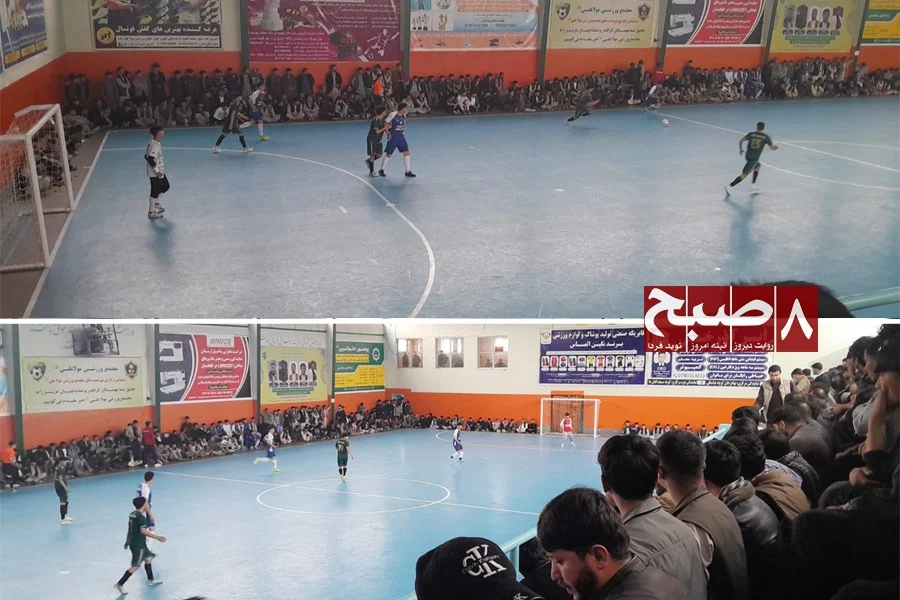
A number of young people in Kabul have complained about a shortage of suitable, standard sports facilities in different parts of the city. They say they are forced to use private halls and fields and pay hourly fees. According to them, the cost of using these venues is a heavy burden for many young people, and their financial means do not allow them to exercise regularly. They add that in many parts of Kabul there are no public, low-cost sports venues, and that they have to travel to more distant areas to access suitable facilities.
Speaking to the Hasht-e Subh Daily, these young people say that the lack of public sports facilities, particularly for low-income youth, has limited the opportunity to exercise regularly. They are calling for the establishment of public, standard sports fields and halls in different parts of Kabul.
Amrullah, a resident of the Qala-e-Zaman Khan area of Kabul, expressed concern about the shortage of standard, low-cost sports facilities in the area. He adds that, because such venues do not exist, a number of young people turn to vacant lots and open spaces to play sports. In his view, these spaces lack the necessary facilities for sports, and using them sometimes creates problems for both athletes and residents.
The young man says: “There is no cricket field where we can go after work and spend time with our friends. The lack of sports facilities, especially gymnasiums, has created many problems. One of the major problems is that when there is no designated place for sports, people are forced to play in front of other people’s houses or on vacant lots. In this situation, both the athletes and the residents are bothered, because these places are usually on thoroughfares and dust is generated.
Amrullah adds that there are not enough sports gymnasiums in various parts of Kabul, and that the cost of using the existing facilities is also high for many young people. According to him, these costs do not match the economic means of a number of families and have led some young people to give up going to the gym and exercising regularly.
Amrullah says: “For football, the situation is a little better, but for cricket, because more space and equipment are needed, the costs are also higher. Many young people, if they have a job, set aside time to exercise in the morning or after work, but the lack of a suitable venue has made this difficult.”
Seyar, a resident of Karte Naw in Kabul, says the shortage of sports facilities in the city has limited young people’s access to sports amenities. According to him, in many parts of Kabul there are no suitable halls and fields for disciplines such as football and volleyball, and athletes have to travel to other areas to train.
The athlete says: “One of the major challenges in Kabul is that there are not enough facilities for athletes. Suitable stadiums and gymnasiums for football, volleyball, and other sports are scarce. For this reason, people exercise in vacant spaces and public neighborhoods, which sometimes disturbs residents and is not suitable from a sporting point of view either.” According to him, the limited number of public sports venues has also reduced the options available to young people for training.
Seyar says: “The few gymnasiums that exist are mostly private, and athletes have to pay to use them. Many people cannot afford this cost, and for this reason they cannot use these venues.”
Obaidullah, a resident of Khair Khana in Kabul, says the shortage of sports clubs in the area has led to overcrowding of athletes in the existing venues. He adds that the equipment at some of these clubs is also worn out and there are not enough facilities for athletes to train.
According to Obaidullah, there are also not enough sports fields and halls in a number of areas of Kabul, and athletes face difficulties in training. He is calling for the establishment of more clubs and sports halls in different neighborhoods of Kabul so that athletes can train at the closest venue to where they live.
Obaidullah says: “If we talk about football, apart from Ghazi Stadium, where official matches are held, we do not have many standard fields. For futsal, there are a few grass pitches and halls, but many of them are not standard. If a field or hall has new, standard facilities, grass and equipment, the cost of using it is also high.”
The young man continues: “In this area there may be one or two clubs, and both the cost of using them is high, and their equipment is outdated. If a club has standard facilities and equipment, paying to train there is worth it, but such clubs are scarce in Khair Khana. For this reason, the existing clubs are also overcrowded, because the population is large and sports facilities are limited. I hope more sports halls will be built, because if there is no sport, young people may turn to other things such as drugs. Sport is beneficial for health; it raises young people’s motivation, and it creates ground for healthy competition. Even the energy and morale of young people can have a positive effect on their studies.”
Meanwhile, a number of women athletes say that, because of restricted access to sports venues, they do most of their training at home. They say that the lack of suitable and accessible venues for women’s sports has limited their opportunities for regular athletic activity.
Aqila, a woman athlete in Kabul, says that the Taliban’s closure of sports venues to women has cut off her access to a suitable place to exercise. She adds that, because of the need for regular exercise, she is now forced to train at home, but the lack of suitable space and the high price of sports equipment have made it difficult for her to continue her training.
The woman says: “Since the Taliban came to power, we have not been able to access a suitable place for sports. I exercise at home, but we do not have many facilities. For this reason, I do yoga so that my mind can be at peace. I love chess and bodybuilding very much, but I cannot pursue these two interests. I hope the restrictions will be lifted so that women can work and exercise without limits and breathe freely.”
In recent years, sport has been one of the favorite activities of many young people in Afghanistan, but the shortage of standard sports fields and halls, especially in the city of Kabul, has made it difficult for a number of them to access suitable facilities.
The Taliban-controlled General Directorate of Olympics, Physical Education and Sports says that 60 sports federations are active in Afghanistan and that about 1.3 million athletes are under the umbrella of this directorate. However, athletes say that in many parts of Kabul there are no public, low-cost sports facilities, and that they must pay high fees to use private venues.
You can read the Persian version of this report here:
کمبود مکانهای ورزشی و هزینههای بلند؛ جوانان کابل از دشواری ورزش شکایت دارند