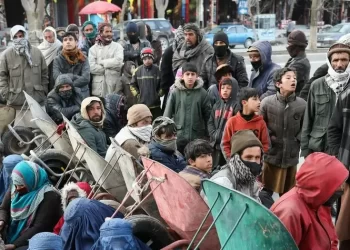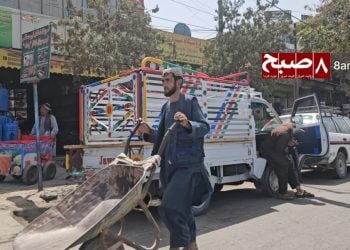

Several young people in Kabul have voiced complaints about shrinking job opportunities and rising unemployment across the city. They say that since the Taliban took control of Afghanistan, employment in private companies has dropped sharply, while government posts are increasingly reserved for those with prior ties or close connections to the Taliban.
These young people say the absence of meaningful work has pushed many of them toward migration, temporary jobs, or low-paying labor. They warn that the prolonged crisis has taken a serious toll on their economic stability and mental health. In their view, a hiring process lacking any transparency, a broken job market, and the concentration of opportunities in the hands of a select few have stripped many of them of any real hope for a better future.
Speaking to the Hasht-e Subh Daily, they stressed that they expect nothing from the Taliban in terms of job creation and called on private companies, organizations, and institutions to step up and open more doors for young people. To ease the unemployment crisis, they argued, the private sector needs greater investment, and targeted employment programs must be developed, particularly for educated youth.
Ahmad, a Kabul resident who lost his job six months ago, said he is deeply worried about the dwindling prospects in the country. Despite holding a university degree from abroad and more than a decade of professional experience, he has been unable to secure suitable work. The situation, he said, has left him in serious financial difficulty.
“I hold a degree in electrical engineering from the University of Tehran and have over ten years of experience in the field,” Ahmad said. “Before the fall of the previous government, I worked with foreign companies, but those opportunities vanished after the Taliban took control. I then worked on a project basis for a private company, but our contract ended six months ago. Since then, I have knocked on many doors and found nothing suitable. If this continues, supporting my family will only get harder. The economic pressures have hit every corner of the market, and I am already three months behind on rent.”
Shamsullah, another Kabul resident, described the rising unemployment as deeply troubling. He said many young people have been forced into unskilled, low-income work simply because there is nothing else available. Nepotism and ethnic favoritism, he added, run deep in Taliban institutions and even in parts of the private sector, and are a key reason so many qualified young people are being shut out.
“Unemployment is one of the defining struggles of young people in this country,” he said. “Even those who studied abroad come back and regret it, because there is simply no work. I know someone in our extended family who studied electrical engineering in Turkmenistan. He passed both the exam and the interview, but was passed over because of nepotism and ethnic favoritism. I also know an engineer who, because he could not find work in his field, is now doing completely unrelated tasks at the Ministry of Urban Development and Housing.”
Shamsullah believes that placing young people in jobs outside their area of expertise not only opens the door to institutional exploitation but also robs them of professional growth while burdening them with psychological stress and overwork.
“When a young person works outside their field, they inevitably lack the skills required, and that creates pressure, both mentally and professionally,” he continued. “They also have no bargaining power over their salary and must accept whatever they are offered. I know people who graduated from civil engineering three years ago and are still unemployed, while others with the right connections were already working in three or four offices before they even graduated.”
Zikrullah, yet another Kabul resident, said that the collapse of job opportunities has given some private companies room to exploit their workers freely. With unemployment so widespread, he noted, many young people who lose their jobs also lose the will to fight for better conditions and end up accepting even lower pay just to stay afloat.
“Exploitation of employees is everywhere, but it is most visible in the private sector,” Zikrullah said. “Ordinary workers put in up to 12 hours a day doing demanding work, yet take home only 6,000 to 7,000 afghanis a month. No one is looking out for them. The Taliban collects its taxes and steps back. There is also the problem that many people do not fully understand their own value and lack the confidence to look for better opportunities. You will find someone with a narrow skill set earning 40,000 to 50,000 afghanis, while someone far more qualified cannot find a single job.”
Zikrullah added, “Companies exploit this imbalance freely. In the same role, one person may earn 30,000 afghanis, another 20,000, and a third only 15,000, and all of them are told to keep their salaries to themselves. It is a system built on exploiting people’s lack of awareness, and the Taliban imposes no oversight or accountability on companies at all.”
These grievances are surfacing at a time when the Taliban have said they are exploring the possibility of sending workers to Russia, while Turkey has issued 20,000 work visas for citizens of Afghanistan.
The backdrop to all of this is a private sector that has contracted sharply since the Taliban’s return to power, with a large number of businesses having shut down due to economic hardship.
The United Nations had previously warned that Afghanistan’s economy remained severely fragile in 2025. According to the UN, unemployment has reached 75 percent, poverty now affects more than 90 percent of the population, and over 70 percent of people depend on humanitarian aid to survive.
The World Bank (WB) has also reported that unemployment in Afghanistan has doubled, with one in four young people now out of work. The WB noted that since the Taliban’s return, families have been compelled by economic necessity to send more members into the workforce just to get by, yet demand for labor remains critically low.
You can read the Persian version of this report here:
جوانان کابل: بیکاری، واسطهسالاری و نبود فرصتهای کاری آینده ما را نابود کرده است