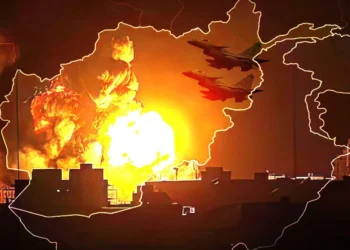
The fall of the Taliban government in 2001 created a glimmer of hope among Afghans. The first months of the new government’s formation, accompanied by a broad international campaign, were warmly welcomed by various social strata. The Taliban had expressed their readiness to live under a new system formed with the collective agreement of Afghans and international support. After more than two decades of war and tyranny, the country lay in ruins, with no possibility of achieving basic livelihood, administrative, and educational requirements. There seemed to be no way to overcome this situation internally. The confrontation between the Taliban and the United States, leading to the overthrow of the Taliban regime, provided an unprecedented opportunity. The people, who were abandoned and forgotten under the rule of a primitive and despotic group, suddenly became the focus of attention for powerful countries and international institutions. Radio stations were abuzz with fresh news, and there was an unprecedented vibrancy among all political spectrums. New alliances were formed, past constitutions revised, and politicians resorted to faded friendships and camaraderie to position themselves in the rapidly evolving new dynamics.
The suddenness of the US military attack, which led to the fall of the Taliban, was forgotten amidst the political news and diplomatic efforts to form a new administration. Except for those who directly experienced the attacks, the general public remained ignorant of how they were launched. Before they had a chance to discuss the US military attack, a clamorous political process began, turning these dynamics into a global consensus to safeguard the nation held hostage by fundamentalism. The presence of jihadi leaders, strongmen, foreign technocrats, and educated individuals gave the process a relatively inclusive appearance. It was hoped that the monopoly of local commanders and strongmen would gradually diminish through the democratic mechanisms established under the supervision of the United Nations and global powers. This would allow the people to elect their representatives and establish a stable national system. During the interim and transitional administrations, international support and efforts to introduce a new legal framework of governance encouraged Afghans to be more hopeful for the future. The sense of work and struggle for a better future permeated throughout society. Immigrants returned to the country, villagers moved to cities, and families made long-term plans for the education and growth of their children. It was commonly believed that influential countries should no longer target the blood and lives of our youth. Instead, they would compete to invest in the country’s mines, water, and trade routes. It was assumed that the political groups involved in the war would realize that competition in the democratic field is more effective than warfare.
The reputation of Western donors supporting democracy and people’s votes further added to the optimism. It was hoped that foreigners would facilitate the democratic system rather than dictate and impose their priorities. The financial and technical support from the international community was significant. During the first decade, considerable progress was made in legislation, education, higher education, professional staff training, building legal and administrative frameworks, as well as investment and entrepreneurship. However, over time, the veil was lifted from many faces, and some of the optimism turned out to be illusions.
One of the illusions was the integration of jihadi leaders, commanders, and powerful ethnic groups into the democratic system. The expectation was that people would gradually have the opportunity to elect their representatives to parliament and the government, leading to the formation of a stable national system. Unfortunately, this did not materialize. Instead, the government became a place where money and positions were distributed among a group of contract-holders and power shareholders. These individuals owed their influence to their roles during Jihad and civil wars, or their connections with international institutions and foreign embassies. New aristocratic families emerged, considering themselves the owners of tribes, provinces, or districts. The continued presence of these contractors became a key factor in the failure to establish a legitimate national government. Regrettably, domestic capacity to seize this opportunity was low, and the people lacked the necessary capability to challenge the monopolists and contractors. Although the international community officially declared its mission to support Afghans in state-building, it opted for a simplistic approach of interacting and compromising with local power figures. Governments with decisive roles in financial and political support established independent political channels through numerous parallel offices in all fields. This created a conducive environment for division, factionalism, lawbreaking, and financial corruption.
Large amounts of money flowed from various sources in the name of fighting terrorism and supporting the Afghan government, leading to the creation of unmanageable mafia channels over the years. Corruption became an open secret, and the campaign to fight terrorism and support state-building in Afghanistan turned into a breeding ground for corruption and the cause of its collapse. Unfortunately, those who should have stood against this evil were themselves infected by it.
What initially appeared as a national and international effort to establish a legal and democratic system gradually transformed into an anti-democratic campaign and a competition for negotiation and interaction with terrorists. It was not just the United States that established an office for the Taliban in Qatar, turning the leaders of the group from isolated fugitives into proud negotiators for the future of Afghanistan’s administration. Prominent domestic and foreign parties also entered into contact and dialogue with the Taliban, and this new campaign was labeled the “peace process.”
Following US President Joe Biden’s statements about his country’s triumph in dealing with the Taliban, criticism of the US government’s role in surrendering power to the Taliban has intensified. While it is undeniable that the United States was the main actor in this process, it is incorrect to think that Washington imposed predetermined scenarios on our nation without any role played by Afghan politicians and the Afghan people. The post-Bonn Conference on Afghanistan and the national and international effort to build a stable and legal administration in Afghanistan ultimately failed. The causes of this setback can be attributed to the initial plan of those efforts, the inability of Afghans to transition from being political-ethnic power shareholders and contractors, intelligence competitions, regional disruptions, and many other factors. However, the burden of this failure rests primarily on the shoulders of Afghans and the US government. After the collapse of the Soviet Union, the US government declared its commitment to establishing democracy and changed systems with arrogant confidence. It launched “spring” and “color revolutions” worldwide. However, it has now lost the exclusive right to represent democracy and has suffered a great failure in terms of ethics and diplomacy. The United States can no longer launch international campaigns for “change” as it once did, and its traditional friends in our region are seemingly changing course and joining new alliances. Democracy and the rule of law are valuable historical experiences for our era, and Afghanistan will eventually return to that path. However, the instrumental use of these historical achievements in recent decades has left bitter memories. Unfortunately, we were unable to join the ranks of nations where the ruler’s order is not dictated by Sharia, where important national decisions are made through valid legal channels, and where people have the right to vote and enjoy personal and social freedoms.
With its military and economic power, the United States can turn threats into opportunities. Through the use of economic incentives and the force of military capabilities, it can deter and recruit even the most rebellious terrorist groups. When President Biden speaks of victory, he refers to his country’s ability to adapt to different situations, rather than following a single plan. If tomorrow the people of Afghanistan can create an alternative to the Taliban, it is likely that the United States and other world powers will not insist on preserving that group and will instead take steps to take advantage of the new situation. It is important to understand that the responsibility for creating a new situation lies with Afghans themselves, and foreign support becomes the main determining factor only in exceptional cases, such as the events following September 11, 2001.