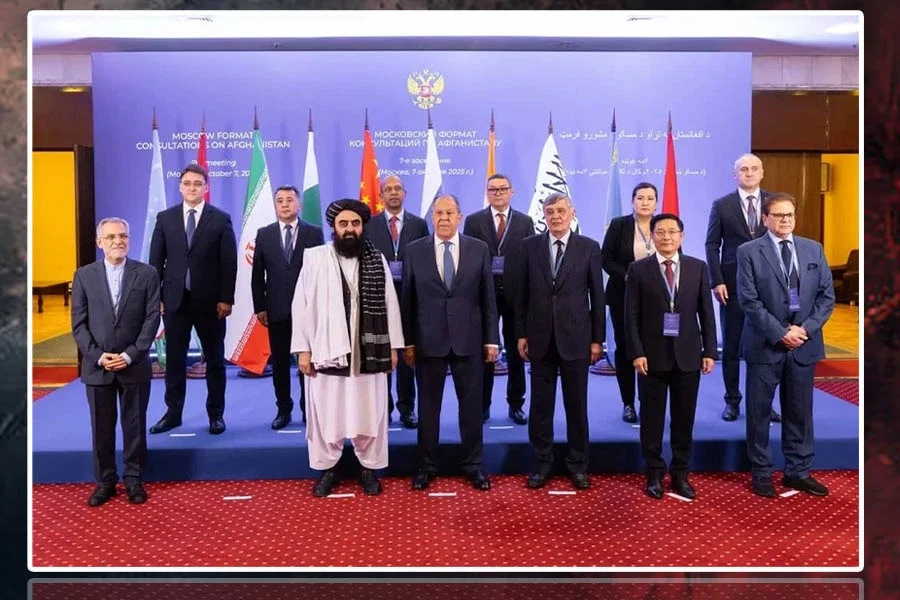
What a strange world this has become. Pakistan, a country that for years was one of the Taliban’s most important political backers, now sits in the same room as the Taliban and accuses the group of harboring terrorists. The Taliban, in turn, accuse Pakistan of carrying out military attacks on civilians, destabilization, and using “military language” against Afghanistan. Stranger still, this dispute is no longer only between Kabul and Islamabad. The disagreement has escalated to the point that the Moscow Format, at its eighth meeting, was unable to issue a “joint statement.” Zamir Kabulov, Russia’s Special Representative, said plainly that the delegations of Afghanistan (the Taliban) and Pakistan failed to agree on the final text.
This may be one of the strangest contradictions in the politics of our region. Pakistan, which once presented the Taliban as the only “solution” for Afghanistan, now regards them as part of its own “security” problem. The Taliban, who for years saw Pakistan as their most serious supporter, now accuse it of destabilizing their regime. Yes, politics is not a land of eternal friendships; interests change, and alliances shift. But what was seen in Moscow was not merely a disagreement over a few words in a statement. The rift between the Taliban and Islamabad has reached a stage where the two sides do not even share a “common language” to describe the problem.
The more noteworthy point lay in the remarks of Mawlawi Amir Khan Muttaqi, the Taliban’s foreign minister, when he complained that the proposed draft of the statement mentioned Afghanistan too much in connection with terrorism. On the surface, this objection concerns a diplomatic phrase, but underneath it carries a larger meaning: the Taliban have still not been able to shake off the shadow of the accusation that they support terrorism.
Taliban officials indeed sit alongside senior officials of regional countries in Moscow and elsewhere, and more importantly, they have official relations with Russia. Yet when it comes to the statement of a regional meeting, the Taliban still face this bitter and plain reality: regional and global terrorists taking refuge within the territory under the group’s control. This may be one of the most difficult contradictions the Taliban face in consolidating their position: the doors of diplomacy have opened to them, but the reality of sheltering terrorism remains.
Russia is also drawn into this picture. On one hand, Moscow is the first country to have officially recognized the Taliban regime. On the other hand, the fight against terrorism and the Taliban’s sheltering of terrorists remain on the agenda of the Moscow Format. This contradiction is not cheap for Moscow. Russia can recognize the Taliban, but it cannot easily change the security mindset of regional countries toward the Taliban with a single political decision.
Of course, it is not only Russia. All the countries neighboring Afghanistan and Pakistan now face a problem that, if not contained, will go beyond the dispute between the two countries and affect the whole of “regional diplomacy.” The matter is clear: if a meeting with the history and importance of the Moscow Format cannot issue a joint statement today because of the dispute between the Taliban and Pakistan, another meeting may face the same problem tomorrow. The Taliban and Pakistan will sit side by side at many meetings on Afghanistan, and as long as security disputes and mutual accusations continue, it would not be surprising if they quarrel at other tables as well.
This is the alarm that Moscow has sounded. The Moscow Format was created to coordinate the countries of the region on Afghanistan, but at the eighth meeting, the two sides’ disagreement over the language of terrorism became so serious that even the joint final text fell victim to it. Russia has said that this disagreement does not mean the end of the Moscow Format, but what happened showed that a bilateral crisis can cast a shadow over a multilateral mechanism.
This is where the role of Russia, China, and Iran becomes more prominent. For all three countries, Afghanistan and Pakistan are of great importance. Therefore, the issue is no longer only whether the Taliban and Pakistan can reconcile. The issue is that their dispute must not become a factor that wears down regional diplomacy in Afghanistan.
Another important point that cannot be ignored is the weight of the Taliban in the Moscow Format. It is no small matter that a dispute between the Taliban and Pakistan could prevent a regional meeting from issuing a joint statement. Whether we like it or not, this indicates how much the Taliban’s position matters in the view of the other member countries. This means that although the Taliban are grappling with a “legitimacy crisis,” this has not led to the group’s position being completely ignored at neighborhood and regional meetings. When the Taliban’s opposition to the text of a statement reaches the point where a meeting ends without a joint final document, it means the group’s voice has been heard at a regional table, if not fully.
You can read the Persian version of this analysis article here: