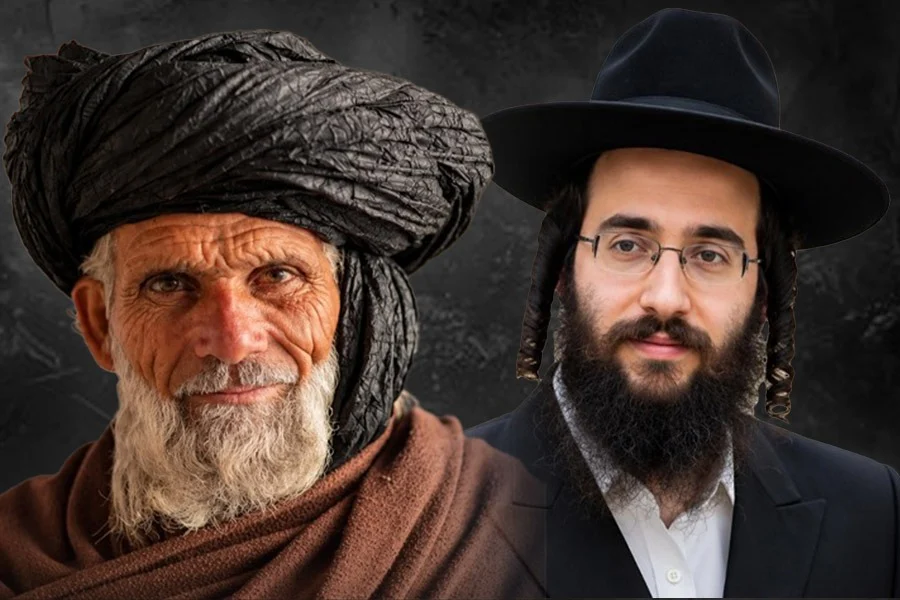
Sometimes it is said that the Pashtuns are among the “Ten Lost Tribes of the Children of Israel”. This article examines where that claim came from, what role English authors played in retelling it, and what the historical and scientific evidence says about it. The more important question is this: if some elites use this narrative to portray the Pashtuns as separate from the shared history of the people of Afghanistan, what effect will that have on relations between ethnic groups?
The story of the ten lost tribes has a historical root. In the late eighth century BCE, the Assyrians conquered the northern Kingdom of Israel and deported part of its population to other lands. However, not all of the people were exiled, and many remained in the same region. Over time, the fate of a number of the exiles could no longer be traced clearly. From this point, the idea of the “lost tribes” took shape, and various peoples were later linked to them. The Assyrian deportation of people is a historical fact, but the claim that the Pashtuns descend from those groups has not been proven (Sources 1 and 2).
On the other hand, the presence of Jews in the land of Afghanistan is a historical fact. Writings recovered from the eleventh to thirteenth centuries CE attest to the lives of Jewish communities in this region. In later periods, Jews also lived in places including Herat and Kabul, and had their own language, writings, and religious rites. In the nineteenth century, they were also part of the urban and commercial life of the region. But their presence in Afghanistan does not prove that the Pashtuns descend from the ten tribes exiled by the Assyrians. The two matters differ in terms of time and the type of evidence. The history of the Jews of Afghanistan is part of the history of this land and should be understood in its own right (Sources 14 and 15).
To link the Pashtuns to the story of the lost tribes, reference is sometimes made to the similarity of tribal names to names in the Bible, and sometimes to customs said to be shared between the Pashtuns and the Jews. None of these similarities, on its own, proves the descent of a people. The issue becomes more serious when an unproven claim turns into a tool of identity politics. If some elites, by repeating it, seek to portray the Pashtuns as separate from the peoples with whom they have lived for centuries in the same land and with whom they have built a shared history and culture, they may fuel distrust and ethnic division. To judge this claim, one must first see when the narrative of Pashtun descent was written and which parts of it have independent documentation.
In the nineteenth century, when Afghanistan gained greater importance for British policy, this narrative entered English-language books. Alexander Burnes, who had traveled to the region before the First Anglo-Afghan War, asked people about this ancestry and recorded their answers in his book “Travels into Bokhara”. He himself writes that he did not have the chance to read carefully the history books that were brought to him. Burnes’s account therefore shows that such a belief existed among some of the people he spoke with, but it does not prove its historical accuracy (Source 4).
For some English readers, the story of a “lost tribe” was appealing. This view can be understood in the political and religious atmosphere of the time; they could imagine a land with which Britain had become engaged in war and political rivalry through a familiar story from the Bible. Such writings could capture the reader’s attention and create a simple picture of a complex society. Nevertheless, what can be seen in the sources examined is the retelling and interpretation of an old narrative, not a document of a state program (Sources 4 and 5).
English authors also did not agree among themselves on this subject. Some, relying on facial features, tribal names or social customs, linked the Pashtuns to the Jews. Robert Gordon Latham reported these views, but considered the claim that the Pashto language is Hebrew to be false. Therefore, even in the writings of that time, the Israelite descent of the Pashtuns was not an accepted scholarly conclusion (Source 5).
Attributing peoples to the “lost tribes” did not occur only in the case of the Pashtuns. In Britain itself, too, some groups claimed that the English or other peoples of northern Europe came from the same tribes. This movement expanded in the nineteenth century and formed a federation in 1919. Latham also reported that some authors attributed “Jewish” characteristics to the Baloch. In these examples, apparent similarities became the basis of stories about the origins and ancestry of peoples (Sources 5 and 6).
Now let us examine the claim itself from a scientific perspective. Pashto is an Iranian language. Linguists reached this conclusion by examining the structure of the language and the regular change of words and sounds over time. The Pashto language,d an important part of the cultural history of the Pashtuns, is linked to the other peoples of the Iranian and Khorasani linguistic sphere. The similarity of a name such as “Yusufzai” to the name Yusuf cannot, on its own, prove the migration of an ancient tribe (Source 10).
Customs, too, do not on their own reveal the descent of a people. Hospitality, granting refuge, or circumcision are seen in various societies. Some customs spread through religion and contact between peoples, and some arise under similar social conditions. To understand Pashtun culture, one must examine the history of their own way of life, their family relations and their social conditions. The research of Fredrik Barth on the Pashtuns of Swat also shows that understanding tribal relations requires examining the lives and social relations of the people. From one shared custom, it cannot be concluded that two peoples came from one ancient tribe (Source 11).
Genetic studies, too, have so far not proven this claim. These studies point to the diversity and historical mixing of the populations of Afghanistan. One study on Pashtun men raises the similarity of some paternal markers with markers present in other populations and offers speculation about its meaning; but such a similarity does not determine the name and identity of an ancient tribe. A distinction must be made between language and biological descent: the Iranian character of the Pashto language is a clear linguistic finding, but no people can be considered to have a “pure race” (Sources 12 and 13).
So why does this story continue to spread? In a society where historical education is not easily accessible, and people live under the pressure of poverty and crisis, a short and glorious story spreads more easily than careful research. This does not mean that poor people are naive. When reliable sources are less often written in the language of the people or reach them, claimants and identity-building elites have more opportunity to entrench simple answers. Sometimes, too, a person who repeats this claim believes they are bringing honor to their people, while tying the real history of that people to an unproven lineage and pushing its links with the other peoples of the region to the margins; a matter that can also have negative consequences for that people.
The Pashtuns do not need to find a sacred ancestor in a distant land to have a place in history. The Pashto language, an important part of the historical and cultural heritage of the Pashtuns, is linked to the Iranian and Khorasani world, and this heritage has been formed in connection with the other peoples of Afghanistan and the region. If someone seeks, through an unproven genealogy, to drive a wedge between the Pashtuns and this shared history, or to use it to place one ethnic group above another, they have put history in the service of identity politics. Understanding identity begins with asking questions and examining evidence, not with accepting a story that merely sounds good.
Sources
Source 1: Gary Knoppers, “The Fall of the Northern Kingdom and the Ten Lost Tribes: A Reconsideration,” in the book Jews and Samaritans: The Origins and History of Their Early Relations, Oxford University Press (OUP), 2013. On the exile of part of the population and the remaining of another part in the region.
https://academic.oup.com/book/10746/chapter-abstract/158838028
Source 2: Zvi Ben-Dor Benite, “Assyrian Tributes,” in the book The Ten Lost Tribes: A World History, OUP, 2009. On the Assyrian exile and the formation of the story of the lost tribes.
https://academic.oup.com/book/4771/chapter-abstract/147021599
Source 3: University of Manchester Library, introduction to the manuscript “Makhzan-i Afghani” and its contents, including the genealogy of the tribes of Afghanistan. This source shows the existence of the narrative before the Anglo-Afghan wars, not the accuracy of the genealogy.
https://www.digitalcollections.manchester.ac.uk/view/MS-PERSIAN-00155
Source 4: Alexander Burnes, Travels into Bokhara, Volume 1, the section discussing the ancestry of the people of Afghanistan. The text of the book is available on Project Gutenberg.
https://www.gutenberg.org/cache/epub/58074/pg58074-images.html
Source 5: Robert Gordon Latham, The Ethnology of the British Colonies and Dependencies, the sections relating to the Baloch and the people of Afghanistan. The text of the book is available on Project Gutenberg.
https://www.gutenberg.org/files/31296/31296-h/31296-h.htm
Source 6: Centre for the Critical Study of Apocalyptic and Millenarian Movements (CenSAMM), “British Israelism.” On the history of this movement, the claim of a kinship between the English and the tribes of Israel, and the formation of the federation in 1919.
https://www.cdamm.org/articles/british-israelism
Source 7: Proceedings of the British House of Commons, 21 May 1941, “Paper Control: Pamphlets.” The federation’s pamphlet is named in it.
https://hansard.parliament.uk/commons/1941-05-21/debates/ddfec788-342e-44be-b117-246f47cc1482/PaperControl%28Pamphlets%29
Source 8: Proceedings of the British House of Commons, 11 June 1941, “British Israel World Federation.” The response of the Minister of Information regarding a government promise to the federation.
https://hansard.parliament.uk/commons/1941-06-11/debates/e4f43631-7a22-4679-9a15-970785bc98eb/BritishIsraelWorldFederation
Source 9: Imperial War Museums (IWM), catalog entry for the 15 January 1941 issue of the publication The National Message, identifier LBY E.J. 262. This entry confirms the existence of the issue; the text of the publication cannot be read on the archive page.
https://www.iwm.org.uk/collections/item/object/1506002346
Source 10: Encyclopaedia Iranica, entry “Afghanistan vi. Paṣ̌tō.” On the place of Pashto among the Iranian languages.
https://www.iranicaonline.org/articles/afghanistan-vi-pasto/
Source 11: Fredrik Barth, Features of Person and Society in Swat: Collected Essays on Pathans, description of the work in the ethnographic archive of Yale University (eHRAF World Cultures). On the examination of social relations and Pashtun identity.
https://ehrafworldcultures.yale.edu/cultures/au04/documents/005
Source 12: Harlette Lacau et al., “Afghanistan from a Y-chromosome perspective,” European Journal of Human Genetics, 2012. On the paternal markers of Pashtun men and the authors’ possible interpretations of them.
https://www.nature.com/articles/ejhg201259
Source 13: Marc Haber et al., “Afghanistan’s Ethnic Groups Share a Y-Chromosomal Heritage Structured by Historical Events,” PLOS ONE, 2012. On the genetic diversity and historical links of the populations of Afghanistan.
https://journals.plos.org/plosone/article?id=10.1371/journal.pone.0034288
You can read the Persian version of this analysis article here: