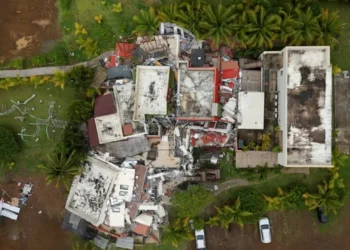
Last year, a suicide attack occurred in front of Sayyid-al-Shuda Girls School, killing at least 100 innocent students and nearby residents. Since then, more than 100 families live in mourning. That was not the last attack on education centers. Attacks on cultural, educational, sports, and mosques have sequentially taken place in this part of Kabul for the last two decades.
The area has just been hit by a series of bloody explosions on April 19, 2022. The terrorists targeted Abdul Rahim Shahid School, a public school with thousands of students at one shift, and a private education center at the same time and on the same day. People are all grieving and mourning the death of their beloved children – most of whom are teenage children.
As soon as the sound and smoke sparked in the sky, all the families rushed to the school without fear of further attacks and went to the hospitals to find a sign of their children. The tears in their eyes have dried up from the intensity of their grief and there is no tear left to shade for grieve of their beloved children. The women run to the hospital. Those who have a son shaded in blood do not care about anything else. When they reached the gates of Mohammad Ali Jinnah Hospital, Taliban rebels prevented them of entering the hospital. Not only their screams do not change anything with Taliban rebels cruelty at the hospital gates, but they are also driven away by pounding guns and slaps.
Taliban rebels by slapping the victim’s relatives at the gates and firing in the air have dispatched the crowds on the gate.
Eyewitnesses who visited Ali Jinnah Hospital to donate blood to the victims of this incident have painful story. They say the Taliban did not allow anyone to enter the hospital. The mothers and fathers and all those who had visited the hospital to donate blood were beaten and humiliated by the rebels at the gate.
In video clips shared on social media, a girl is telling a painful story of how she ran toward the hospital as soon as she heard about the explosions and attack on Abdul Rahim Shahid where her brother is a student. “My brother is in the ninth class. I was very worried about him,” she adds. “But as I heard that he had left school before the blast, I could not resist and ran to the hospital to help the other victims, but unfortunately, Taliban soldiers on the gate were not allowing anyone to enter the hospital,” she further stated.
“Taliban have turned a hell out of the country. They even do not know how to handle their assignments in such moments. Instead of helping the people, they beat and torture the people,” she said
The bloody image of another teenager is being shared on social media, symbolically dyeing his clothes and chanting on the streets with the slogan: “Do not kill us, we are innocent.”
No one can wipe us out. Your grandfathers could not destroy us, no one else can.
Footage is released on social media, showing the “inhuman treatment of the Taliban” with the victims’ families. The video, recorded in front of the closed gates of Ali Jinnah Hospital, shows people who have gathered to donate blood have not been allowed in and receiving no response other than a slap in their face by the Taliban at the other side of the gate.
Another video shows people fleeing the scene, and a man with tears in his eyes says, “No one can wipe us out. Your grandfathers could not destroy us, no one else can.” By expressing these words, he wants to say that elimination is not the way and no one can eradicate the people who have a rich historical background in this land.
The video, which is being shared on Facebook, shows a girl in front of the camera. “We were being killed during the former government, and we are being killed now too,” she said. “Today we do not want to be silent, we do not want to be told that you are a woman, be silent.” In a painful voice, simultaneously, she speaks of further suffering that is being inflicted on this part of Kabul, and on the other hand, she is crying out for the grief of women who are not even allowed to attend the funerals of their loved ones. She sends a message to the Taliban that even by killing and blowing up, they cannot prevent the presence of the people in the community and they must get rid of the idea of elimination and destruction.
Another young man, with tears in his eyes and a throat full of hatred for seeing his people alone in the middle of nowhere, condemns the leaders of the Hazara community and says: “Why did you leave us alone in the middle of a battlefield?” A simple question that is difficult to answer. A question that is unlikely to be answered by leaders.
A woman also shouts: My husband was taken from me in Dehmzang, my daughter in the Mehdi Mawood educational center and my last child was taken from me today in the incident of Abdul Rahim Shahid School. There is no word to express grieve and pain of the lady. Tolerance of such great grief and excruciating pain is not that easy and imagination of being in her position is difficult. Only an Afghan woman can bear such great grief, although it slowly breaks and melts away.
Sad and heartbreaking images of the condition of the wounded people have been released, showing men and women carrying their blood-soaked children. Tragic and horrific scenes are reflected that people around the world cannot even imagine.
After tolerating five years of discriminations, tortures, humiliation, mass killing by Taliban in 1990s, an era of hope shined for Hazaras with the overthrown of the cruel regime by American collation forces in 2021.
Though their presence in the government during the past two decades has been more of like a symbolic representation, but the environment was enabled in private and education sector that could empower them literally and financially.
With the emergence of Mohammad Ashraf Ghani, the former traitor president in 2014, the environment for all the other ethnics, particularly for Hazaras changed. Since 2014, 40 brutal cases of attacks have been recorded on the Hazara community across the country.
The systematic ethnic cleansing has a very deep and long root in the history started by the brutal and beast king Abdurrahman who who declared jihad against the Hazaras with British money and weaponry and help from Punjabi mercenaries and advisers, suppressing a proud ethnic group for the centuries to come. During his era, on the basis of his direct decrees rooted with religious Fatwas, 62% of the Hazara population was annihilated, their lands and properties were seized and distributed among the Pashtun. The remaining population was either forcefully displaced internally or fled the country.