You can read part 1 here: Part 1 – The Enemies of the Taliban
You can read part 2 here: Part 2 – The Enemies of the Taliban
You can read part 3 here: Part 3 – The Enemies of the Taliban
Media in Exile
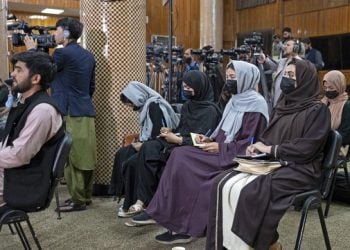
Although the officials of some Afghan media outlets working outside the country do not consider the Taliban their enemy, the fact that these media outlets refuse to operate under the regime in Kabul and defend values against which the Taliban have declared war places them, at least from the perspective of the Taliban and their supporters, in the enemy category. Zabihullah Mujahid, the Taliban’s spokesperson, once explicitly labeled the media outlets operating abroad as enemies of the group, signaling the Taliban’s hostile and uncompromising stance toward free media. The closure of the Hasht-e-Subh Daily website domain (8am.af) and the subsequent filtering of other media sites operating outside Afghanistan are part of the Taliban’s war against media critical of their regime. Additionally, the Taliban’s efforts to arrest journalists working with exiled media have intensified over time, and they have even offered rewards for locating journalists affiliated with foreign-based outlets.
Thus, whether they wish to or not, exiled media are classified as enemies of the Taliban. The activities of these media, which inform the Afghan public of current events without censorship, work against the interests of the regime in Kabul. The Taliban, viewing free information flow as detrimental to their cause, make every effort to prevent the public from accessing uncensored information. The importance of the media operating outside Afghanistan lies in their reporting on the harsh realities taking place within the country, challenging the Taliban’s policies of repression and censorship. These outlets serve as one of the few platforms that contribute to the reproduction of critical knowledge in a society where the Taliban’s brand of Islamism seeks to eradicate such knowledge.
In Taliban-controlled Afghanistan, where news reporting has been transformed from a process of awakening and raising awareness—crucial for the development of critical knowledge in society—into a dreary, unbearable exercise in censorship and propaganda, the only hope for citizens lies in social networks and media outlets that reject the Taliban’s order and operate from outside the country. These media, if we are to be realistic, represent a glimmer of hope for resistance amid barbarism. They remain committed to critical journalism and refuse to compromise or collaborate with the Taliban. Had they wished to do so, they would not have relocated outside Afghanistan and, like the private domestic media, become part of the Taliban’s propaganda machinery. This commitment must be cherished, and every effort should be made to strengthen it. Exiled media must continue to resist the compromises and corruption that have plagued domestic media, defending the integrity and commitment of journalism to truthful and uncensored reporting. The responsibility of critical journalism, in the face of a regime that regards opposition to freedom of speech and democratic values as one of its pillars, is no less important than military resistance—and arguably even more so. Critical journalism forms a key foundation of cultural resistance against the domination of an ideology rooted in tribalism and savagery.
In a society ravaged by crime and chaos, where the law of the jungle prevails and news reporting has been more restricted and conditional than ever, the role of critical journalism in producing and analyzing the harsh realities becomes increasingly significant. The corruption, crimes, and oppression inflicted on the people by a backward and fanatical group must be depicted as they truly occur so that the world can understand the extent of the ignorance and madness that have ensnared Afghanistan. We must confront official journalism—the kind that often dresses up lies as truth with appealing popular narratives and conceals facts to maintain the dominant order—by exposing the grim reality and the terror governing our homeland. Official journalism, with its financial and technical resources for manipulating and fabricating facts, plays a destructive role by making falsehoods seem palatable to a significant audience. Critical journalism must also combat commercial journalism, which, by prioritizing profit over the radical rejection of the ideology of ignorance, willingly places the yoke of servitude around its neck and subscribes to the politics of fear.
If commercial journalism’s impact is not more destructive than military repression, it is certainly no less so. The most dangerous thing commercial journalism does is create space for the ruling powers by compromising with them, whether directly or indirectly. Instead of opposing the system, commercial media supports the rules of tyranny, undermining cultural resistance against the savage onslaught on citizens’ lives. These media play a significant role in legitimizing the Taliban and removing the stigma from this group. That is why we must raise the cost of compromising with and aiding the Taliban and negotiating over democratic values, to prevent journalism from descending completely into corruption, tyranny, and religious fanaticism. We must contribute to the political and social isolation of the Taliban, rather than allowing them to turn the media into their platform.
Indeed, given the level of fear the Kabul regime exhibits toward media outlets operating outside the country and the way it deals with them, it is clear that these outlets have been quite successful in their work. They have stood against the Taliban’s attempts to turn the country into a graveyard for freedom of expression and a dark, monophonic den by defending the free flow of information and freedom of speech. In a country where private domestic media have sacrificed freedom of speech for commerce and have succumbed to collaboration with one of the most repressive political regimes, the efforts of the media working outside Afghanistan must be valued and fully supported.
You can read the Persian version of this analysis here:
بخش چهارم – دشمنان طالبان | روزنامه ۸صبح
You can read part 1 here: Part 1 – The Enemies of the Taliban
You can read part 2 here: Part 2 – The Enemies of the Taliban
You can read part 3 here: Part 3 – The Enemies of the Taliban
You can read part 5 here: Part 5 and Final – The Enemies of the Taliban