• 8AM.MEDIA
  • ویب‌سایت فارسی
  • پښتو ویب‌پاڼه
  • اۉزبېکچه ویب‌سایت
  • Podcast
Wednesday, October 14, 2026
Hasht-e Subh
  • Home
  • News
    • Afghanistan News
    • World News
  • Opinion
    • Editorial
    • Analysis
  • Reports
    • Daily Reports
    • Investigative Reports
  • Society
    • The story of people
  • Women’s Word
  • Columns
    • Three Years After Afghanistan’s Fall: The Taliban’s Resurgence
    • Towards Equality
    • The Resurgence of the Taliban: Two Years Since Afghanistan’s Fall
    • Hebatullah Report Special Edition
    • Resistance for Education Special Edition
    • Special Column on Taliban’s Education Curriculum
    • Nawroz
  • Interviews
  • Contact Us
    • About Us
    • 8AM MEDIA Annual Awards
    • Submit an Article to Hasht-e-Subh
  • 8am.mediaBack
Subscribe
No Result
View All Result
  • Home
  • News
    • Afghanistan News
    • World News
  • Opinion
    • Editorial
    • Analysis
  • Reports
    • Daily Reports
    • Investigative Reports
  • Society
    • The story of people
  • Women’s Word
  • Columns
    • Three Years After Afghanistan’s Fall: The Taliban’s Resurgence
    • Towards Equality
    • The Resurgence of the Taliban: Two Years Since Afghanistan’s Fall
    • Hebatullah Report Special Edition
    • Resistance for Education Special Edition
    • Special Column on Taliban’s Education Curriculum
    • Nawroz
  • Interviews
  • Contact Us
    • About Us
    • 8AM MEDIA Annual Awards
    • Submit an Article to Hasht-e-Subh
  • 8am.mediaBack
No Result
View All Result
Hasht-e Subh
No Result
View All Result

Portrait of a Rural Afghan Woman

A life of hardship and abuse, longing and hope

8AM Media 8AM Media
8 March 2024 - Solar Hijri Date: 1402/12/18 [t_time:1709894582]
Portrait of a Rural Afghan Woman

By Khurasani, Hasht-e Subh

This publication is part of the “Towards Equality” Sparknews-led program, a collaborative alliance of 16 international news outlets highlighting the challenges and solutions to reach gender equality.

Laila calls this remote corner of the Afghan desert home; here, water and greenery are mere mirages. This desolate stretch isn’t far from a security outpost in the Baghlan province, which for years has witnessed relentless fighting. Laila’s house, like all the others here, is crafted from mud and straw and is the same color as the harsh arid landscape. At age 30, her face already has more creases than her long, worn skirt; each line tells the painful story of a youth of deprivation and yearning.

For Laila, life should revolve around “water, books and being by the side of her lover,” yet all these fundamental rights have been denied to her. The only place water can be found near her settlement is the local mosque, which supplies brackish, undrinkable water, so she fetches potable water from a township farther away. Every drop is precious, life sustaining.

In the village where Laila’s father lives, girls’ education is limited to memorizing a few verses of the Quran, and it is rare to find a girl over the age of 20 who is unmarried. “Every day, a girl gets engaged in our village,” she says. Laila herself was engaged—and, in a way, sold—at the age of 15. After memorizing a few chapters of the Quran and learning how to wrap her scarf around her neck, her father handed her over to his nephew, a man twice her age. On the day the suitors came, Laila listened to her father’s conversations from behind the door. Despite knowing that her father had secretly sold her for 350,000 Afghanis (around 4,700 US dollars), she somehow still hoped he would tell them no.

Laila reflects on those days with heart-wrenching grief. “Back then, I didn’t dare enter the house and disrupt the engagement. A person who doesn’t marry for love becomes severely ill. During my three-year engagement, every time they spoke my fiancé’s name and said, ‘your husband has arrived,’ I would be bedridden for days with fever and vomiting. Even on my wedding day, when I entered the house, I smelled a foul odor.”

As a child, Laila knew her fate wouldn’t be better than that of her sisters, but she found solace in her father’s words. He had told her that he would arrange her marriage in such a way that she could feel that she had chosen her husband herself. He did not keep his word. Then one day, despite witnessing her misery in her marital home, her father said, “If you can’t make it work, I might as well suffocate you myself.”

Thirteen years have passed since Laila’s marriage, during which she has given birth seven times; five of her children were stillborn. The cycle of pregnancies and childbirth, accompanied by a mix of hope followed by depression and ill temper after the loss of yet another baby, has woven a tapestry of poignant stories. She holds back tears, takes a deep sigh and says, “If I don’t grow old, then who will?”

She feels intensely lonely. The sole means of connecting with the outside world is a small television. Illiterate, she has always harbored a wish to attend school and learn. “Wearing a white school uniform has always been one of my dreams. Girls didn’t go to school in our area. We didn’t have a girls’ school, but I understood that education isn’t exclusive to boys. When I got married, there was an elementary school in a distant area, but my husband wouldn’t allow me to attend. He thought I was seeking an excuse to escape.”

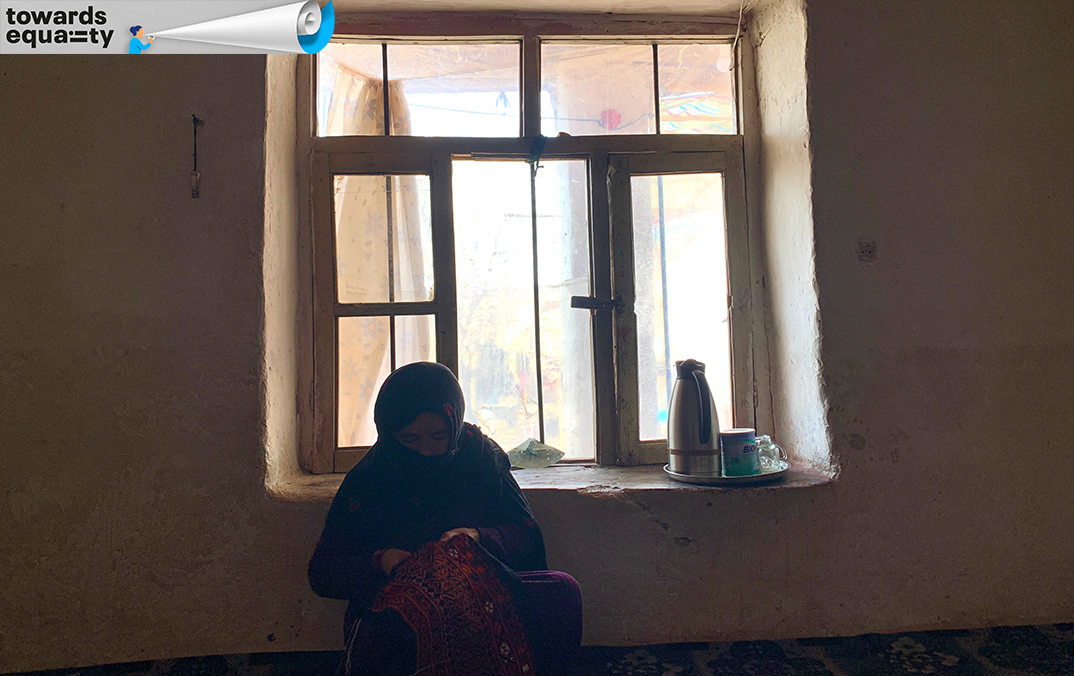
When Laila’s husband denied her the right to read and write, she turned to Baluchi embroidery to alleviate her distress. She quickly mastered the craft and started making clothes for others. She found a few customers in the city—something that did not go unnoticed by her husband. With a wry smile, Laila says, “He had troubled me so much that he thought I’d escape as soon as I had money in my hands.”

Fed up with her husband’s oppression and other people mocking her for her unsuccessful pregnancies, Laila finally decided to seek a divorce. She sought help from friends who were also her customers, but her husband became aware of her plans and made her life so miserable that she could not speak for a week.

Still, she did not back down. She had saved money for the day of her departure and intended to follow through with her plan. Then fate intervened. The Taliban, which had turned this region into a battlefield for years and made life a living hell for its residents, came back into power. “It felt like a bucket of ice water had been poured over my head,” says Laila. “I was forced to reconcile with my husband; there was no way to escape.”

Now, Laila awakens every morning next to a man she despises, goes out to milk the cows, checks on her sheep and feeds her chickens. She has no opportunity to attend school and no permission to use her skills to earn money; she has neither a supportive family nor a government that advocates for women like her. Yet Laila has never resigned herself to all the hardship and violence—she still yearns for an ordinary life.


ShareTweetSendSendShare

Related Posts

Gender bias in AI: “We underestimate the human component of these tools”
No category

Gender bias in AI: “We underestimate the human component of these tools”

12 March 2024 [t_time:1710279389]
India’s solar power push delivers an unexpected bonus – empowering rural women
No category

India’s solar power push delivers an unexpected bonus – empowering rural women

12 March 2024 [t_time:1710278475]
Mother’s Tree
No category

Mother’s Tree

12 March 2024 [t_time:1710277932]

Latest

Loading latest news...

Popular stories

  • An aerial view shows collapsed buildings and widespread damage following an earthquake in Panama (Photo: Reuters)

    More Than 200 Aftershocks Recorded in Panama Since Friday’s Earthquake

    Share
    Share Tweet
  • Axios: Trump Expects Ukraine Not to Attack Russian Oil Refineries

    Share
    Share Tweet
  • UN Report Reveals Shifts in Family Attitudes and Rise in Domestic Violence in Afghanistan

    Share
    Share Tweet
  • The Politics We Inherited: Rethinking Afghanistan’s Political Culture

    Share
    Share Tweet
  • Mujahid: Pakistan Should Address Its Internal Problems Instead of Making Accusations

    Share
    Share Tweet

Podcast

Insights
Insights

Join Lynne O’Donnell for 8AM’s podcast series, Insights.
Lynne talks with generals, diplomats, soldiers, journalists, politicians, activists, people who have front row seats for conflicts around the world, and citizens with a story to tell, happy or sad. For this first series, Afghanistan is the focus. Lynne and her guests talk about the collapse of the republic in August, 2021, and the impact since — for the people of Afghanistan, for the security of the region, for the safety of the world. It’s important, interesting and insightful.

Insights/22: Controlling the Narrative with Mina Sharif
byinsights8am

Controlling the Narrative

Lynne O’Donnell talks with Mina Sharif, author, activist, women’s rights campaigner, educator and mentor. They discuss who controls the narrative and who speaks for Afghanistan’s people when the Taliban appear to have seized control not only of the country but of the message, too.

Have a listen

Insights/22: Controlling the Narrative with Mina Sharif
Episode play icon
Insights/22: Controlling the Narrative with Mina Sharif
Episode Description
Episode play icon
Insights/21: Media Meltdown with Zahra Joya
Episode Description
Episode play icon
Insights/20: Terror Inc with Scott Richards
Episode Description
Episode play icon
Insights/19: Busting Stereotypes with Bushra Gohar
Episode Description
Episode play icon
Insights/18: Media Matters with Waliullah Rahmani
Episode Description
Episode play icon
Insights/17: What Goes Around Comes Around with Sima Samar
Episode Description
Search Results placeholder
Hasht-e Subh

8AM Media, also known as Hasht-e-Subh Daily, stands as Afghanistan's premier independent and non-profit newspaper, resonating as a beacon of journalistic integrity since its establishment in June 2007 by esteemed Afghan journalists and human rights advocates. With a steadfast commitment to citizen journalism and civic education, Hasht-e-Subh Daily has earned its place as the most esteemed publication in the nation.

Publisher: Sanjar Sohail
Email: [email protected]
Executive Director: Parwiz Kawa
Email: [email protected]

Read More

Muttaqi and Indian Chargé d’Affaires Discuss Expanding Ties and Economic Cooperation

UN Supports Job Creation for Returnees in Afghanistan

UNICEF: Barring Girls from Education Has Made It Harder for Pregnant Women to Access Healthcare

Community-Funded Healthcare Center Completed in Ghazni

UNICEF: More Than 2.6 Million Girls in Afghanistan Barred from Education Since 2021

Editor’s Choice

Every Saturday morning, 8AM MEDIA English Services Department will guide you through the week’s biggest stories from Afghanistan and the international community.

Subscribe

© 2026 - ©Hasht-e Subh Daily

No Result
View All Result
8am.Media
پښتو ویب‌پاڼه
ویب‌سایت فارسی
اۉزبېکچه ویب‌سایت
  • Home
  • News
    • Afghanistan News
    • World News
  • Opinion
    • Editorial
    • Analysis
  • Reports
    • Daily Reports
    • Investigative Reports
  • Society
    • The story of people
  • Women’s Word
  • Columns
    • Three Years After Afghanistan’s Fall: The Taliban’s Resurgence
    • Towards Equality
    • The Resurgence of the Taliban: Two Years Since Afghanistan’s Fall
    • Hebatullah Report Special Edition
    • Resistance for Education Special Edition
    • Special Column on Taliban’s Education Curriculum
    • Nawroz
  • Interviews
  • Contact Us
    • About Us
    • 8AM MEDIA Annual Awards
    • Submit an Article to Hasht-e-Subh
  • 8am.media

© 2026 - ©Hasht-e Subh Daily