• 8AM.MEDIA
  • ویب‌سایت فارسی
  • پښتو ویب‌پاڼه
  • اۉزبېکچه ویب‌سایت
  • Podcast
Monday, September 21, 2026
Hasht-e Subh
  • Home
  • News
    • Afghanistan News
    • World News
  • Opinion
    • Editorial
    • Analysis
  • Reports
    • Daily Reports
    • Investigative Reports
  • Society
    • The story of people
  • Women’s Word
  • Columns
    • Three Years After Afghanistan’s Fall: The Taliban’s Resurgence
    • Towards Equality
    • The Resurgence of the Taliban: Two Years Since Afghanistan’s Fall
    • Hebatullah Report Special Edition
    • Resistance for Education Special Edition
    • Special Column on Taliban’s Education Curriculum
    • Nawroz
  • Interviews
  • Contact Us
    • About Us
    • 8AM MEDIA Annual Awards
    • Submit an Article to Hasht-e-Subh
  • 8am.mediaBack
Subscribe
No Result
View All Result
  • Home
  • News
    • Afghanistan News
    • World News
  • Opinion
    • Editorial
    • Analysis
  • Reports
    • Daily Reports
    • Investigative Reports
  • Society
    • The story of people
  • Women’s Word
  • Columns
    • Three Years After Afghanistan’s Fall: The Taliban’s Resurgence
    • Towards Equality
    • The Resurgence of the Taliban: Two Years Since Afghanistan’s Fall
    • Hebatullah Report Special Edition
    • Resistance for Education Special Edition
    • Special Column on Taliban’s Education Curriculum
    • Nawroz
  • Interviews
  • Contact Us
    • About Us
    • 8AM MEDIA Annual Awards
    • Submit an Article to Hasht-e-Subh
  • 8am.mediaBack
No Result
View All Result
Hasht-e Subh
No Result
View All Result

A Buildup of Crises: The Republic’s Collapse Began Long Before Kabul Fell

Translated by Farhad Farhaad | Originally written in Persian by Rastakhiz Shoala

Mohammad Farhaad Mohammad Farhaad
20 August 2026 - Solar Hijri Date: 1405/05/29 [t_time:1787205920]
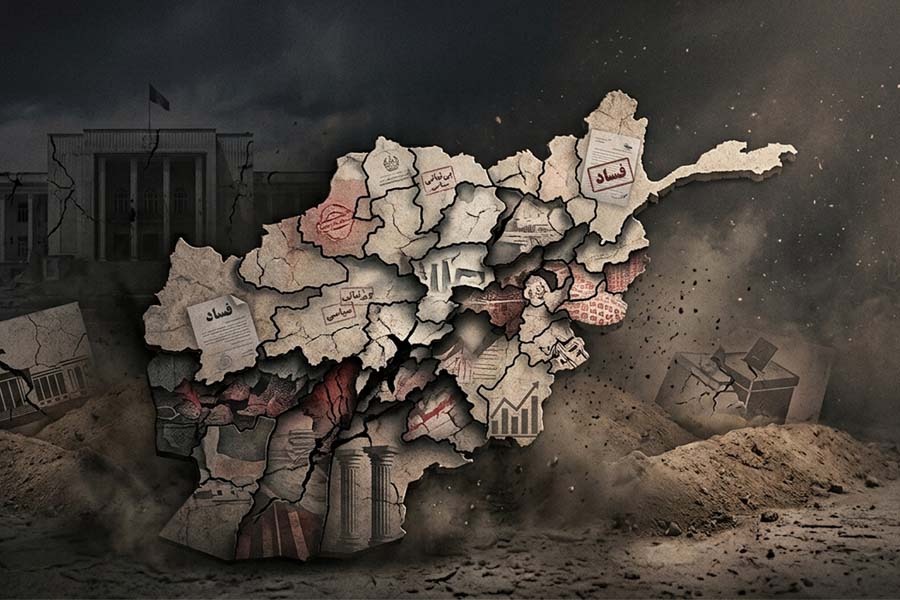
A cracked map of Afghanistan marked with corruption, fraud, and political crisis symbols illustrates the republic's gradual collapse. (Photo credit: AI)

AI

In the popular narrative, everything about 15 August 2021 is reduced to a single day: the day the Taliban entered Kabul, Ashraf Ghani left Afghanistan, and the republic collapsed. But this narrative describes the final act of the collapse rather than explaining its cause. The truth is that the republic did not fall in a day. What happened on 15 August marked the end of a process that had begun years earlier, one in which political, institutional, and social crises piled up one after another, steadily weakening the political system from within.

To find the starting point of this erosion, we must go back to December 2001 and the first Bonn Conference, where the post-Taliban political system took shape. The first step toward the republic’s collapse was taken the moment that system’s foundation was laid in Bonn.

The Bonn Conference pulled Afghanistan out of the political vacuum left by the fall of the Taliban regime and paved the way for a new government. But it also laid the groundwork for an order that would later become a source of crisis. Rather than resting on an inclusive social contract among Afghanistan’s political forces, the new system emerged from an agreement among armed groups, influential ethnic leaders, and Western-backed actors.

As a result, the government was built not on citizenship and accountable institutions but on political power-sharing, a balance among rival power networks, and dependence on foreign support. Many of the commanders and influential figures who had themselves been part of Afghanistan’s crisis became part of its power structure. In that sense, Bonn was not the direct cause of the republic’s fall, but it planted the first seeds of the crisis that would later surface as corruption, ethnic rivalry, weak state institutions, and a legitimacy crisis.

The second stage of the republic’s erosion can be traced to that legitimacy crisis, which entered a new phase with Afghanistan’s second presidential election in 2009. The first election had already faced criticism and fraud allegations, but the 2009 vote dealt the first serious blow to public trust in the ballot box. Widespread fraud, the invalidation of hundreds of thousands of votes, and disputes over the results left many citizens with the impression that power no longer flowed from their votes.

The trend deepened with each subsequent election. The 2014 election crisis, resolved through a political deal rather than a clear result, produced the National Unity Government and sent a clear message: even the country’s most important democratic exercise could not settle power at the ballot box. The 2019 election, marked by low turnout, disputed results, and two rival inauguration ceremonies, wiped out what little public trust remained in the electoral process. A republic that had drawn its legitimacy from elections gradually lost its main source of legitimacy. Yet the legitimacy crisis was only one link in a longer chain. Structural corruption, weak governance, and a crisis of political leadership all accelerated the decline.

Corruption became embedded in how the state functioned. From major contracts to government hiring, from official appointments to the distribution of resources, many citizens felt that political and ethnic ties had replaced law and merit. Instead of standing as a symbol of justice and accountability, the government came to represent patronage, monopoly, and inefficiency.

The republic’s leaders, meanwhile, never managed to agree on a shared national project. Personal rivalries, ethnic disputes, power struggles, and fragile coalitions kept the government tangled in internal conflict rather than focused on solving the people’s problems. In the republic’s final years, as the Taliban advanced rapidly, political leaders remained locked in old disputes and failed to unite around defending the system. A system whose own leaders cannot agree on its survival cannot expect its people to sacrifice for it.

Perhaps the republic’s greatest failure, however, played out in geography. The government could never build a lasting bridge between Kabul and rural Afghanistan. While political, economic, and media attention concentrated overwhelmingly on the major cities, many villages remained cut off from development, public services, justice, and an effective state presence.

In many districts, people came to know the government not through schools, hospitals, courts, or public services, but through a local commander, a corrupt official, or a checkpoint. The Taliban exploited that vacuum, steadily expanding their influence in rural areas. Long before they seized Kabul, they had already pushed much of rural Afghanistan beyond the republic’s political and social reach.

Compounding all of this, the system’s heavy reliance on foreign support left it especially vulnerable. Over two decades, the republic never built enough legitimacy or internal capacity to stand on its own. When the Doha Agreement was signed and American forces withdrew, the system’s last supporting pillar gave way. But had the republic’s internal foundations not already been eroded, the U.S. withdrawal alone could not have triggered such a rapid collapse.

This brings us back to a question that has occupied many minds for five years: why did almost no one defend the republic on 15 August? The answer lies in that same accumulation of crises. People generally defend a system they see as their own, one they trust and believe their fate is tied to. By its final years, the republic had lost much of that public trust. This did not mean people supported the Taliban; it meant the republican government had failed to convince society that it represented the republic’s own ideals.

Seen this way, 15 August was simply the moment when two decades of accumulated crises revealed themselves openly and irreversibly. The republic’s collapse had begun years earlier, when the political order born at Bonn was built on power-sharing, elite competition, and dependence on foreign backing instead of inclusive participation, accountable institutions, and public trust. What happened on 15 August was the outcome of crises that had two decades to be resolved, and never were.


You can read the Persian version of this analysis article here:
انباشت بحران؛ فروپاشی جمهوریت سال‌ها پیش آغاز شده بود

ShareTweetSendSendShare

Related Posts

Qatar's Deputy National Security Adviser Hamad bin Khamis Al-Kubaisi (L) and Türkiye's intelligence chief Ibrahim Kalin (R) led separate delegations to Kabul and Kandahar for talks with senior Taliban officials. (Photo credit: Social Media)
Analysis

Two Mediators, One Case: Foreign Officials’ Visit to Kabul and Kandahar

20 September 2026 [t_time:1789925302]
Hesamuddin Akbari, a dentist in Badghis province, was killed by armed men in Qala-e-Naw. (Photo credit: Exclusive)
Afghanistan News

Criminal Incidents Increase: Dentist Killed in Badghis

20 September 2026 [t_time:1789923677]
A thick layer of dust and smog blankets Kabul, obscuring the city skyline as residents complain of worsening air pollution. (Photo credit: AFP)
Daily Reports

Kabul Engulfed in Dust: Residents Complain of Rising Air Pollution

20 September 2026 [t_time:1789923413]

Latest

Loading latest news...

Popular stories

  • Hamza bin Laden - the son of Osama bin Laden (Photo: Social Media)

    Al-Qaeda Releases Hamza bin Laden Message on 9/11 Anniversary

    Share
    Share Tweet
  • UN Report Reveals Shifts in Family Attitudes and Rise in Domestic Violence in Afghanistan

    Share
    Share Tweet
  • German Politician Calls for Faster Deportation of Undocumented Afghan Migrants

    Share
    Share Tweet
  • Pakistan Army Spokesperson: Afghanistan Has Become a Base for Dozens of Terrorist Groups

    Share
    Share Tweet
  • U.S. Defense Secretary Calls Washington Post Worse Than Iranian State Media

    Share
    Share Tweet

Podcast

Insights
Insights

Join Lynne O’Donnell for 8AM’s podcast series, Insights.
Lynne talks with generals, diplomats, soldiers, journalists, politicians, activists, people who have front row seats for conflicts around the world, and citizens with a story to tell, happy or sad. For this first series, Afghanistan is the focus. Lynne and her guests talk about the collapse of the republic in August, 2021, and the impact since — for the people of Afghanistan, for the security of the region, for the safety of the world. It’s important, interesting and insightful.

Insights/22: Controlling the Narrative with Mina Sharif
byinsights8am

Controlling the Narrative

Lynne O’Donnell talks with Mina Sharif, author, activist, women’s rights campaigner, educator and mentor. They discuss who controls the narrative and who speaks for Afghanistan’s people when the Taliban appear to have seized control not only of the country but of the message, too.

Have a listen

Insights/22: Controlling the Narrative with Mina Sharif
Episode play icon
Insights/22: Controlling the Narrative with Mina Sharif
Episode Description
Episode play icon
Insights/21: Media Meltdown with Zahra Joya
Episode Description
Episode play icon
Insights/20: Terror Inc with Scott Richards
Episode Description
Episode play icon
Insights/19: Busting Stereotypes with Bushra Gohar
Episode Description
Episode play icon
Insights/18: Media Matters with Waliullah Rahmani
Episode Description
Episode play icon
Insights/17: What Goes Around Comes Around with Sima Samar
Episode Description
Search Results placeholder
Hasht-e Subh

8AM Media, also known as Hasht-e-Subh Daily, stands as Afghanistan's premier independent and non-profit newspaper, resonating as a beacon of journalistic integrity since its establishment in June 2007 by esteemed Afghan journalists and human rights advocates. With a steadfast commitment to citizen journalism and civic education, Hasht-e-Subh Daily has earned its place as the most esteemed publication in the nation.

Publisher: Sanjar Sohail
Email: [email protected]
Executive Director: Parwiz Kawa
Email: [email protected]

Read More

UNICEF-Funded Reconstruction of Four Water Supply Networks Begins in Parwan

Afghanistan: When Pollution Becomes an Economy of Illness

Two Mediators, One Case: Foreign Officials’ Visit to Kabul and Kandahar

Body of Young Man Found Hanging in Farah Province

Criminal Incidents Increase: Dentist Killed in Badghis

Editor’s Choice

Every Saturday morning, 8AM MEDIA English Services Department will guide you through the week’s biggest stories from Afghanistan and the international community.

Subscribe

© 2026 - ©Hasht-e Subh Daily

No Result
View All Result
8am.Media
پښتو ویب‌پاڼه
ویب‌سایت فارسی
اۉزبېکچه ویب‌سایت
  • Home
  • News
    • Afghanistan News
    • World News
  • Opinion
    • Editorial
    • Analysis
  • Reports
    • Daily Reports
    • Investigative Reports
  • Society
    • The story of people
  • Women’s Word
  • Columns
    • Three Years After Afghanistan’s Fall: The Taliban’s Resurgence
    • Towards Equality
    • The Resurgence of the Taliban: Two Years Since Afghanistan’s Fall
    • Hebatullah Report Special Edition
    • Resistance for Education Special Edition
    • Special Column on Taliban’s Education Curriculum
    • Nawroz
  • Interviews
  • Contact Us
    • About Us
    • 8AM MEDIA Annual Awards
    • Submit an Article to Hasht-e-Subh
  • 8am.media

© 2026 - ©Hasht-e Subh Daily