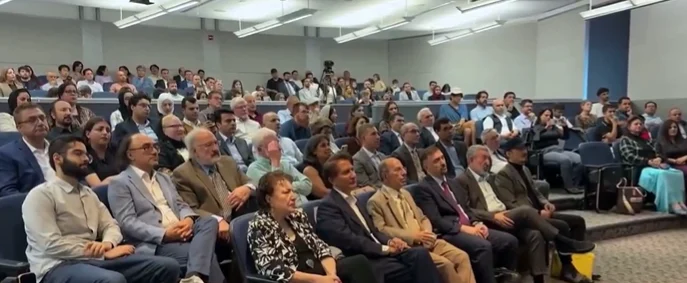
The International Conference “Rumi: A Global Voice for Peace” was held on Friday, October 2, 2026, on the occasion of the 819th anniversary of Mawlana Jalaluddin Muhammad Balkhi, internationally known as Rumi. It was organized by the organization Khana-e-Mawlana and George Washington University (GWU) in the United States. The organizers say they will hold these programs annually. The announced goals for continuing the Rumi gatherings in America include introducing and launching the “Rumi Medal,” holding the third edition of the “Rumi Global Literary Prize,” and installing a statue of Rumi in Washington, D.C.
The conference was attended by a number of researchers and university professors, American admirers of Rumi, diplomats, some senior officials of the former government, and cultural and artistic figures from Afghanistan. The program began with Basir Ahmad Wajuhat playing the rubab and performing the melody “Listen to the Reed.” A short film followed on Rumi’s thoughts regarding humanity, difference, empathy, and peace.
Tariq Eqtedari said the purpose of the event was not only to honor the historical and literary figure of Rumi. He said the conference was an opportunity to revisit Rumi’s thought in connection with the questions facing humanity and the contemporary world. Referring to wars, violence, extremism, and widening social and cultural divides, he said the theme “Rumi: A Global Voice for Peace” was chosen as an effort to examine the capacity of Rumi’s intellectual, literary, and spiritual legacy in the areas of peace, coexistence, tolerance, and human dignity.
Mirwais Balkhi, head of Khana-e-Mawlana, spoke about the roots of conflict and its link to the inner state of human beings. He said peace does not merely mean the absence of war or the end of an external conflict, and that some external conflicts are rooted in unresolved inner struggles. He added that anger, self-centeredness, and ignorance can set the stage for confrontation with others, and that achieving external peace without addressing these factors is difficult.
Mr. Balkhi described Rumi as “a true child of Balkh, the voice of Afghanistan, a shared civilizational heritage, and a global citizen.” He said that after eight centuries, Rumi’s message can still reflect the pain and joy of people today. According to him, Rumi’s mystical knowledge leads a person first to self-knowledge and then to understanding others, and peace also begins with a change within the human being.
Naseer Ahmad Faiq, Acting Permanent Representative of Afghanistan to the United Nations (UN), also stressed the universality of Rumi’s message and the role of knowledge and insight in human liberation. According to him, Rumi’s legacy is not limited to one geography, ethnicity, language, or culture, and “Rumi is a gift to all humanity.” Faiq described knowledge and hope as concepts that, in Rumi’s thought, can guide people from ignorance and darkness toward understanding and liberation.
Farhad Darya, a renowned Afghanistan artist and singer, also spoke at the conference about the connection between music, poetry, insight, and friendship in Rumi’s thought. He said Rumi’s poetry cannot be regarded merely as a collection of words, because music is present in the structure of his poetry, and in his works, expression, melody, and meaning are woven together.
Mr. Darya also emphasized Rumi’s effort to move beyond the molds and boundaries that create distance between people. He said that before linguistic, geographic, and cultural differences separate people from one another, poetry and music can provide ground for shared experience and empathy.
Specialized Session on Peace in Rumi’s Thought
In the second part of the program, Mustafa Akyol, a writer, researcher, and university professor in America, spoke about peace in Rumi’s thought, the ways and mechanisms of achieving it from Rumi’s perspective, and the relevance of his views on peace in the world today.
Mohammad Faghfoori, an Iranian researcher in the United States, also said at the session that understanding Rumi’s view of peace cannot rely solely on words and famous quotations, and that attention must be paid to the structure and depth of his thought. He described difference as one of the realities of human life and said that the existence of people with different beliefs, views, and experiences does not in itself cause conflict. The problem begins, he said, when a person cannot understand another’s difference and turns it into hostility.
According to Faghfoori, the path to peace is not the elimination of differences or the homogenization of people, but understanding and accepting those differences. From this perspective, people can think differently and still live side by side.
Sayed Hassan Ikhlaq, a researcher, Rumi scholar, and university professor in America, also stressed the need to move beyond superficial and purely romantic readings of Rumi. He described self-knowledge, self-acceptance, and acceptance of diversity as important pillars of Rumi’s thought, and said a person’s relationship with others is linked to how they know themselves. According to him, accepting others is not merely tolerating a different person, but recognizing human diversity and finding the possibility of coexistence amid differences.
After the specialized session, Homayoun Sadozai, a songwriter and singer from Afghanistan, and Milad Yousefi, a musician and artist, performed music. This part of the program was accompanied by recitations of Rumi’s ghazals.
Announcement of Khana-e-Mawlana’s Future Programs
In the final part of the conference, Reza Hosseini, a writer and university professor, announced that the commemoration of Rumi will henceforth be held annually with a research approach, and that each year a specific theme from Rumi’s thought and works will be the main focus of discussion and research.
Khana-e-Mawlana also announced the launch of the “Rumi Medal.” According to Khana-e-Mawlana, the medal will be an international award whose theme will be set each year in line with the main focus of the program. Given this year’s theme, the first edition of the medal has been dedicated to peace, and its first recipient is expected to be introduced at next year’s program after the stages of nomination, review, and adjudication.
Khana-e-Mawlana says an independent structure has been planned for the medal, and that the nomination and evaluation criteria, selection method, secretariat, and jury will be determined. Reputable and qualified figures from different countries are expected to serve on the jury.
In another part of the program, Khana-e-Mawlana announced efforts to install a statue of Rumi in Washington, D.C. The request for the project is expected to be submitted to government and city officials in Washington, and a petition will also be made available to gather support from admirers for the project.
Exhibition of Artworks and Calligraphy
Another part of the conference was dedicated to an exhibition of artworks and calligraphy. Sulaiman Hedayat displayed part of Rumi’s literary heritage through the art of calligraphy, writing out his poetry.
Also, at the art exhibition of the program, works inspired by Rumi’s poetry, thought, and spiritual world, prepared by the Honarsalar organization, were displayed for the participants.
The organizers of the conference say the aim of continuing such programs is to revisit Rumi’s thought and examine its capacity to respond to the challenges of the contemporary world, particularly in the areas of peace, coexistence, acceptance of differences, and human dignity.
You can read the Persian version of this report here:
همایش «مولانا؛ صدای جهانی برای صلح»؛ برنامههای برای پاسداشت و گسترش میراث مولانا در امریکا