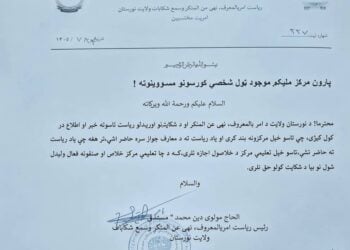
Several students are criticizing the Taliban’s ban on smartphone use at universities. They say the decision could create serious problems for the education process, research, and students’ access to academic resources. According to these students, today’s technology has become an inseparable part of education and learning, and smartphones play an important role in accessing digital libraries, scholarly articles, educational resources, and academic communications. They consider restricting the use of this tool a harmful decision. Meanwhile, several university professors, reacting to the decision, warn that such a measure could pose serious challenges to the expansion of knowledge and the advancement of students’ academic capacity.
Tawab (pseudonym), a student at the Faculty of Sharia at Kabul University, criticizes the ban on students’ use of smartphones. He says that in today’s world, the smartphone is not merely an entertainment device but has become one of the most important educational and scholarly tools. According to him, banning smartphone use could disrupt the education process and students’ access to academic resources.
Tawab adds, “I disagree with banning smartphone use at universities, because these devices provide students with a wide range of capabilities. Quick access to digital libraries, reading scholarly articles and research papers, and using dictionaries and educational applications are among the important advantages of smartphones.”
The student also says: “In many cases, professors ask students to search for academic material on the internet or receive lesson files through mobile phones. With the ban on smartphone use, students will face numerous problems and limitations.”
Ali (pseudonym), a student at Kabul Polytechnic University, says the ban on smartphone use by students is a step backward in the age of technology and could negatively affect the educational and academic progress of young people. He adds, “Today, technology is an inseparable part of education and learning. Restricting smartphone use for a generation that is supposed to play an important role in the future development and modernization of society seems to be a harmful decision.”
Pointing to students’ educational needs, particularly in technical fields, this student says: “In the faculties of computer science and engineering, technology is advancing rapidly, and many educational resources are available online. Professors also repeatedly ask students to research course topics on the internet or follow supplementary lessons online. Under such circumstances, restricting smartphone use can make the learning process difficult.”
Ali also says, “Many students cannot afford to buy printed books and pamphlets, and they read digital versions on their mobile phones. In addition, finding academic resources and material on the internet takes only a few minutes, whereas searching for the same material across multiple books requires much more time and resources.”
Omid (pseudonym), a student at the Faculty of Literature at Kabul University, says he supports reasonable restrictions and managed use of smartphones at universities. In his view, neither a complete ban nor absolute freedom in using these devices is an appropriate solution. He adds: “The best approach is to establish clear rules for smartphone use in educational settings. During class hours, students should turn off their phones or set them to silent mode so that teaching is not disrupted, but during academic research and educational activities, mobile phone use is a serious and unavoidable need.”
The student also says: “Universities should launch awareness programs for students on the healthy and responsible use of technology and promote a culture of proper smartphone use. In this way, students can use this tool as a useful instrument for education and research, rather than as a factor for wasting time and reducing concentration.”
Meanwhile, Ahmad (pseudonym), one of the university professors, criticizes the ban on students’ smartphone use. He warns that such a decision could pose serious challenges to the expansion of knowledge and the advancement of students’ academic capacity.
This university professor says: “In the current era, keeping students away from technology and modern educational tools means restricting their access to knowledge and learning opportunities. Today, knowledge and technology have become so intertwined that separating them is practically impossible.” He adds: “Smartphones and other digital tools form an important part of the contemporary education process, and restricting their use can have negative consequences for the quality of education, research, and students’ academic growth.”
Shoaib (pseudonym), a professor at Kabul University, warns that the ban on smartphone use by students and professors may restrict students’ access to digital libraries, lecture notes, online educational resources, study groups, and academic communications with professors, and hurt the quality of education and research.
The professor says: “Taliban officials have stated that the purpose of this decision is to create a healthy and orderly educational environment, increase students’ focus on their lessons, and strengthen order and discipline in academic settings. The matter was raised at the university’s Academic Council meeting, but council members were not allowed to ask questions or express their views, even though such a decision could have wide-ranging consequences for the education process.”
It is worth noting that previously, residents of several provinces, including Herat, Ghazni, Laghman, and Kabul, had told the Hasht-e Subh Daily that the Taliban’s Propagation of Virtue and Prevention of Vice forces inspect citizens’ mobile phones.
The Taliban have also recently banned smartphone use in their government offices in several provinces, including Kabul, Panjshir, Farah, and Balkh.
You can read the Persian version of this report here:
تلفن ممنوع؛ دانشجویان: طالبان دروازههای دانش دیجیتال را میبندند