
In continuation of their restrictions against women in Herat, the Taliban have once again ordered that women who fail to observe the group’s prescribed dress code will be arrested and transferred to prison, effective immediately. In a new directive issued in Herat, the Taliban declared that women who wear perfume and walk past men are to be considered “adulterers,” and that prayers led by a mullah imam whose wife does not comply with the group’s dress code are classified under Islamic jurisprudence as “makruh tahrimi,” meaning strongly discouraged to the point of near-prohibition. Women and girls in Herat have expressed deep concern, saying the Taliban harbor an unrelenting hostility toward them and are enemies of their joy, happiness, and sense of cleanliness. In their own words, wearing a mask and a burqa in the current heat is an unbearable ordeal.
An audio recording attributed to an employee of the Taliban’s provincial governor’s office in Herat is circulating on social media. In it, a speaker states that a meeting was held last week at the provincial headquarters, led by Islamjar, the Taliban’s governor of Herat, and the head of the group’s Ministry for the Propagation of Virtue and Prevention of Vice (MPVPV). At that meeting, the MPVPV was instructed to prepare a text citing the Quran and Sunnah and to issue it publicly once again.
The audio, reportedly released last Thursday, includes the following statement: “Tomorrow, the mullahs, especially the Friday prayer leaders across all districts, should call on the people to convene gatherings. We will also share the directive that has been provided to us within the group.”
The Taliban directive states that a woman who wears perfume while walking past men is to be regarded as an “adulterer.” It further specifies that if the wife of a mullah imam does not observe the group’s dress code, prayers led by that imam are classified as “makruh tahrimi,” meaning strongly discouraged to the point of near-prohibition in Islamic jurisprudence. The directive also invokes Decree No. 1930 of Hibatullah Akhundzada, the Taliban Supreme Leader, under which women and girls employed in certain government positions under Taliban control will be suspended from their duties if they fail to comply with the required dress code.
The Taliban in Herat have communicated this directive to all city districts and sub-districts. It was also announced at Friday prayers by mosque imams the previous day. The directive warns that people must not permit women to leave their homes without observing the Taliban’s prescribed dress code.
Behnaz (pseudonym), a young woman in Herat, recounts: “Our neighbor attended Friday prayers and called my brother to report that the mosque’s prayer leader had announced that any woman or girl appearing without a burqa would be arrested, and that her husband, father, or brother, if employed in a government position, would be dismissed. It was also stated that women would not be released even through the intercession of community elders, and that people should take heed. People were kept inside the mosque until two o’clock in the afternoon while sermons were delivered.”
Another Herat resident says: “Prayer leaders at most mosques in the city warned during Friday prayers that women wearing a manteau, short clothing, or appearing without a prayer chador and mask would be sent to prison by the MPVPV. The Taliban’s security commandant, intelligence services, and the MPVPV are coordinating on this matter and are jointly monitoring the city.”
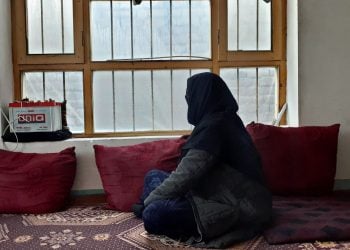
Sara (pseudonym), another young woman in Herat, says: “The Taliban’s ever-tightening laws make life harder and more intolerable for us with each passing day. As independent human beings, we are denied the right to choose our own clothing, behavior, or way of life. Through these inhumane orders, they are working to eliminate women and girls from public life. They appear to be threatened by the very existence of women, yet they cannot accept seeing a woman advance, be happy, dress well, or live on her own terms.”
She adds: “In this sweltering heat, wearing a mask, a prayer chador, a long black garment, and a headscarf all at once is truly beyond endurance. It feels like suffocation, like a slow death. In the Taliban’s view, a woman has only one option: to live and die as a slave.”
Maahrokh (pseudonym), another young woman living in Herat, says: “The Taliban make life more difficult for us every single day. They impose a new, severe restriction against women daily, driven by nothing but hostility. This latest order, that women will be jailed for not dressing as the Taliban demand, is deeply alarming. Fear takes hold of us entirely when we consider being imprisoned for our clothing. This is neither humane nor moral nor in accordance with Islamic law. It is blatant oppression against all women and girls, stripped of their most fundamental rights, their lives turned into a burning prison.”
She adds, “We have been forgotten by the world. No one acted on our behalf. Everyone merely chanted slogans for their own recognition. It is we who have always been, and continue to be, the ones who pay the price, simply for being women in Afghanistan.”
These concerns arise within the framework of the Law for the Propagation of Virtue and Prevention of Vice, under which women’s voices have been classified as “Awrah” and women are permitted to leave their homes only for essential needs, with their faces covered and their voices lowered. The law further prohibits women’s voices from being audible even from within their own homes and bans drivers from transporting women without a male guardian. It also forbids the recitation of religious hymns in women’s voices.
In 2022, Hibatullah Akhundzada, the Taliban Supreme Leader, issued an order requiring women to cover their faces, warning that “guardians” of women who failed to comply would be imprisoned and hauled before a court. Under that order, the burqa was described as “the best hijab and a symbol of the culture of the people of Afghanistan,” one that had been in use for generations. The decree also stated that black clothing and a black burqa that are not “tight-fitting” may qualify as religiously acceptable attire.
The Taliban Supreme Leader’s decree reads: “An unveiled woman should first be identified at her home, and her guardian warned and punished.” Further clauses state: “In the second step, her guardian shall be summoned to the relevant authority; in the third step, her guardian shall be imprisoned for three days; and in the fourth step, her guardian shall be referred to the courts to receive an appropriate sentence.”
Previously, the International Criminal Court (ICC) issued arrest warrants for Hibatullah Akhundzada and Abdul Hakim Haqqani, head of the Taliban’s Supreme Court, on charges of crimes against humanity. The ICC stated that both senior Taliban officials are being prosecuted for their roles in the systematic, gender-based persecution of women, girls, and other individuals in Afghanistan.
You can read the Persian version of this report here:
حجاب اجباری و هشدار تازه طالبان؛ زنان بدون چادری در هرات زندانی میشوند