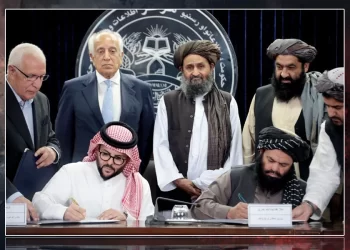
The Taliban continue to sign illegal contracts for the extraction and exploitation of Afghanistan’s mines. They now control the country’s natural resources—wealth that once funded their war efforts through illegal mining—and have gained increased opportunities for exploitation as their criminal economic networks expand. Recently, the Deputy Prime Minister for Economic Affairs announced the launch of “exploration and extraction” at 21 major mines in Afghanistan. However, citizens and economic experts have raised concerns over the unregulated extraction and smuggling of minerals in the absence of a legitimate government. They argue that the mining operations lack transparency and accountability, endangering the future of the country’s mines. Without a legitimate political framework, experts claim that these mining contracts only benefit the Taliban, not Afghanistan.
Reports indicate that since the Taliban’s takeover, at least 205 mining contracts have been signed with over 150 companies. Since gaining control, the Taliban have focused on mining, signing more than 100 contracts with Chinese, Qatari, Turkish, Iranian, and some domestic firms over the past three years. Yet, the details of these contracts remain undisclosed, and their procedures lack transparency and accountability.
Many citizens believe that the Taliban, who previously funded part of their insurgency through illegal mining, now use the proceeds to strengthen their criminal economy. By signing mining contracts, they secure a significant portion of the revenue from these resources.
In a recent statement, the Deputy Prime Minister for Economic Affairs announced the commencement of exploration and extraction at 21 major mines. On November 10, the Taliban agency shared on social media that contracts had been awarded for the extraction of iron, lead, zinc, gold, ruby, chromite, cement, barite, and coal. According to the Taliban, most of these mines are located in Herat province. Specifically, iron and barite mines are in the districts of Rabat Sangi and Ghorian, coal mines in Obe and Karukh, and an iron mine in Pashtun Zarghun. Gold mines in Takhar and Baghlan, a ruby mine in Kabul, a chromite mine in Parwan, and lead and zinc mines in Ghor have also been contracted. However, the Taliban have not provided specific details about the terms and conditions of these contracts.
Economic analysts argue that Afghanistan’s mines are now accessible only to a few countries with limited financial ties to global markets, and the current contracts lack legal protection. They assert that these deals are not in Afghanistan’s interest, as they primarily generate income for the Taliban to cover their daily expenses.
Because the Taliban lacks international legitimacy, only a limited number of countries and companies are willing to participate in the bidding process. This creates a monopoly-like situation where the Taliban have no alternative buyers. Experts argue that a free, competitive market would raise the value of Afghanistan’s mines and lead to contracts that better benefit the Afghan people.
Azarkhsh Hafizi, an economic analyst, told Hasht-e Subh Daily that Afghanistan has over 1,400 confirmed or indicative mineral deposits, including rare elements. Hafizi believes that with a legitimate political framework and reasonable economic and legal structures, Afghanistan could become one of the world’s wealthiest countries. He warns that, in the absence of legitimate governance, the sale of Afghanistan’s mineral resources presents significant challenges. Due to the Taliban’s unrecognized status, Afghanistan cannot approach international courts to resolve trade disputes, depriving its citizens of the opportunity to defend their interests.
Hafizi also pointed to issues with previous contracts, such as the Mes Aynak copper deal with China. Despite more than 18 years having passed, misunderstandings persist due to unclear contract terms. The former Afghan government required China to build a railway connecting Mes Aynak to an international port, but China refused. Although China initially pledged $800 million in aid to Afghanistan and made several payments, it later ceased further installments.
Hafizi emphasized that processing minerals domestically into semi-refined and refined products could create thousands of jobs and add significant value. Currently, raw ore sells for $8 to $10 per ton, but when processed, its value rises to $700 to $800. These unrefined minerals are sold to neighboring countries, processed, and then sold at ten times the original price. Hafizi warns that without a strong legal and political foundation, these contracts cannot secure benefits for the Afghan people, and the country’s mines could be exhausted without alleviating poverty—similar to the experience of mines in Southern and Central African countries.
The Afghan Witness project reported that since the Taliban took over, by February 2024, they had signed at least 205 mining contracts with over 150 companies, primarily from China, Iran, Turkey, and Qatar. Some contracts involve British firms and a company potentially linked to Iran’s Islamic Revolutionary Guard Corps (IRGC). The report reveals that Taliban officials “play a more active role in the mining sector,” with the leadership holding shares in at least nine mining projects. Five of these projects, initially appearing as royalties, later evolved into direct partnerships with the Taliban’s Ministry of Mines and Petroleum.
Meanwhile, some Afghan citizens voice concerns over the Taliban’s reckless exploitation of the country’s mineral wealth, fearing that the wealth Afghanistan has preserved for years will now support al-Qaeda and other terrorist groups. They insist that foreign mining contracts with the Taliban are illegal and lack legal binding.
Hamid (a pseudonym), a resident of Ghor, warns that the future of Afghanistan’s mining sector is in grave danger. He stresses that Afghanistan currently lacks legitimate law and government, making any mining contracts with the Taliban legally void. He emphasizes that such contracts have no legal force or validity.
The George W. Bush Institute previously reported that countries such as Iran, China, Russia, and certain foreign companies benefit from the Taliban’s looting of Afghan mines. Earlier this year, the institute reported that in 2022, the Taliban earned approximately $2.2 billion from mining, although the details of how this revenue was spent remain unclear.
Jessica Ludwig, a co-author of the report and Director of Global Policy at the George W. Bush Institute, stated, “Afghanistan has around $1 trillion in natural resources now controlled by the Taliban. The mafia-like corruption of the Taliban must be curbed to ensure that this insurgent group does not access resources they use to maintain power.” The report urged the U.S. and its allies to control financial channels to the Taliban as leverage against the group. It also highlighted an oil contract with two Chinese companies with close ties to Taliban officials.
As mining activities accelerate under Taliban rule, concerns are growing over the potential loss of Afghanistan’s cultural heritage. In 2022, two excavations took place in the Bamyan Valley, a region rich in cultural heritage. It appears that those involved had extensive knowledge of excavation techniques and the specific locations of these caves and the surrounding area.
You can read the Persian version of this daily report here: