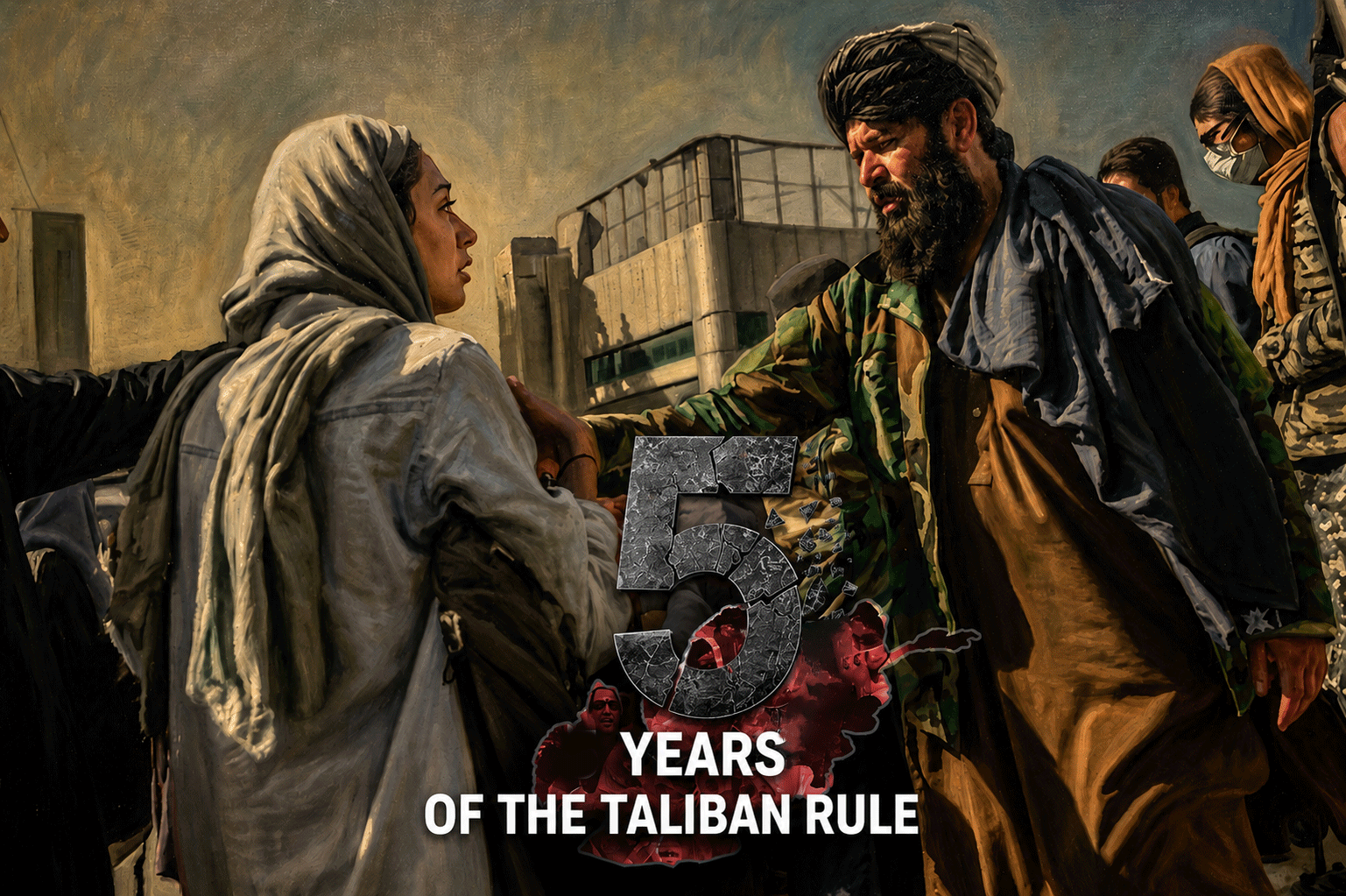
A document from the Human Rights Team of Afghanistan’s Permanent Mission to the United Nations shows that between 2021 and 2026, the Taliban have transformed scattered restrictions into a legal, administrative, and executive structure aimed at removing women from public life, suppressing dissent, controlling the media, and violating the rights of children and minorities.
Five years after the Taliban’s military takeover of Afghanistan, a document titled “Five Years of Military Domination by the De Facto Taliban Authorities: Afghanistan’s International Human Rights Obligations and a Record of Non-Compliance, 2021 to 2026” presents a legal picture of the group’s conduct. The document was prepared by the Human Rights Team of the Permanent Mission of Afghanistan to the United Nations in Geneva, and it measures the Taliban’s conduct, treaty by treaty, against Afghanistan’s international obligations.
The document’s central finding is that the events following August 15, 2021 cannot be regarded as a temporary interruption in the course of human rights. In the authors’ assessment, the Taliban have turned deprivation into a method of governance and turned restriction and suppression into binding rules. Initial decrees have gradually evolved into nationwide regulations, executive structures, and codified laws, and their scope has expanded from women’s education and employment to freedom of expression, fair trial, and the rights of children and minorities.
Standing Obligations and Suppressed Civil Rights
Before the Taliban’s return to power, Afghanistan was party to the International Covenant on Civil and Political Rights (ICCPR), the International Covenant on Economic, Social and Cultural Rights (ICESCR), the Convention on the Elimination of All Forms of Discrimination Against Women (CEDAW), the Convention on the Rights of the Child (CRC), the Convention Against Torture (CAT), and several other international instruments.
The document emphasizes that Afghanistan remains a party to these treaties, and that a change of government or the domination of the country by one group does not suspend or nullify its legal obligations. From this standpoint, the Taliban, as the de facto ruling authority, are obligated to observe the commitments that Afghanistan accepted before 2021. Nevertheless, the five-year assessment states that the Taliban have continuously, and in some cases systematically, violated numerous provisions of these treaties.
The issuance of the “Criminal Procedure Code for Courts” in early January 2026 is identified in the document as one of the most significant steps in the legalization of repression. According to the assessment presented, this code criminalizes criticism of Taliban policies and leadership, grants judges broad and largely unchecked authority to punish opponents and critics, and obligates citizens to report individuals suspected of opposing the Taliban.
The document’s authors regard these regulations as conflicting with freedom of expression and the right to protection from arbitrary interference in privacy. They conclude that the Taliban have moved from the restrictions and coercive measures of the early years toward institutionalizing repression within the judicial and legal structure.
Violations of the right to life, the prohibition of torture, and the ban on arbitrary detention are among the other central themes of this assessment. Between August 15, 2021 and June 30, 2023, the United Nations Assistance Mission in Afghanistan (UNAMA) recorded 218 extrajudicial killings, 14 enforced disappearances, more than 144 cases of torture and ill-treatment, and 424 cases of arbitrary detention. Most of the victims were former members of the security forces, police, and the General Directorate of National Security, individuals who, despite the Taliban’s declared “general amnesty,” have been detained, tortured, disappeared, or killed.
Women protesters and women detained on charges of violating so-called “moral” regulations have also reported beatings, electric shocks, threats against family members, denial of medical treatment, and inadequate detention conditions. The document describes the resumption of public flogging and executions since 2022, particularly in cases lacking fair trial guarantees, as a violation of the right to life and the prohibition of torture and inhuman treatment.
In September 2021, the Taliban made prior permission mandatory for holding demonstrations and even demanded approval of protesters’ slogans. Women’s protests in defense of education, work, and basic freedoms were violently suppressed. Protesters faced beatings, arbitrary detention, enforced disappearance, and torture, and journalists covering the protests, as well as family members of some organizers, were also targeted.
According to the document, this repression subsequently extended to the media through censorship, the detention of journalists, the designation of permitted and prohibited topics, and the obstruction of free access to information. Between August 2021 and September 2024, more than 336 violations of the rights of journalists and media workers were recorded. The document also cites more than 150 additional cases since May 2025 and notes that Afghanistan ranks 175th out of 180 countries on the press freedom index.
The disruption of telecommunications is also described as part of this trend. In September 2025, internet service was first disrupted in parts of the country, and on September 29, internet and mobile networks were cut off across all of Afghanistan without prior notice. This measure, in addition to affecting freedom of expression and access to information, disrupted banking, financial transfers, emergency medical services, and humanitarian activities.
The Taliban’s judicial system, according to the document, is also in conflict with the principles of fair trial, legality of crime and punishment, and equality before the law. In Taliban courts, the testimony of a woman does not carry equal weight to that of a man. Women have been excluded from serving as judges, prosecutors, and defense lawyers, and the absence of judicial independence, the vague definition of offenses, limited protection for defendants, and the broad authority of judges have created conditions conducive to the arbitrary application of the law.
The rights of religious minorities have also been restricted. The document refers to the closure of Ismaili gathering houses (jamaat khanas) in Badakhshan and restrictions on Shia Ashura ceremonies. In a number of provinces, the observance of Ashura has been confined to designated locations, and in Kabul, individuals have been detained for displaying Ashura flags.
Women and Girls: From Decree to a System of Discrimination
According to statistics in the document, by July 2026 the Taliban had issued 264 decrees and directives affecting human rights, of which 166 specifically targeted women and girls. These restrictions cover nearly every core area of CEDAW, from education, employment, and health to political participation, equality before the law, and rights related to marriage and family.
The exclusion of women began within the first weeks of the Taliban takeover. In September 2021, the Ministry of Women’s Affairs was replaced by the Ministry for the Propagation of Virtue and Prevention of Vice. Structures for addressing violence against women ceased to function, safe houses and support mechanisms were closed or dissolved, and women judges, prosecutors, and defense lawyers were gradually removed from the judicial system.
As a result, the Taliban not only took no action to eliminate discrimination but also dismantled the institutions established to prevent discrimination and violence, while expanding the structures used to enforce discriminatory restrictions.
The Law for the Propagation of Virtue and Prevention of Vice, which took effect in August 2024, is considered a major step in codifying these restrictions. This law obligates women to fully cover their faces in public places, restricts their voices from being heard outside the home, and further curtails their freedom of movement, expression, employment, and participation in public life.
The requirement for a mahram (male guardian) to accompany women on journeys of more than 72 kilometers had been in effect since December 2021, and in May 2022, full body covering was formally made mandatory. In subsequent years, women were excluded from parks, gyms, restaurants, and other public spaces. The 2024 Law for the Propagation of Virtue codified these scattered restrictions into regulations governing women’s dress, voice, movement, and social interaction.
By April 2025, the enforcement committees for this law were active in 28 of Afghanistan’s 34 provinces, and about 3,300 members of the Morality Police, with broad authority, monitored the dress, movement, and conduct of citizens.
According to the document, enforcement of these restrictions has continued into 2026. From June 6 to 8, at least 30 women were detained in the city of Herat on charges of failing to observe the Taliban’s required hijab. The Taliban’s Ministry of Hajj and Religious Affairs also distributed a ten-page document to Friday preachers on June 18, requiring the covering of the entire body except the eyes, the wearing of thick and loose clothing, and abstention from perfume and adornment.
The mahram requirement has also expanded from long-distance travel to everyday matters. In some areas, members of the Morality Police have instructed shopkeepers and health center staff not to provide services to women without a mahram. In Kandahar, cosmetics sellers were barred from selling goods to women without a mahram. In Uruzgan, health centers were told not to admit female patients without a mahram, and female health workers were also required to have a mahram while working. In Logar, a shopkeeper who sold food to a woman without a mahram was beaten and detained for several hours.
The Taliban’s Ministry of Justice issued Decree No. 18, known as the “Procedure for Judicial Separation of Spouses,” on May 14, 2026. This decree sets restrictive conditions for women seeking separation while preserving the unilateral right to divorce for men.
The decree also stipulates that if a relative other than the father or grandfather arranges the marriage of a child to a person deemed “of equal social standing” with a customary dowry, the marriage is considered valid. The document regards this provision as legitimizing child marriage under such circumstances.
According to this assessment, the Taliban’s five years of rule began with the dismantling of institutions supporting equality, continued with the prohibition of education, work, movement, and public participation, and culminated in mandatory enforcement and the codification of nationwide laws. International human rights mechanisms have described the cumulative effect of this structure as an institutionalized system of gender based discrimination, one that, in their view, reflects “gender apartheid” and may constitute gender persecution.
Education, Employment, and Health: A Chain of Deprivation
In September 2021, secondary schools and high schools reopened for boys and male teachers, but girls above grade six were not permitted to return. On December 20, 2022, universities were also closed to women, and subsequently, vocational, medical, nursing, and midwifery training was restricted or banned.
By August 2026, the ban on girls’ secondary education had entered its fifth year, and none of the fundamental restrictions have been lifted. The UN Women’s Gender Index has shown that nearly eight out of every ten young women have been excluded from education, employment, or vocational training.
The document emphasizes that the ban on education violates not only the right to education but also affects the right to work and health. The exclusion of girls from school, university, and medical training will reduce the future number of female doctors, nurses, midwives, and teachers, while the Taliban have simultaneously restricted women’s access to male doctors.
This policy increases women’s economic dependency, raises the risk of early and forced marriage, and reduces their access to health services, psychological support, shelter, and legal aid. A thematic report issued in February 2026 by the UN Special Rapporteur described these restrictions as reinforcing components of a coordinated system of gender based discrimination in the health sector.
The exclusion of women from the labor market has also been gradual. In 2021, many female employees in government offices were ordered to stay home. In December 2022, women’s work in non-governmental organizations was banned, and in April 2023, this ban was extended to women’s employment with the United Nations. Subsequently, women’s beauty salons were closed, and women’s activity in media, commerce, and other sectors was restricted.
Since September 7, 2025, the Taliban have banned women, including national UN staff, contractors, and female visitors, from entering United Nations offices across Afghanistan. According to the document’s calculations, this ban had continued for 326 days as of July 30, 2026. This measure, in addition to violating the right to work, has also restricted women’s presence in public life and the delivery of humanitarian assistance.
By March 2022, it was estimated that 61 percent of previously employed women had lost their jobs, and the economic loss from this process was between 600 million and one billion dollars. The International Labour Organization (ILO) also estimated in 2022 that women’s employment had declined by 25 percent compared to the period before the Taliban takeover, while the decline for men was seven percent.
The World Bank recorded an overall decline in Afghanistan’s gross domestic product (GDP) of about 27 percent in 2021 and 2022. The document regards the economic crisis as a multi-causal phenomenon but identifies the Taliban’s restrictions on women as one of the structural factors intensifying recession, poverty, and family dependency.
In the university entrance exams held in May and June 2026, approximately 120,000 men participated, but no woman or girl was permitted to take part. UNICEF has estimated the cost of denying girls secondary education at about 2.5 percent of Afghanistan’s annual GDP, with the long-term loss of opportunity estimated at 5.4 billion dollars. The number of girls affected by this ban is estimated at 2.2 million.
The mahram, dress, and employment restrictions have also directly affected women’s right to health. In some areas, women without a mahram have been turned away from health centers, and female health workers have also been required to have a mahram to travel to their workplaces.
In November 2025, sick women and female staff at government hospitals in Herat were barred from entry for failing to observe the Taliban’s required dress code, a measure that, according to the document, immediately reduced patient admissions by 28 percent.
Human Rights Watch has recorded that in at least 16 provinces, female staff of aid organizations have been required to have a mahram while working, and in at least 11 provinces, they have been excluded from participating in the distribution of food and essential goods. These restrictions have made it more difficult for female-headed households, rural women, women with disabilities, and girls to access humanitarian assistance.
Estimates from the United Nations Development Programme’s (UNDP) “2026 Socio-Economic Outlook” show that in 2025, about 74 percent of Afghanistan’s population faced livelihood insecurity. The document notes that drought, reduced aid, the large-scale return of migrants, and the economic crisis have also played a role in this situation, but that the exclusion of women from work and services has intensified these vulnerabilities.
Children, Minorities, and Torture
The document states that, in addition to the ban on girls’ education, the Convention on the Rights of the Child (CRC) has been violated as a result of a broad crisis in child protection. Children in Afghanistan face school dropout, hazardous labor, separation from family, early and forced marriage, sexual abuse, trafficking, arbitrary detention, corporal punishment, use in armed activities, and harm from explosive materials.
The Taliban’s Decree No. 18 considers a marriage arranged for a child by a relative to be valid under certain conditions and also restricts a child’s right to annul such a marriage. For example, the silence of a virgin girl after reaching puberty can nullify her right to annul the marriage.
The document states that forced and underage marriages, including the marriage of girls as young as seven or eight, have increased since August 2021. Economic pressure resulting from the ban on education and work has driven families toward the early marriage of daughters, and cases have also been recorded in which women and girls were married to Taliban members without their consent.
In 2023, the detention of 31 children, including 29 boys and two girls, on charges of association with opposition groups was recorded, and one of them died in custody. Children have also been flogged in Taliban courts. In addition, the recruitment and use of 342 boys by the Taliban has been confirmed, 150 in combat roles and 192 in support roles.
In the section related to the Convention on the Elimination of Racial Discrimination, the document discusses violence, forced displacement, deprivation of land and property, and the absence of equal protection for ethnic minorities, particularly the Hazaras. In the months immediately following the Taliban takeover, thousands of Hazara residents in Daikundi and Uruzgan were driven out of their villages. In many cases, they were not given an effective opportunity to prove ownership, and some of the land was distributed among Taliban supporters. The forced displacement of Uzbek and Turkmen communities has also been reported.
Women and girls with disabilities also face multiple layers of discrimination. In rural areas, geographic distance and limited services, combined with the mahram requirement and dependence on male relatives, have restricted their access to information, travel, treatment, and assistance.
Within the framework of the Convention Against Torture (CAT), the document describes the Taliban’s shift from widespread mistreatment in detention facilities toward the institutionalization of cruel, inhuman, and degrading punishment. Between January 2022 and July 2023, UNAMA recorded more than 1,600 human rights violations in detention facilities across 29 provinces. Nearly half of these cases involved torture or cruel, inhuman, and degrading treatment.
Reported methods include severe beatings, electric shocks, suffocation, holding detainees in painful positions, and forced water ingestion to extract confessions or information. Since November 2022, public flogging has again been implemented as a judicial punishment, and, according to the document, the 2026 criminal regulations have incorporated corporal punishment into the official legal framework.
Accountability and the Risk of Permanence
One of the document’s key findings is that these human rights violations do not operate in isolation from one another. The ban on girls’ education, in the first instance, violates the right to education and the principle of non-discrimination, but in the long term it also eliminates their access to specialized employment, independent income, health information, and decision-making power, and it increases the risk of child marriage and forced marriage.
The closure of medical, nursing, and midwifery training, in addition to restricting the right to education, weakens the future capacity of the health system. The ban on women’s employment in government offices, non-governmental organizations, and the United Nations not only violates a woman’s individual right to work but also affects food security, health, humanitarian assistance, and children’s rights.
The document states that the Taliban’s refusal to cooperate with human rights bodies does not prevent scrutiny of Afghanistan’s record. The Committee on the Elimination of Discrimination against Women reviewed Afghanistan’s fourth periodic report in June 2025 without Taliban participation. A delegation of former officials and women human rights defenders in exile took part in the process, and the Committee’s concluding observations were published on July 10, 2025.
In October 2025, the UN Human Rights Council established an “Independent Investigative Mechanism for Afghanistan” to collect, consolidate, analyze, and preserve evidence of violations. Also in July 2025, the International Criminal Court (ICC) issued arrest warrants against the Taliban Supreme Leader and the head of the group’s Supreme Court in connection with gender persecution.
Australia, Canada, Germany, and the Netherlands also invoked Article 29 of CEDAW in September 2024, a measure that could lay the groundwork for bringing a case against Afghanistan before the International Court of Justice (ICJ). Victims and witnesses outside Afghanistan can also provide documents and information to judicial bodies in some countries through the avenues of universal or extraterritorial jurisdiction.
The five-year assessment shows that the gap between Afghanistan’s international obligations and the Taliban’s conduct has widened each year. By mid 2026, 166 decrees had specifically targeted women and girls, and scattered prohibitions had become a lasting structure.
The Taliban’s five-year pattern, according to this document, has not been one of retreat and reform but rather a progression from directive to decree, and from decree to codified law. The Law for the Propagation of Virtue and Prevention of Vice, the “Criminal Procedure Code for Courts,” and Decree No. 18 are identified as the most prominent examples of this trend.
The document warns that international engagement with the Taliban, absent clear, measurable, and independently verified progress on human rights, risks normalizing a structure that has turned discrimination and repression into law. Preserving the investigative mechanism for Afghanistan, supporting the International Criminal Court, sustaining treaty monitoring, backing civil society and women-led organizations, and preventing further reductions in humanitarian aid are among its central recommendations for addressing the entrenchment of this situation.
You can read the Persian version of this report here:
پنج سال تسلط طالبان؛ از نقض تعهدات بینالمللی تا قانونیسازی سرکوب