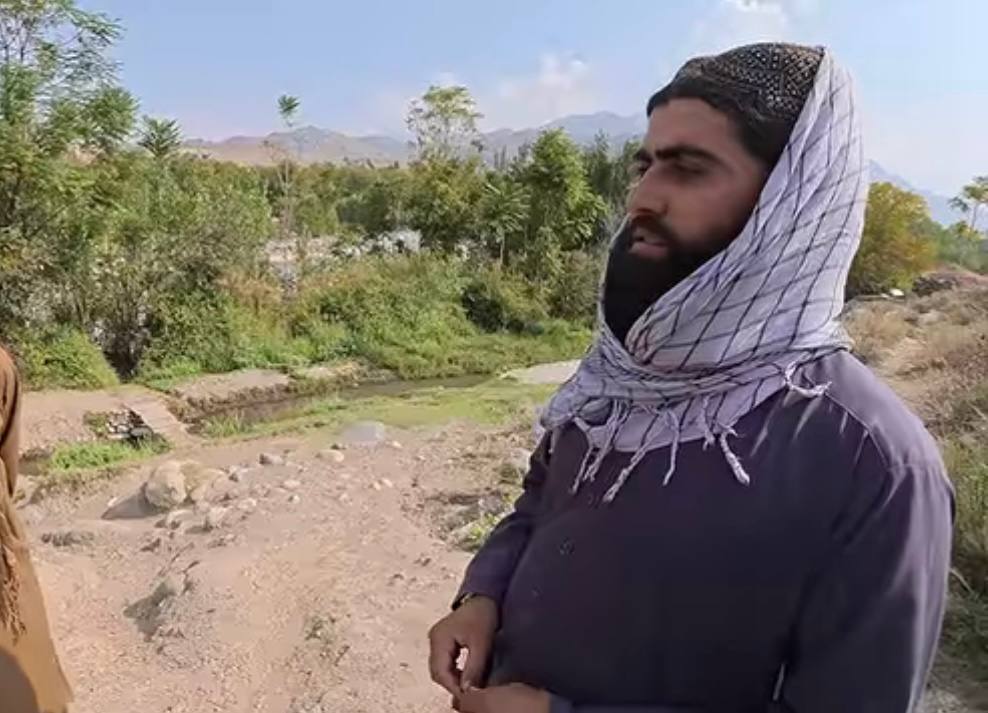
Since the founding of the group, the Taliban have been widely and continuously accused of mass killings, crimes against humanity, and torture of opponents. Over the past five years, too, despite claiming a general amnesty, the group has shot its opponents in groups with their hands tied. In the latest case, a Taliban fighter told a British tourist that he alone had killed 14 people in Panjshir. In a video the British tourist published on his YouTube channel, the interpreter says the Taliban killed these people on charges of membership in the National Resistance Front of Afghanistan (NRF), though the Taliban fighter himself does not specifically mention the NRF by name. In response to these remarks, several users and political and cultural figures have described them as a sign of war crimes and the killing of opponents by the Taliban. They described the remarks as a “small corner” of the Taliban’s crimes and stressed that such behavior amounts to a crime against humanity.
Will Bailey, a British tourist and content creator, published a video of his four-day trip to Afghanistan on his YouTube channel on Monday, September 28, 2026, titled “Four Days in the World’s Most Dangerous Country.” In the final part of the video, he speaks with a Taliban member who proudly recalls killing 14 people in Panjshir and implies that killing non-Muslims is “like killing a chicken” for him.
In the video, he is seen traveling with Taliban members to several provinces of Afghanistan, firing a Kalashnikov, and talking at Taliban checkpoints about war, weapons, personal life, marriage, and women.
In his conversation with Bailey, the Taliban member speaks of joining a religious school in Nangarhar after finishing school, and says he received military and jihadist training there. He also says he fought members of the Islamic State (ISIS) in Kunar Province and considers fighting them harder than fighting American forces. According to him, ISIS members fight based on their belief, while American forces fight to receive a salary and return home.
The Taliban fighter says in the conversation that there is a difference between killing Muslims and killing people who, in his view, do not accept Islam. Referring to this, he says killing non-Muslims is as easy for him as killing a chicken.
When the British tourist asks the Taliban fighter how many people he has personally killed so far, he replies that he once killed 14 people in Panjshir. When Bailey asks whether these people were ISIS members, the Taliban interpreter replies: “No, they were members of the National Resistance Front of Afghanistan.”
The publication of the video on social media has drawn widespread reactions. Several users have regarded it as evidence confirming claims of war crimes and the killing of civilians by the Taliban, and have alleged that the act had ethnic motives.
Nusratullah Behrang, a former university lecturer in Afghanistan, referring to the Taliban fighter’s confession of killing 14 people in Panjshir, wrote: “This is a small corner of the crimes that the rule of evil, a tribal one carried out in the name of religion, has committed across Afghanistan, especially in Panjshir, Baghlan, Badakhshan, Takhar, and the north. Being from Panjshir is the first justification for killing. If an incident occurs on a corner of Kabul’s streets, the militias of the evil rule go after the Panjshiris of that neighborhood without any document or proof. Ordinary people of Panjshir are now being collectively punished in Afghanistan. They have been driven out of everywhere. The people of Panjshir and the province of Panjshir are treated like an enemy, captives, and a conquered territory. Today, even a rural Panjshiri is not allowed to go to his own farmland without a permit.”
Ehsan Salaam, a satirist, wrote in a satirical tone: “Everyone is proud of something. This pampered aggressor is proud of killing fourteen Panjshiris in one day! This pride is no longer a warning bell; it is the bell of a human crime. The warning bell was rung four or five decades ago! The word killing no longer provokes a reaction, as if killing were equivalent to drinking water.”
Khushhal Nabizada, the former head of public health in Kabul under the previous government, wrote: “When a segment of people is dehumanized, killing them becomes easier for the perpetrators of violence, because the victim is no longer a human being with a life, family, feelings, and the right to live in their minds, but is reduced to an enemy and a target. In such an atmosphere, someone can speak calmly about killing 14 people and take pride in it.”
According to him, the people of Panjshir have faced dehumanization over the past five years. He adds: “The responsibility for creating this dangerous atmosphere does not lie solely with armed Taliban members. Those who normalize this violence, portray the victims as worthless, and weave a religious narrative around this act share responsibility for the continuation of this atmosphere.”
Meanwhile, the Hasht-e Subh Daily had also found in its investigative reports that, in the first few months of their rule over Afghanistan, the Taliban shot 17 residents of Darah district in Panjshir over the course of seven days. According to another report by the Hasht-e Subh Daily, the Taliban also shot 70 residents of Panjshir with their hands tied. Videos of these shootings have also been widely shared on social media. The Taliban claimed at the time that these people were members of the NRF, while local sources confirmed that several civilians, including students and laborers, were among those killed.
Likewise, numerous videos have been published on social media since the Taliban takeover in which civilians are seen being shot by Taliban fighters despite their pleas and requests to be spared. At that time, the group shot the majority of the members of opposing fronts after they were captured.
Two days ago, an entity calling itself the “Global Council of Panjshiris” also announced in a report that, within one year, 66 targeted killings and 340 cases of detention and torture by the Taliban had been recorded in Panjshir. The council said that more than 150 families had been forced by the Taliban to leave their homes.
According to the report, the Taliban have established more than 700 military centers and bases in Panjshir and have deployed more than 21,000 military personnel in the province.
You can read the Persian version of this report here:
اعتراف یک طالب به کشتن ۱۴ تن در پنجشیر؛ زخم سرباز یک «جنایت ضدبشری»