
Leaked documents from the Taliban’s General Directorate of Intelligence (GDI) show that the group has allocated a budget of more than 70 million Afghanis to advance a broad propaganda and media campaign, using media outlets and fake accounts to portray opposition fronts as weak, sow discord among former political leaders and their supporters, instill fear of a return to civil and ethnic war should the Taliban fall, and project the group’s invincibility. The documents also emphasize damaging the image of opponents, highlighting disputes between the Taliban and Pakistan, presenting a positive image of the Taliban regime, and managing public opinion through affiliated media outlets and fake accounts. As part of this propaganda effort, the Taliban control nearly 1,500 fake accounts across social media and other media platforms, with the group’s intelligence directorate determining the direction of these outlets’ activities. According to the document, these outlets have also been tasked with producing reports on Pakistan’s economic weaknesses and disputes among its leaders, as well as reporting on individuals living abroad who are aligned with Taliban objectives, in order to present a positive image of the group internationally.
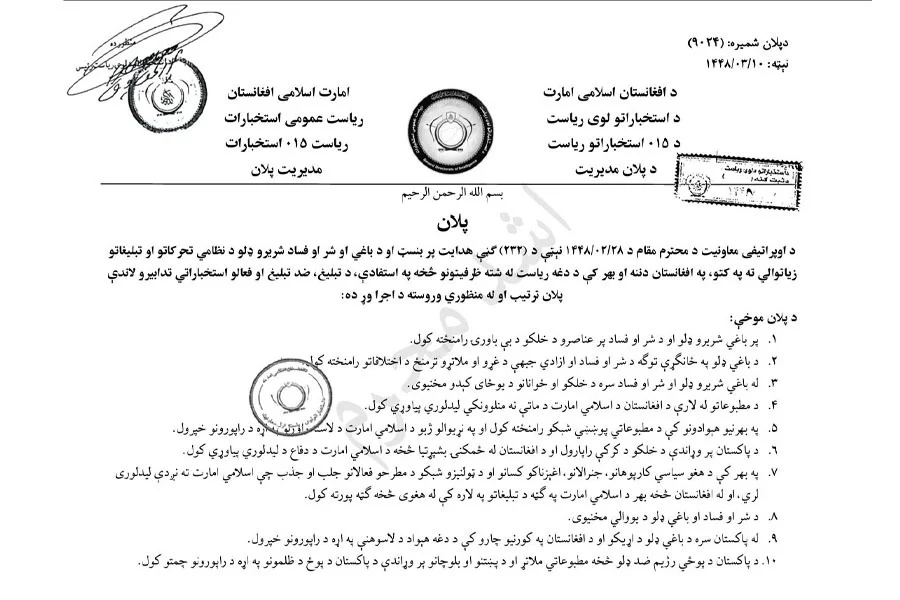
Taliban Propaganda Objectives
A copy of the tactical manual from the Operations Deputy of the Taliban’s General Directorate of Intelligence, which outlines the group’s propaganda methods under the heading “Media and User Accounts,” has recently been leaked to the public. The document states that the Taliban’s primary objective is to sow distrust among opposition forces and the military groups opposed to it.
The Taliban intelligence letter outlines ten core objectives, followed by a list of media outlets and individuals holding fake accounts. The second point states that the Taliban should use these media outlets and fake virtual users to create discord among opposition groups, particularly among opposition fronts and their supporting individuals and networks, and to exploit existing divisions.
Creating Discord Among Opponents
The third point states that false propaganda should be used to prevent the public and young people from joining anti-Taliban fronts. The fourth point emphasizes that views and propaganda aimed at demonstrating the invincibility of the Taliban regime should be published and disseminated through the media.
The fifth point states that a positive image of the Taliban regime should be presented abroad through the publication of relevant reports and material. The sixth point states that psychological operations against Pakistan, and the use of humanitarian cooperation and assistance in line with Taliban interests, should be carried out through these media outlets’ propaganda.
Using Influential Figures in Propaganda
The seventh point states that recruiting political analysts, journalists, and other influential figures, and using them to promote the Taliban regime and counter opposition propaganda, is another objective of this tactical propaganda plan.
In the eighth point, the group emphasizes that media outlets should be used to stoke and highlight divisions to prevent unity and solidarity among anti-Taliban forces.
Damaging the Image of Anti-Taliban Fronts
In the ninth point, Taliban intelligence states that reports on the relations between anti-Taliban groups, particularly anti-Taliban fronts, and Pakistan should be published and emphasized so that the public perceives these fronts as dependent on Pakistan.
The tenth point emphasizes using reports and media activities to spread propaganda against the Pakistani military establishment and to highlight existing problems and grievances there.
Propaganda Against Pakistan
One of the documents also states that reports and material should be prepared on the situation in Pakistan and the activities of anti-Taliban fronts there, particularly regarding the “Freedom Front” and related issues. It also emphasizes that reports and articles should be published on the negative consequences of divisions within Taliban leadership and their effects on the Taliban regime.
It further states that reports should be prepared on Taliban forces, and that the presence of anti-Taliban fronts in various regions should be denied and falsely portrayed. According to the document, media outlets loyal to the group should also report on the activities of regional countries related to Pakistan and Afghanistan, while highlighting Taliban activities.
Instilling Fear of Civil War
In the document, the Taliban have instructed media outlets funded through the group’s intelligence budget to prepare reports on the possibility of civil and ethnic war, suggesting that such conflicts would occur in the absence of the Taliban regime. It also states that reports should be prepared on the activities and efforts of anti-Taliban forces, portraying them negatively in public opinion.
The Taliban have also instructed media outlets under their control and affiliated with them to broadcast frequent reports and videos on television networks about the luxurious, affluent lives of leaders living abroad, while highlighting the deaths of poor families’ children in the war. According to the document, Taliban intelligence has stated that reports should be prepared on the corruption and assets of the families of former leaders and Taliban officials, to undermine public trust in former leaders.
Designated Media Outlets and Propaganda Budget
According to the document, media outlets affiliated with Taliban intelligence have been tasked with reporting on the activities of traders and their relations with Western countries. The document names Yad Channel, Masalas Channel, Hijaz Farsi, Sadai Hindukush, Al-Marsad, Afaq Channel, Naqab Channel, Green Media, Radio Hurriyat, Tolo TV, One TV, Shamshad TV, Ariana TV, and Parda-e Naqab Pi-Channel as the media outlets tasked with publishing this content. A budget of 30 million Afghanis has been allocated for these outlets.
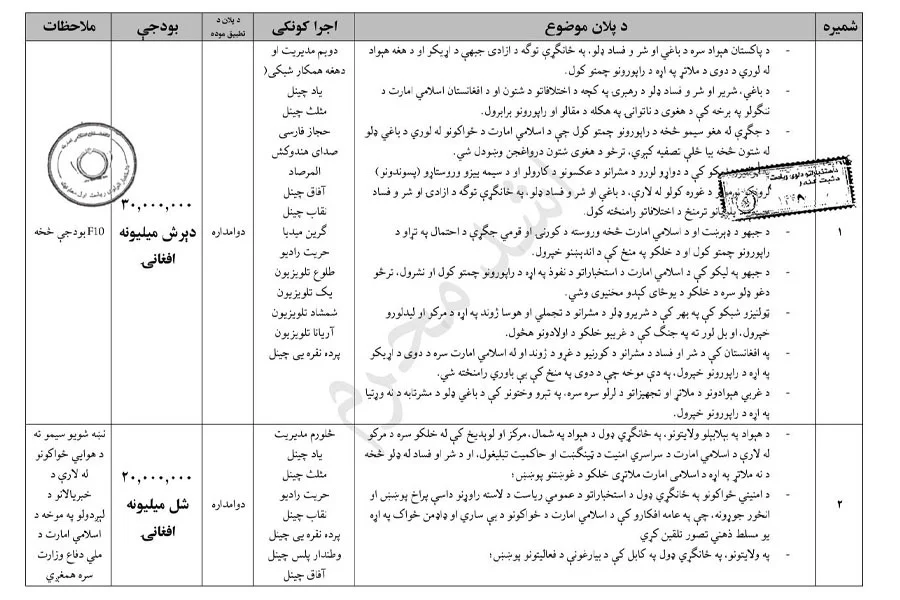
The Taliban have also stated that reports should be prepared and published on money and foreign assistance in the security and political sectors, as well as on the activities and propaganda of opponents and their efforts to create instability and insecurity in the country.
Taliban activities are also to be covered in the media, with reports prepared and published on television networks and other outlets to counter opposition propaganda and showcase Taliban performance. According to the document, specific media outlets and pages have been assigned responsibility for promoting and publishing content under each of these directives.
This part of the Taliban’s propaganda effort is handled by Helmand Channel, Yad Channel, Masalas Channel, Radio Hurriyat, Naqab Channel, Parda-e Naqab Pi-Channel, Watandar Pas Channel, and Afaq Channel, with a budget of 20 million Afghanis.
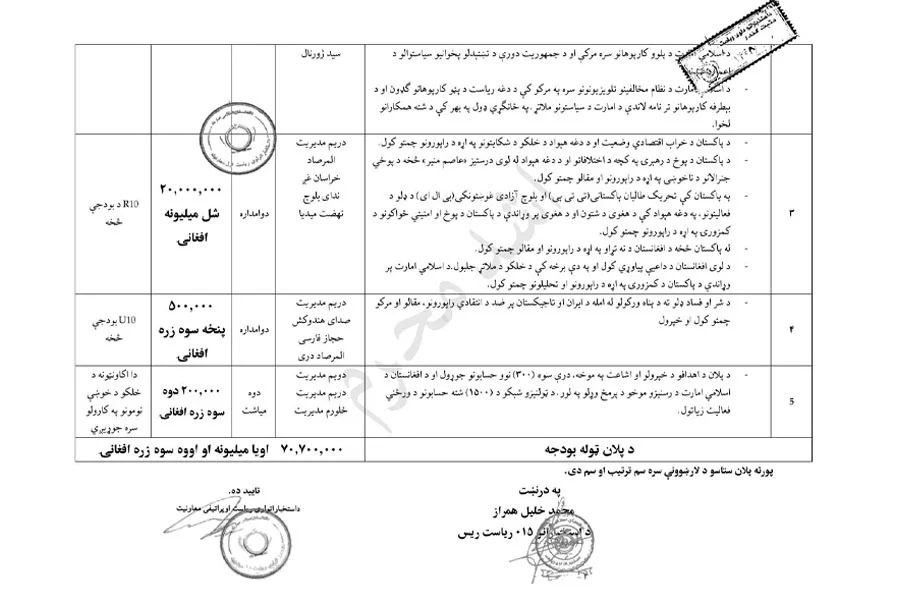
Another part of the document states that reports should be prepared on the disputes within Pakistan and the country’s poor economic situation, portraying Asim Munir, Chief of Army Staff of Pakistan, as being at odds with Pakistani officials. It also states that reports should be prepared on Tehrik-i-Taliban Pakistan (TTP), the Baloch Liberation Army (BLA), and political and security developments in Pakistan and related issues.
The document further specifies that reports and analysis should be prepared on Taliban-Pakistan relations and the disputes between the two sides. Responsibility for this section rests with Radio Hindukush, Hijaz Farsi, and Almas Dari, with a budget of 500,000 Afghanis allocated for it.
The document also states that critical radio reports and other media content should be prepared and published on issues related to Iran and Tajikistan. A budget of 200,000 Afghanis for three months has been allocated for this section, bringing the plan’s total budget to 70.7 million Afghanis.
Fake Accounts and the Intelligence Media Network
A letter from Directorate 015 of the Taliban’s General Directorate of Intelligence, which was leaked to the media, describes a broad campaign to discredit the reporting of independent media outlets. The letter shows that Taliban intelligence controls more than 1,500 fake accounts and media outlets, with the group’s media figures each managing several fake accounts and newly established outlets.
Mohammad Jawad Sargar operates on social media under his main account, “Jawad Sargar,” as well as fake accounts under the names “En Naser Hashemi,” “Madina Panjsheri,” “Nilofar Rahmani,” “Najla Panjsheri,” “Maryam Panjsheri,” and “Tajikistan International Fori.”
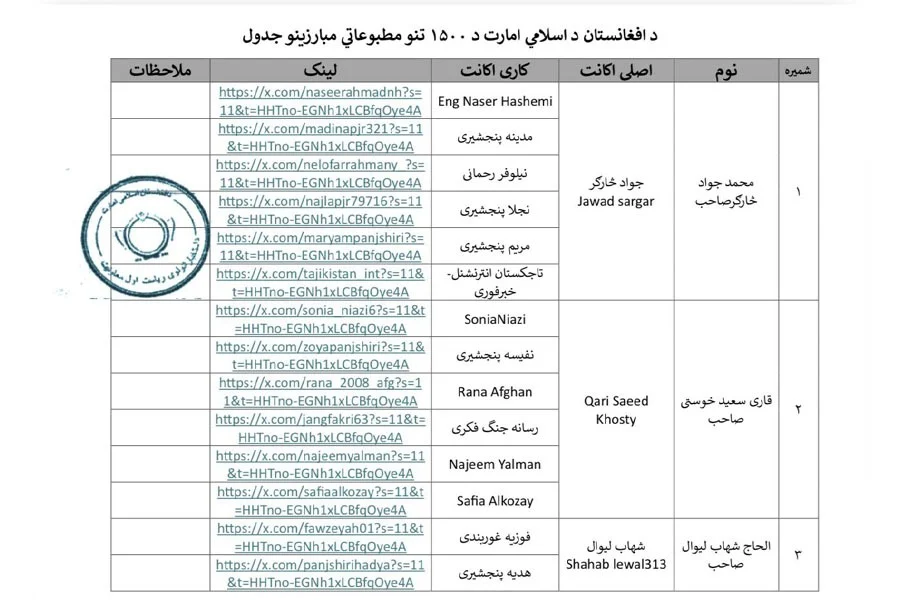
Qari Saeed Khosty, in addition to his personal account, “Qari Saeed Khosty,” also holds other accounts. “SoniaNiazi,” “Nafisa Panjsheri,” “Rana Afghan,” “Resana-e Jang-e Fikri,” “Najeem Yalman,” and “Savia Alkozay” are among the other accounts, most of which operate on social media under female names and, according to the document, receive resources and information from Taliban intelligence.
Taliban Propaganda Over the Past Five Years
Over the past five years, the Taliban have expanded their propaganda methods by creating fake accounts under female names. The group has countered news, information, and reports published by independent media outlets by establishing various media platforms, consistently seeking to distort public perception by presenting an outwardly popular image.
You can read the Persian version of this report here:
تاکتیک تبلیغاتی طالبان؛ برجستهسازی اختلافات جبههها و القای ترس از جنگ داخلی