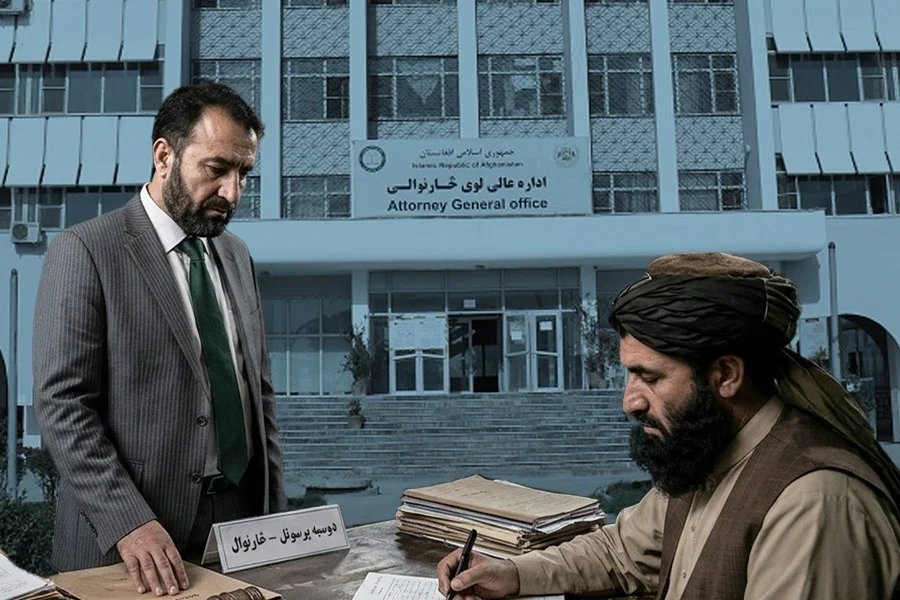
Some former prosecutors of the previous government who work in the Directorate for Supervision and Prosecution of Taliban Decrees and Orders say the Taliban have intensified the process of dismissing them and replacing them with Taliban fighters, on the verbal order of Hibatullah Akhundzada, the group’s leader. The Hasht-e Subh Daily also has a letter showing that 11 former prosecutors in six provinces have been dismissed from their duties without any reason being given. Sources say several Taliban governors and intelligence officials complained to Akhundzada and claimed that these prosecutors were fabricating cases against officials of the group on charges of involvement in corruption.
Prosecutors of the previous government who worked in the Directorate for Supervision and Prosecution of Taliban Decrees and Orders have expressed concern about their dismissal by the group. At the same time, a letter has come into the possession of the Hasht-e Subh Daily showing that 11 prosecutors in the provinces of Daikundi, Bamyan, Nangarhar, Kapisa, Nuristan and Maidan Wardak have been dismissed from their duties. According to sources, the process of dismissing prosecutors and the remaining employees of the previous government in this directorate is continuing.
One former prosecutor, who has also worked under the Taliban regime, says: “A committee has been established under the supervision of the deputy for finance and administration of the General Directorate for Supervision and Prosecution of Taliban Decrees and Orders, which reviews employees’ service records and appoints new people [Taliban fighters] in place of the former staff. This committee leaves 40 to 50 former employees without a livelihood every week.”
According to him, several former prosecutors who worked in this Taliban-controlled institution have been dismissed from their duties on the verbal order of Akhundzada, the group’s Supreme Leader. He claims that Akhundzada has ordered that all administrative and professional personnel of the previous government who work within the Taliban’s supervision and prosecution directorate be dismissed from their duties and not be hired by any department.
This former prosecutor adds: “The reason for this decision is that the Taliban’s General Director of Intelligence and the group’s Chief Justice went to Akhundzada in Kandahar and told him that the personnel of the previous government’s Attorney General’s Office (AGO) treat Taliban members with spite and animosity and fabricate cases against the mujahideen.”
Another former prosecutor of the previous government says: “The Taliban committee has been formed under the chairmanship of Shah Mohammad Shahid, the deputy for finance and administration. Ezatullah Haqqani, the civil deputy, the military deputy, and the head of personnel affairs are also members of this committee.”
Another prosecutor, who was dismissed from his post on the order of the Taliban Supreme Leader, says that Aminullah Obaid, the Taliban’s current governor of Kabul and the group’s former governor in Daikundi, embezzled 8.1 million Afghanis worth of aid from the Afghan Red Crescent Society (ARCS), including flour, cooking oil, tents and blankets. According to this prosecutor, the prosecutors had prepared the case file and sent it to the capital.
This former prosecutor adds that Taliban governors, including Obaid, complained about the previous government’s prosecutors in a meeting with Akhundzada in Kandahar and claimed that they were fabricating cases against members of the group. According to him, following these complaints, Akhundzada issued a verbal order to dismiss the previous government’s prosecutors. He says that the removal of Shamsuddin Shariati from the leadership of the Taliban’s supervision and prosecution directorate, and his appointment as the group’s governor in Uruzgan, also took place within this framework.
Findings of a Hasht-e Subh Daily report also show that Aminullah Obaid allocated at least 50 tonnes of wheat and humanitarian aid amounting to 20 cargo trucks, which had been intended for residents of Daikundi, to his friends and relatives in the provinces of Kabul, Ghor, Maidan Wardak, Farah and Uruzgan.
Meanwhile, a member of the family of one of the previous government’s prosecutors, who is worried about the dismissal of his relative, says that the Taliban are hiring people affiliated with themselves in place of these employees.
Expressing concern about the livelihood of the affected families, he adds: “Where should we go and whose door should we knock on? How much misery must we endure for a morsel of bread? There is no one to hear the voices of so many oppressed, innocent, and helpless people. Since the day this damned group came to power, it has done nothing but inflict injustice and cruelty on the poor people.”
On the other hand, some people who passed the recruitment exam of the Taliban’s Directorate for Supervision and Prosecution of Decrees and Orders say that after their work history was reviewed and it was found that they had worked in this department under the previous government, they were declared unsuccessful despite having passed. According to them, these people were told that Akhundzada has ordered that the previous government’s prosecutors must not be hired in this department under any circumstances.
These individuals add that some employees of the directorate have told them that the Taliban’s decision is for the remaining employees of the previous government to be gradually replaced with members of the group. They stress that the Taliban are gradually continuing the process of dismissing the remaining employees of the previous government and appointing people affiliated with the group.
Earlier, sources in one of the Taliban-controlled institutions that has close ties with the group had also confirmed that the Taliban are gradually dismissing all employees of the previous government, including university lecturers, and hiring Taliban members and people affiliated with and close to the group in their place.
Akhundzada, the Taliban Supreme Leader, has changed the nature of the Attorney General’s Office from a judicial and legal institution into a supervisory body whose duty is limited to monitoring the implementation of his decrees. The former Attorney General’s Office now operates under the name “General Directorate for Supervision and Prosecution of Orders and Decrees” and is responsible for overseeing the observance and implementation of Akhundzada’s decrees.
According to letters that were previously obtained by the Hasht-e Subh Daily, this Taliban-controlled institution demands clarification from the group’s officials on how the Taliban Supreme Leader’s decrees are being implemented. Issuing arrest warrants based on the order of the Taliban Supreme Leader, supervising detention facilities, transferring prisoners from abroad to Afghanistan, and extraditing suspects are listed as other duties of this institution. Proposing, drafting, amending, and annulling Taliban documents are also considered among the institution’s core responsibilities.
You can read the Persian version of this report here:
تصفیه ایدیولوژیک طالبان؛ دادستانهای حکومت پیشین چگونه برکنار میشوند؟