
Summary
In the wake of the Taliban’s takeover of Afghanistan in August 2021, the nature of its communication strategy has undergone a radical shift. While the group once relied on underground media and religious sermons, today, they operate a digital propaganda machine that strategically leverages social media platforms, most notably X (formerly Twitter). This transformation has not only allowed them to reach wider audiences but also to mask repression under the guise of good governance and ideological consistency. This investigative piece unpacks a network of 78 out of the initial 120 accounts suspected of being bot accounts attributed to the Taliban’s online influence strategy. At least 42 accounts were observed to have been suspended or stopped their activities. Through linguistic patterns, identity anomalies, behavioural data, and timeline synchronisation, the article reveals a concerted campaign to control narrative terrain, particularly around negative promotion of the Taliban.
What the Data Reveals?
Using a scraped dataset from X (formerly Twitter), collected via Outscraper on 2 May 2025, we identified 78 unique accounts operating in a strikingly similar manner. The initial phase of research included at least 120 accounts, many of which are now either suspended or stopped being active. These accounts exhibit abnormal behaviour in tweet/post volume, timing, content, and profile construction. Over 70 of these use the surname “Panjshiri,” despite the region’s well-documented opposition to the Taliban. Even more curiously, the majority of these accounts are managed either by one or several individuals presenting themselves as ethnic Tajiks. The implications are clear—identity fabrication is central to this digital strategy.
A significant cluster of accounts formed between October 2022 and April 2023, showing signs of batch creation, and over 60% of accounts were created within a six-month window, hinting at planned digital mobilisation.
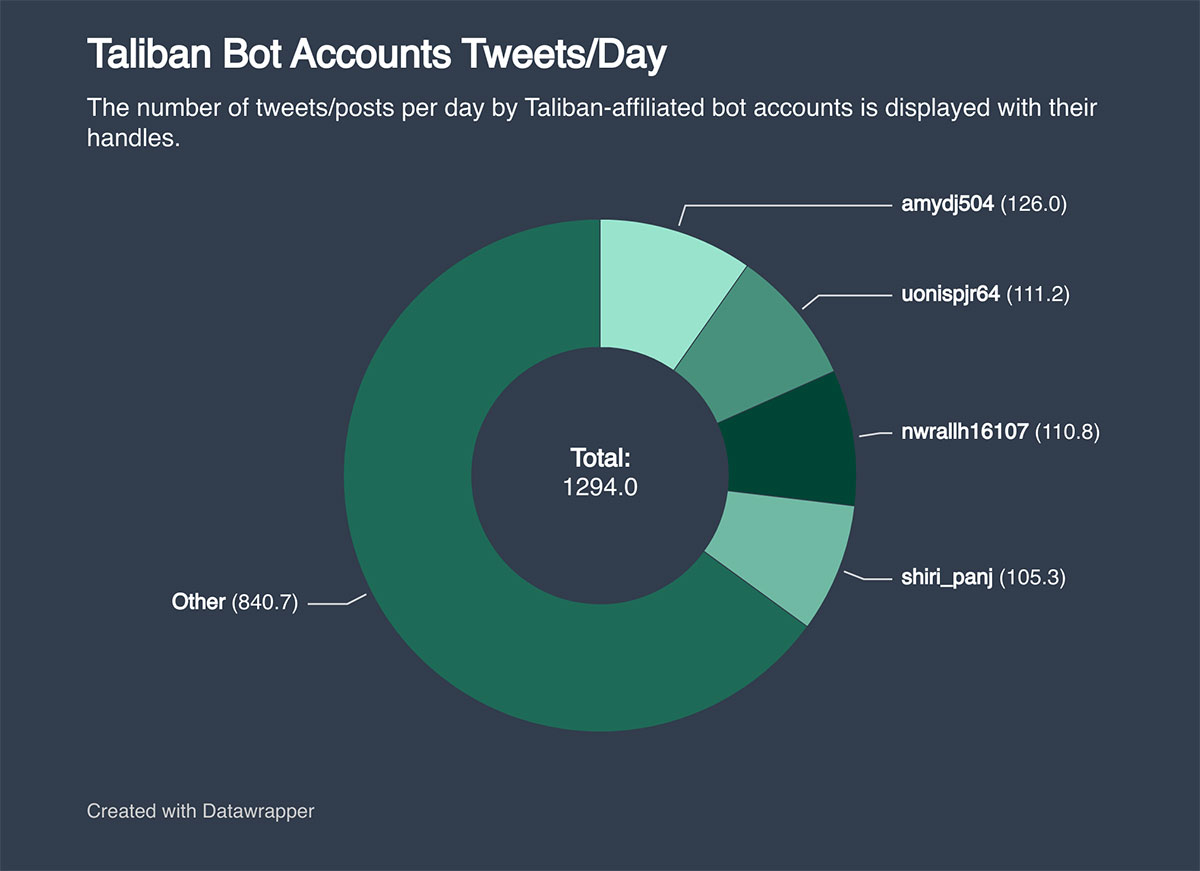
On average, accounts tweeted 16.6 times per day, with the most active account averaging 126 tweets daily. In some cases, over 70,000 tweets were published within less than two years. These are not lone individuals engaging in political discussion; this is structured, possibly semi-automated amplification.
The Weaponisation of the ‘Panjshiri’ identity
Panjshir has become synonymous with anti-Taliban sentiment. Known historically as the stronghold of the Northern Alliance, and later the National Resistance Front of Afghanistan (NRF), it stands as both a symbolic and strategic obstacle to Taliban legitimacy. In co-opting ‘Panjshiri’ surnames and wrapping them in nationalistic or Islamic rhetoric, these accounts appear designed to confuse both domestic and international observers.
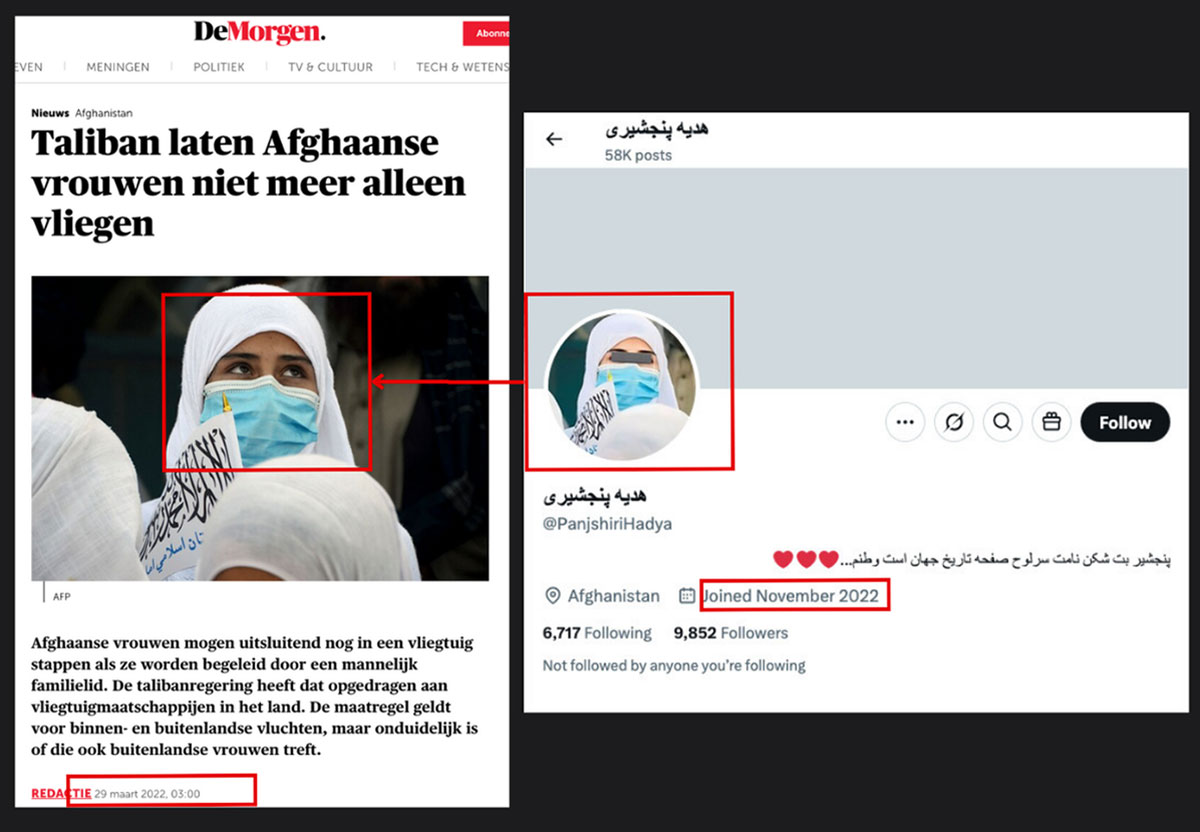
Accounts like @PanjshiriHadya, @samiyapjr, and @nwrallh16107 cloak themselves in the ‘Panjshiri’ identity while distributing Taliban-aligned content. These accounts prominently feature names like “Hadya,” “Sumiya,” and “Farzana”, all female names, despite the Taliban’s well-documented repression of women. This is more than irony; it is manipulation aimed at constructing an illusion of inclusive governance.
This strategy also serves a second purpose to obscure search engine results and skew online sentiment analysis. For instance, if a journalist or analyst searches for “انفجار در پروان,” which translates to “explosion in Parwan”, the presence of tens of positive Taliban-aligned tweets with the same keyword, sometimes as hashtags, floods the information space, making it harder to surface genuine content.
Hashtag Hijack, Timeline Coordination, and Disruption
One of the clearest tactics used by this network is temporal keyword hijacking. In a telling case, the NRF issued a statement on a Taliban outpost being attacked in Panjshir. Within a few minutes, accounts in this dataset began posting about Panjshir’s natural beauty, its landscape, or vague pro-governance development updates. Although these tweets appeared unrelated to the claimed attack, they were tagged with the word “Panjshir” in Farsi to contaminate search feeds.
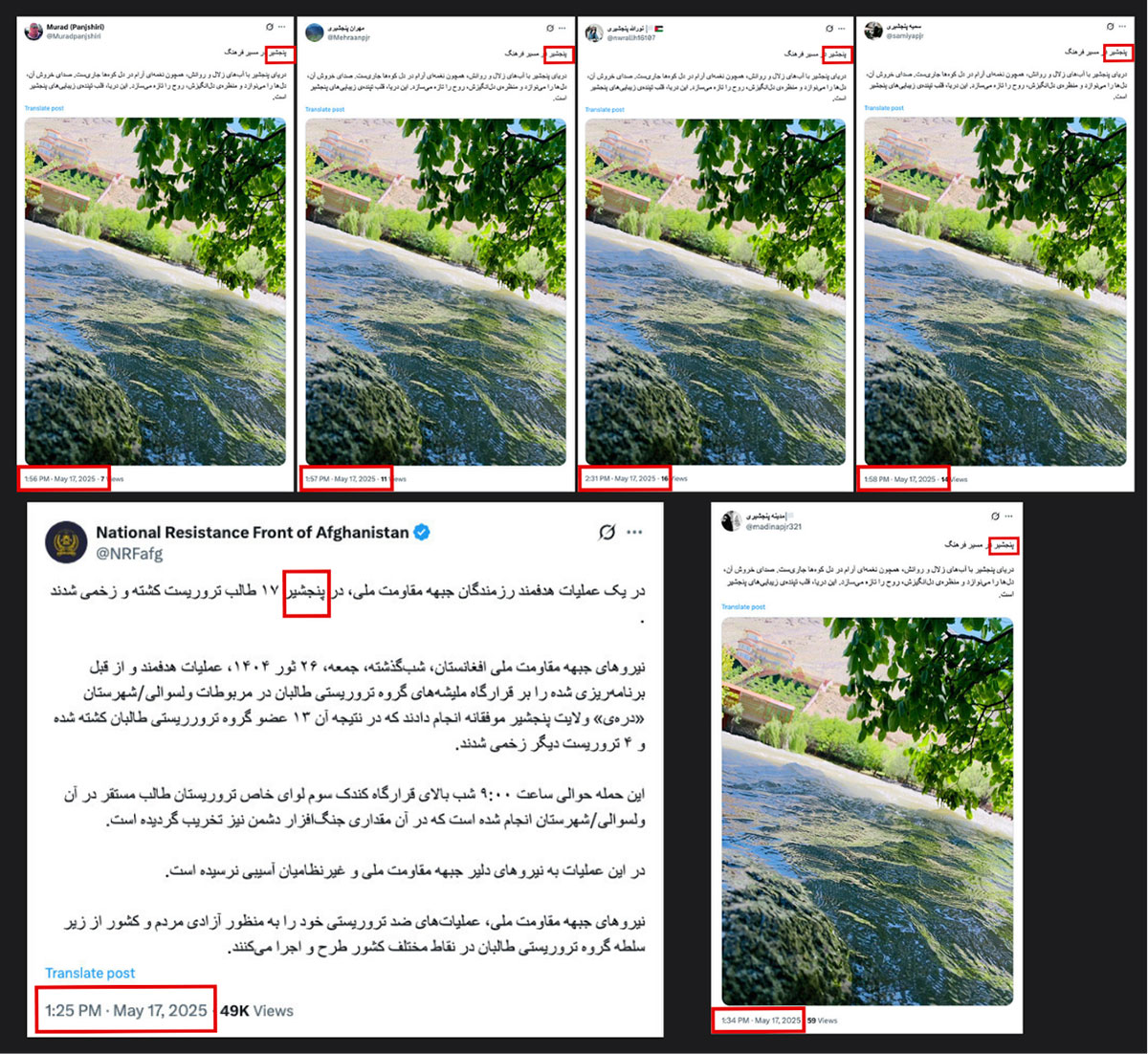
This approach mirrors tactics seen in other authoritarian digital campaigns. In Myanmar, Russia, and Iran, bot armies have deployed similar keyword flooding tactics during uprisings or sensitive political moments. The Taliban appear to have adopted a similar strategy.
Interestingly, the duplicated content among multiple accounts suggests either central scripting or coordinated behaviour by multiple operators. In some cases, image memes and poetry verses praising the Taliban or Islam were shared across accounts within seconds of each other, sometimes with near-identical wording.
One of the more chilling observations is the uniformity in tone. These accounts rarely, if ever, express personal sentiment. There is no grief, joy, anger, or humour. Instead, posts are comprised of religious quotes, promotional material for Taliban governance, Islamic calls to modesty (particularly targeting women), and natural landscape or cityscapes. The tweet content ranges from glorifying Taliban fighters to applauding new construction projects, always reinforcing the image of an efficient, righteous regime.
Accounts have been found to excessively promote the hijab, religious education, and infrastructural development, especially in contentious provinces. The use of hashtags like #اتلان (heroes) and #حفظه_الله (May God protect him) is commonly used to reference Taliban figures, painting them as noble warriors rather than political oppressors.
Taliban’s Media Evolution
The Taliban’s social media sophistication is not accidental. Researchers from institutions like George Washington University’s Program on Extremism and the Digital Forensic Research Lab have traced this evolution; post-2021, the Taliban moved from WhatsApp and Telegram to X (formerly Twitter) for more international reach. They strategically softened their tone, pushing governance stories, poetry, and religious wisdom instead of brutal punishments. The Taliban also avoid official branding in bot accounts but align them ideologically, allowing plausible deniability.
Pro-Taliban digital influencers, while often lacking formal affiliation with the Taliban, appear to receive informal backing. This is evident across platforms such as X, where accounts sympathetic to the regime demonstrate a marked increase in followers, reach, and engagement. Many of these accounts, ranging from bots to real users, interact within tightly connected circles, following and amplifying each other’s posts. Some even explicitly call for mutual support, mimicking grassroots mobilisation. Though rudimentary, this networked approach remains effective. It enables the Taliban to amplify official narratives, drown out dissent, and circumvent platform restrictions through the use of loosely affiliated actors.
These developments should not be seen in isolation. The Taliban are learning from other digital authoritarian regimes, adapting methods that work, whether in Turkey, Saudi Arabia, or Russia, and refining them for the Afghan context.
Illusion Projection on Gender, Ethnicity, and Public Legitimacy
By simulating female users from a Tajik stronghold, the Taliban are attempting a digital sleight of hand. This tactic is particularly deceptive in a regime where women are banned from education, employment, and public life. What does it mean when a regime that prevents women from tweeting in real life creates digital women who flood X with pro-Taliban content?
Equally important is the linguistic contradiction. Panjshir is a Farsi-speaking province, yet the majority of these “Panjshiri” bot accounts tweet in Pashto. This not only undercuts their authenticity but signals a failure to even construct believable personas, indicative that their main target audience might not even be the Afghan population, but international observers or algorithmic filters.
What emerges from this analysis is a sophisticated and adaptive effort to create an “Algorithmic Emirate.” A world where visibility equals legitimacy, and silence is buried under floods of hashtags, bots, and slogans. The Taliban are not simply waging a war against journalists or human rights activists; they are waging a war against the very architecture of truth.
By deploying fabricated identities, simulating public consensus, and hijacking real-time discourse, the Taliban’s digital operatives have weaponised social media’s weaknesses to suppress criticism, glorify control, and erase dissent. The challenge for observers, analysts, and platforms is no longer just identifying disinformation, but dismantling the networks designed to algorithmically normalise it.
In this information war, the battlefield is the feed. And the Taliban, it seems, are not just fighting—they are optimising.
Limitations and Areas for Further Research
As an independent OSINT investigator and analyst, I recognise that while this analysis provides critical insight into the structure and behaviour of Taliban-linked bot accounts, it remains limited in scope and calls for a more comprehensive investigation. Key areas warranting deeper exploration include network analysis to map retweet patterns and follower overlaps that would visually expose the coordinated machinery behind these accounts. Sentiment analysis could help measure the polarity and trajectory of Taliban-related keywords, especially during moments of political tension. Stylometric techniques might reveal whether multiple profiles are authored by the same operators, while visual hash analysis could link image reuse across platforms to broader Taliban media infrastructure.
Moreover, comparing these tactics to those used by authoritarian regimes in countries like Russia, Iran, and Myanmar, where bot armies have deployed keyword flooding during uprisings or sensitive events, would help determine whether the Taliban are innovating or merely replicating established playbooks. Lastly, this investigation focuses solely on X (formerly Twitter). Given the Taliban’s increasing presence on Telegram, TikTok, Facebook, and YouTube, future research should trace whether similar behavioural patterns and influence networks appear across these platforms.
You can read the Persian version of this investigative report here:
شبکه سازمانیافته رباتهای طالبان؛ بازی با هویت، زبان و روایت در ایکس