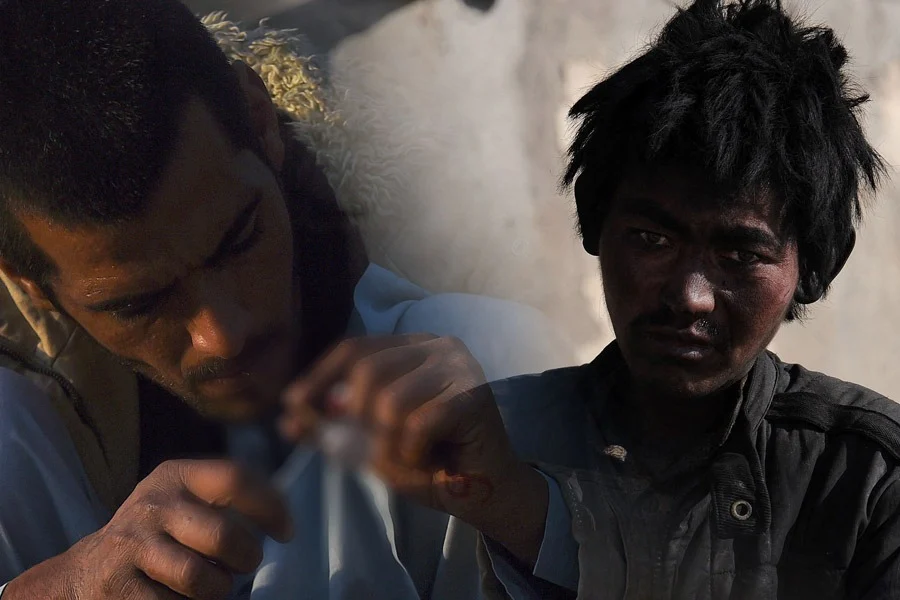
This report includes interviews with several teenagers who have become addicted to drugs. Most of them say they first started using drugs at the encouragement of friends or people close to them and became dependent after a while. They say economic hardship, unemployment, and difficult living conditions also pushed them toward drug use. Some of these teenagers say they used “Tablet K” to work more and reduce fatigue, but they got used to it after a short time and eventually became addicted.
Some of them say that at first they believed using these substances gave them more energy for work and reduced their fatigue, but over time their consumption increased and quitting became difficult for them.
Nawid (pseudonym), a 17-year-old, says he became addicted after one of his friends encouraged him to use “Tablet K.” He says he worked as a driver’s assistant for a vehicle driver, and his friend told him that taking this tablet would relieve his fatigue.
Nawid says: “I am a driver’s assistant. I left school when I was in grade eight. My friend said he would give me a tablet that would make me happy, relieve my tiredness, and help me learn my lessons faster. When I took it, I no longer felt tired. I used it for three days and then got used to it. It has now been three years that I have been using powder and crystal meth. Although I want to quit drugs, people tell very bad stories about treatment centers, and I am afraid.”
He adds: “We buy drugs and Tablet K from child street vendors and shoe-shine boys.”
Munir (pseudonym), 16, says he first used drugs at the encouragement of one of his friends and afterward started using them with a group of friends his own age. He says: “To cover the cost of drugs, I turned to selling narcotics. For four years now, I have been both using and selling drugs. I got drugs from my friend for the first time, and to pay for them, I stole.”
Jawid (pseudonym), 15, also says he became addicted after his friends encouraged him to use drugs, and he now covers part of his family’s expenses by selling them.
The teenager says: “Two years ago, one night, I was a guest at a friend’s house along with five other friends. That same night, I used drugs for the first time and got used to it. For two years now, I have been paying the household expenses by selling drugs. I get the drugs from a company, prepare them, and sell them.”
He adds: “I wanted to study, but I did not know that one night at a party could change the course of my life.”
Abdullah (pseudonym), 15, says his family faces economic problems and that he has stolen many times to pay for drugs. He says that as a result of his addiction and the behavior that came with it, he repeatedly clashed with his family members, and his father eventually kicked him out of the house.
Abdullah says: “I caused fights and chaos at home, and my family had become tired of me. Our economic situation is not good. I stole to pay for drugs. My father kicked me out of the house. I am very regretful, and I want to quit drugs.”
Ebrahim (pseudonym) says his employer encouraged him and several other workers to use drugs and was the cause of the start of his addiction. He says: “I work in a factory. Several other children work there too. Our employer uses hashish, and so that we would work more without feeling tired, he encouraged us to use drugs. We started with cigarettes, then hashish, then crystal meth and Tablet K.”
This comes as several recovered addicts and their families claimed some time ago that in some drug treatment centers in Kandahar, instead of preventing drug use, conditions have been created for patients to access and buy these substances. They said that in some cases, staff at the treatment centers supply drugs to patients or arrange the buying and selling of these substances inside the centers.
You can read the Persian version of this report here:
دسترسی آسان به مواد مخدر؛ نوجوانان چگونه در دام اعتیاد میافتند؟