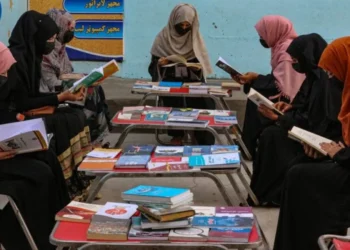
It’s 8:15 a.m., and driven by a deep longing after three years away from school, I turn onto the road that leads to the place where I studied for eight years. The school bell rings at eight sharp. Girls in black uniforms and long white headscarves are entering the school in pairs and small groups. I walk in with one of them.
As soon as I step inside, the attendant at the gate calls me over for a security check. I recognize her voice before I even see her face—it’s Aunt Jamila. I can hardly believe it—how much she’s aged. Wisps of her white hair peek out from under her long woolen shawl. Her face is more lined than the last time I saw her, but her eyes remain bright and youthful. I greet her warmly, but she replies coldly, as if she doesn’t remember me. I’m not hurt. It’s been more than three years since we saw each other daily. There were many students back then. And perhaps I look different now, too. There’s no reason she should remember me.
She lightly taps my handbag a few times for the search and, out of curiosity, asks, “Why are you here? What brought you back?”
I search for an answer beyond just missing the place. I try to form a proper response in my head, but before I can gather my thoughts, a group of eight girls dressed in black hijabs, their faces covered with masks, walks in. My train of thought scatters.
All the girls clearly know the attendant—whom they warmly call Auntie. Their casual greetings make it obvious:
“How was your winter?”
“Happy New Year!”
“Is Ramadan going well?”
The conversation grows lively. With an open smile, the attendant tells them that in the past few days, some of their classmates had come to school as well, trying to find out whether they’d be allowed to resume seventh grade this year. She says the girls went to the principal, hoping to hear good news. The girls’ excitement is clear from their sparkling eyes and slightly parted lips as they wait eagerly for more.
One girl jumps in quickly, “What did the principal say?”
Another adds cheekily, “The principal’s always got something wrong with her head. Who knows what she said this time!”
The attendant replies, “The principal played politics with them. She said, ‘What makes you any different from the other girls? Get out quickly—inspectors are coming. Listen for updates. We’ll announce it when there’s news.’”
Before she finishes, one of the girls says, “She’s right. If they reopen school for girls above sixth grade, it’ll spread like wildfire.”
Another girl, in a low voice, mutters, “Let’s not even go to the office. We came for nothing.”
After those words, their chatter fades into silence. The attendant then adds, “Over the winter, a delegation from the Education Ministry came and collected all the textbooks for sixth grade and above.”
I leave the group and the security checkpoint behind, stepping into the school courtyard. Suddenly, a wave of memories crashes over me. A smile tinged with fear forms on my face. Our school—the largest girls’ school in the city—is so vast that if you’re not familiar with it, you could easily get lost. But my friends and I had walked every inch of it, studied here, played here, laughed, and sometimes cried here. We’d leaped in joy and shed tears of happiness beneath the towering pine and poplar trees that have stood here for decades.
This is where I first wore my school uniform. Where I spent eight full years. I remember clearly how, in the early years, I longed to grow up quickly—so I could be like the older girls who played volleyball and basketball, sending the ball effortlessly through the net. But that dream never came true. I grew taller, but my hands never quite reached the ball to score.
The voices of a group of girls entering the courtyard snap me out of my thoughts. For a brief moment, I feel utterly alone in that vast space. The stream of memories suddenly stops, and the school grounds feel unfamiliar. The once vibrant and colorful atmosphere turns grey before my eyes.
I don’t know why—maybe because no one here knows me anymore. My friends and classmates are gone. I feel like a first grader who doesn’t know which classroom is hers, too scared to step inside.
I take a few steps back. I decide not to go into the school building.
I turn away, leaving all those sweet, beautiful—and even painful—memories in the school courtyard, entrusted to it until the day I return, side by side with my old classmates and friends.
You can read the Persian version of this Afghan woman’s story here:
صحن مکتب؛ یادگار خاطرات شیرینی که پایان نیافت | روزنامه ۸صبح