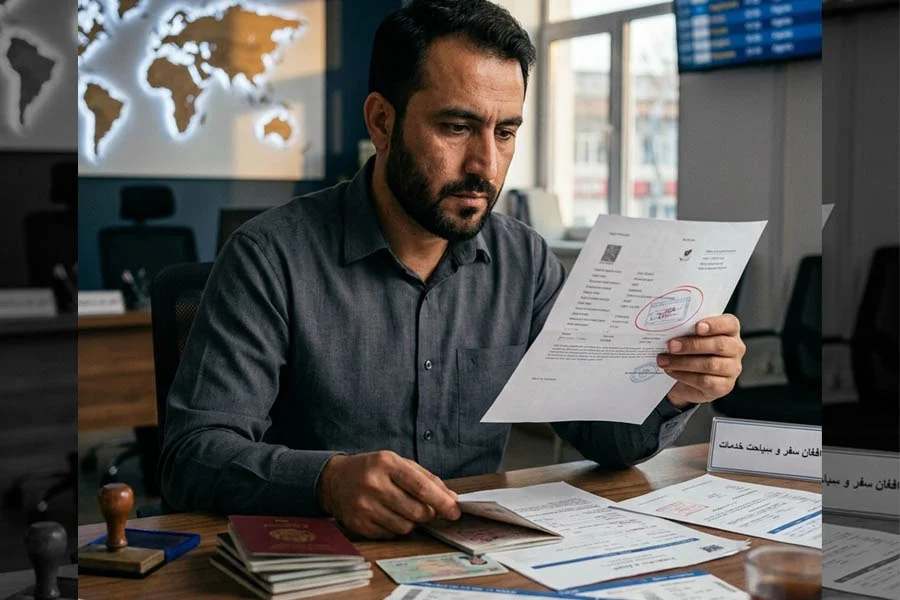
Amid continuing complaints and widespread public concern over fraud by certain travel and educational service companies, sources are revealing the mafia-like nature this trend has taken on. According to sources, a number of these companies obtain money from visa applicants, particularly students interested in continuing their education outside Afghanistan, by offering fake admission offers from universities that do not actually exist, and there is no clear authority to address these fraud cases. Sources add that whenever complaints against a company increase, its officials launch a new company under a different name and use the same method to deceive young people, earning thousands of dollars in the process. They emphasize that these companies have so far not refunded applicants’ money and have kept them wandering for months while pursuing their complaints in Taliban courts.
Credible sources with experience working at these companies told the Hasht-e Subh Daily that a large number of these companies use various tricks to take money from people, especially those seeking to study abroad, under the guise of obtaining visas and admission letters from foreign universities, while the documents they show applicants are forged and fabricated by the companies themselves. According to sources, applicants realize only after paying hundreds of dollars that the offer presented to them was not valid. They then try to get their money back, but according to sources, because this process has become mafia-like and due to the involvement of certain Taliban bodies and corruption in the group’s courts, they are unable to recover their money.
One source, who asked that his name not be mentioned in the report due to security concerns, said he resigned from his position because of what he considers violations and deception of applicants. According to him, some companies charged applicants around 500 dollars to prepare a study admission letter, but in reality they prepared these fake offers themselves and presented them to applicants. He emphasized that after months of follow-up, applicants would not receive a convincing response, and their cases would eventually end up in disputes and Taliban courts. According to this source, some companies took 500 US dollars from applicants in exchange for a fake study offer from Ireland, while no such scholarship had ever been announced by Ireland.
This source added: “Many applicants, upon seeing the fake study offers, assumed the documents were genuine and paid the fees on that basis, when in fact there was no such reality.”
According to him, the number of genuine study offers from universities is very small, and only a limited number of students are actually accepted. He added that in some cases, the companies themselves fell into the trap of fake study offers from universities that did not exist at all in the country in question.
Sources add regarding another case: “People who are in contact with companies from abroad defrauded a company in one instance. The university did not exist at all, but a study offer was sent to the applicant, and money was taken from the company. The company had also received money from the applicant. When it became clear the university was fake, the company did not refund the applicant’s money and said the money should be recovered from the university, when that university did not exist abroad at all.”
One former employee of these companies said: “People are told that the offer is genuine, and they pay money to obtain it. But in some cases, the offer is fake or has conditions the applicant is not informed of. When the visa is rejected, the company does not take responsibility and cites the contract. This is when disputes begin, and people demand their money back.”
Definite Promise, but Only a Possible Visa
Sources also emphasize that some companies, to attract customers, promise applicants definite success in the visa process, while the final decision on issuing a visa rests with the embassy of the destination country.
One source said: “For marketing purposes, some companies promise a hundred percent visa; but when the visa does not come through, they say, ‘ Read the contract; we did not guarantee it.” He said that in some cases, applicants applied for visas at an inappropriate time, but companies did not inform them of the possibility of rejection before they paid the embassy fees.
Referring to cases related to Turkey, this source said hundreds of applicants, after paying various fees including company service fees and embassy fees, have faced visa application rejections.
The source added: “About 700 Turkish visa applications were rejected. The companies knew the visas would not be issued, but they still took people’s money. The company takes 200 dollars, the embassy takes 213 dollars, three thousand Afghanis for a medical examination, and 100 dollars is also taken for translation. A person has to pay all this just to submit a visa application, while it is not at all clear whether they will ultimately receive the visa or not.”
Dispute Over Refunds
Sources say another problem with these companies is their failure to honor promises to refund applicants’ money. According to them, applicants are initially told that if they are not accepted by the university, their money will be refunded; but in numerous cases, after a university application is rejected, applicants’ money has not been paid back. According to sources, in one case involving 36 applicants, only three received part of their money back, while the others were told that their fees would be refunded by the university.
Sources add that in such cases, applicants are left in limbo between the educational service companies and the universities, not knowing which party is responsible for refunding their money.
Companies Changing Names After Client Complaints
Sources say that some educational service companies, after becoming notorious or facing a rise in complaints, continue their activities under a different name.
One source said: “When a company becomes notorious, another company is created under a new name, and they begin their activities again.” He calls on the Taliban regime to more closely scrutinize the operations of educational service and student placement companies, and to take action against companies that take money from applicants but fail to provide the promised services. This source also urges applicants not to be influenced by companies’ advertising and to carefully research the visa process and the credibility of universities before paying any fees, so that their money is not wasted.
You can read the Persian version of this report here:
کلاهبرداری شرکتهای سیاحتی؛ خود شرکتها نیز در دام جعل گرفتار میشوند