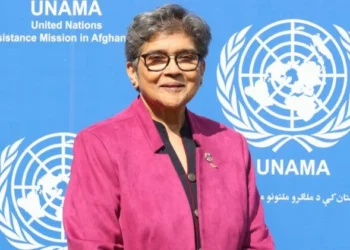
The new political deputy of UNAMA has recently been appointed and has begun her work. According to media reports, she met with Mawlawi Amir Khan Muttaqi, the acting Foreign Minister of the Taliban, yesterday. Roza Otunbayeva, the head of UNAMA, accompanied her to this meeting. The new political deputy, Georgette Gagnon, is a Canadian lawyer with previous work experience in Afghanistan. Before her, the position was held by Markus Potzel, a German diplomat. Since its inception, UNAMA has been involved in numerous significant affairs in Afghanistan, from managing and overseeing elections to defending human rights, especially women’s rights, and even participating in peace negotiations. However, the record left by this UN mission over the past three years, under the leadership of Ms. Otunbayeva, is not defensible. Over this period, UNAMA has consistently yielded to the demands of the Taliban, and at times, even adopted Taliban-like stances. For instance, when the Taliban decreed that women could no longer work for the United Nations, UNAMA initially reacted strongly, but shortly thereafter, it acquiesced and implemented the Taliban’s restrictions on its staff. In another instance, just a few days ago, UNAMA’s deputy and humanitarian coordinator, Indrika Ratwatte, was asked by a journalist during a trip to Kunduz about the Taliban’s closure of girls’ schools. He responded that he “respects the culture and customs of the Afghan people.” While he added that he hoped the Taliban would recognize women’s and girls’ rights and respect their right to education, his implication that the Taliban’s ban on girls’ education reflects Afghan culture and customs is a Taliban-aligned stance and, coming from the UN’s humanitarian coordinator, is entirely bizarre. The Taliban have propagated and reinforced this narrative that preventing girls from accessing education is part of Afghan Islamic culture. Unfortunately, this narrative has now been echoed by UNAMA’s deputy.
Now that the new political deputy of UNAMA has begun her work, her first action has been to meet with Mawlawi Muttaqi. During the meeting, Muttaqi expressed hope that relations between the Taliban and the United Nations would improve following Ms. Gagnon’s appointment. However, relations between the Taliban and the UN were already quite close even before this. The Secretary-General of the United Nations has repeatedly yielded to the Taliban’s preconditions and demands and even convened the Doha talks with a composition and structure that aligned with the wishes of Mullah Hibatullah. When the United Nations excluded women from the Doha conference to the Taliban’s demands, it was a significant retreat from the UN’s stance on human rights, considering it is supposed to be an organization that upholds such principles. In another instance, when the UN Security Council approved the appointment of a special envoy for Afghanistan and tasked the Secretary-General with implementing this, the process stalled due to the Taliban’s opposition. There has been no news of such an appointment by the UN, and in recent months, the organization has not even made any announcements regarding this matter. This is yet another example of the UN’s submission to the Taliban. If, in the end, a special envoy is appointed—likely with the Taliban’s approval—one can be certain that the Secretary-General will consider Mullah Hibatullah’s preferences in selecting this envoy. From this perspective, even before Ms. Gagnon’s appointment, the UN’s relations with the Taliban were already “improving.” The only resistance the UN has shown to the Taliban’s demands has been its refusal to recognize the Taliban’s permanent representative at the United Nations.
Considering the previous relationship between the United Nations, specifically UNAMA, and the Taliban, any hope for improved relations should focus on the relationship between the Afghan people and the UN, as well as the relationship between the UN and the political and military groups opposing the Taliban. Contrary to expectations, the UN has not given much importance to the demands of the Afghan people, particularly women. Although the UN’s Special Rapporteur and UNAMA have produced numerous detailed reports on the Taliban’s crimes, the Afghan people have not seen any serious pressure exerted on the Taliban by the UN to compel them to respect human rights. Whenever the Taliban’s demands have conflicted with human rights standards, the UN has ultimately yielded to the Taliban’s demands. The fact that the UN has shown indifference toward the Afghan people and the military and political groups opposing the Taliban, excluding them from key meetings concerning the country, likely reflects the influence of Taliban pressure. Instead of pressuring the Taliban to respect the legitimate demands of the people and uphold human rights, the UN has become an instrument for whitewashing the Taliban’s actions. The justification provided by the UN’s humanitarian coordinator for the Taliban’s ban on girls’ education, framing it as a reflection of Afghan culture and customs, is a stark example of how UN bodies have shifted from their original mission to becoming tools for the Taliban’s narrative. For this reason, in most cases, the UN operates to the Taliban’s wishes, avoiding engagement with the Afghan people and the political and military groups opposing the Taliban.
Ms. Gagnon, with her extensive background in human rights work and her 28 years of experience in the United Nations, as mentioned by the organization, has taken on this role at a time when the Taliban have intensified their restrictions on women more than ever before. The Taliban have portrayed human rights and human dignity as un-Islamic and inhumane values, and certain ethnic groups, such as the Tajiks and Hazaras, are facing extreme pressure. One of her primary missions is to defend human rights. Meanwhile, there are rumors of negotiations between the National Resistance Front of Afghanistan and the Taliban, suggesting that these discussions have already begun and have made some progress. According to Almas Zahid, head of the peace committee of the High Council of National Resistance for Salvation, these talks will be overseen by the United Nations. A key part of Ms. Gagnon’s mission will be facilitating these potential dialogues. Therefore, the UN must improve its relations with the anti-Taliban political and military groups, protesting women, and the various segments of Afghan society that oppose the Taliban, so that the voices and demands of the Afghan people are heard. These relations can only improve if UNAMA frees itself from the heavy influence of the Taliban and returns to its primary mission of supporting human rights and global peace. Ms. Gagnon, who previously worked from 2010 to 2015 as the head of the UN’s human rights section in Afghanistan and has experience leading humanitarian and strategic initiatives in post-conflict communities, as well as involvement in UN peace missions, was appointed at a time when these rumors of negotiations are circulating. Her appointment could be significant, indicating the UN’s preparedness to facilitate negotiations. However, as long as the UN only focuses on the Taliban and ignores the Afghan people, no mission will succeed. Without the broad and meaningful participation of the Afghan people, no major national process will yield permanent and sustainable results.
You can read the Persian version of this analysis here: