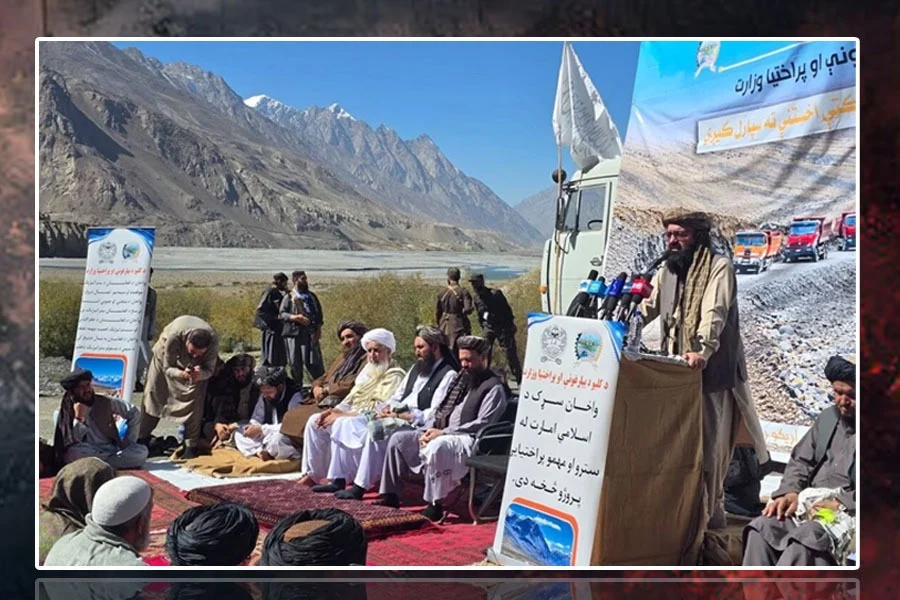
The Taliban’s opening of the Wakhan Road in Badakhshan may, at first glance, be seen as a sign of the group’s effort to connect Afghanistan to China and open a new route for regional trade. However, there is a serious gap between building a road, one surfaced only with gravel at that, and creating an active trade crossing that is acceptable to the regional stakeholders. That gap cannot be filled by an inauguration ceremony alone. It requires a great deal of unfinished work that the Taliban will not be able to complete soon or easily. What the Taliban hastily inaugurated does not mean that China has opened the border or that trade between that country and Afghanistan will flourish. At best, it is an infrastructure asset with potential capacity and an unclear, uncertain future. That is all. China has not only failed to open the Wakhjir crossing so far, but it has no interest in doing so at all, and what the Taliban have showcased has been met with its silence.
The reality is that the Taliban are very fond of holding inauguration ceremonies for development projects, ceremonies that allow them to present the image of an administration busy with reconstruction and development. For a regime that has neither domestic nor international legitimacy, staging development activities can be a tool for projecting a different image at home and abroad. The main message of these displays is clear enough: the Taliban want to show that they do not govern Afghanistan only with war and guns, but are also capable of carrying out development and infrastructure projects. However, a staged inauguration of a project is not necessarily the same as achieving its economic outcome. When the Wakhan Road is built and inaugurated, but the Chinese border remains closed, trade does not actually take shape, and a development achievement does not turn into an economic one.
As the world’s second-largest economy, China needs routes for expanding its foreign trade that are economically justified in terms of cost, security, transport capacity, and clear, better prospects. A mountain road that extends through the difficult-to-traverse heights of the Pamir, and parts of which are unpaved or covered with gravel, cannot by itself replace a trade corridor that meets international standards.
Secure trade requires more than the physical passage along a route. The road must be able to withstand regular freight traffic, and maintenance services, border and customs facilities, insurance mechanisms, and clear arrangements for the transfer of goods must be in place. Moreover, in a region like Wakhan, geographical and climatic conditions are of particular importance. The difficulty of crossing high altitudes and seasonal restrictions can increase the cost and uncertainty of transporting goods.
Therefore, for China, the main question is whether using the Wakhjir crossing offers a significant economic advantage compared with existing routes. A shorter distance on the map does not necessarily mean a cheaper, faster, or more reliable route. Furthermore, it is still unclear to what extent other countries welcome what the Taliban have done.
Meanwhile, the security factor may be even more decisive for China than the technical and economic difficulties. The Wakhan corridor lies along China’s border with the Xinjiang region, an area where Beijing shows great sensitivity about the activities of extremist Islamist groups and the possible spread of armed networks to it. On this basis, China’s concern is the risk of the expansion of Uyghur militant activity and its possible security consequences for Xinjiang. In all likelihood, China’s understanding is that if the Wakhjir crossing is opened, the way will also be opened for extremist militants to enter Xinjiang. In other words, from China’s perspective, opening a crossing is not merely an economic decision. This decision could create new requirements for border control, security monitoring, and cooperation with the Taliban, which, if not handled carefully, could result in the risk of exporting terrorism originating from Afghanistan.
For this reason, a route that holds great economic and strategic value for the Taliban may be a lower priority for China. As a result, the two sides’ dependence on the Wakhjir crossing is not the same. This is why, despite Chinese representatives being invited to the inauguration ceremony of the Wakhan road, no one attended. More importantly, there is no sign of China opening the border. The absence of a Chinese representative at the ceremony could be seen as a disregard for the Taliban’s efforts to build the road and open a trade crossing with Beijing.
Alongside the security of Xinjiang and the economic justification of the route, Pakistan’s position is also important to the potential fate of the Wakhan crossing. It is well known that the relationship between Pakistan and China is strategic in several respects. What gives this relationship weight beyond that of an ordinary bilateral partnership is China’s massive investment in Pakistan. In such circumstances, if Pakistan regards the opening of the Wakhan route as worrying in terms of security, economics, or geopolitics, that concern could also enter China’s calculations.
The importance of Pakistan’s position doubles when we focus on the tensions between that country and the Taliban. Although the Taliban have not stated it explicitly, the most important goal of this kind of effort is to become independent of trade crossings with Pakistan and to diminish that country’s share in regional trade exchanges. For this reason, Islamabad does not want the Taliban to be freed from their dependence on the Torkham and Spin Boldak crossings, among others, by building the Wakhan Road and trying to open the Wakhjir crossing.
You can read the Persian version of this analysis here: