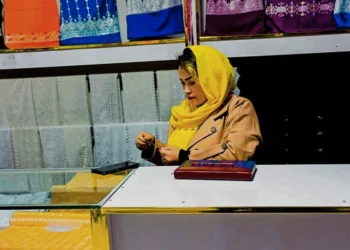
Several street vendors in the Kote Sangi area of Kabul have expressed grievances over the Taliban municipality’s decision to prohibit their activities along roadsides. These vendors state that they are grappling with economic challenges, and this measure by the Taliban is making their lives increasingly difficult. According to them, the Taliban not only fail to provide job opportunities but also impose additional restrictions. The vendors report that the Taliban have instructed them to operate only after 4 p.m. along the roadsides. They are urging the Taliban municipality in Kabul to allocate suitable spaces for their work to enable them to meet their families’ basic needs.
Some vendors argue that if the Taliban municipality designates appropriate locations for them, urban congestion would also decrease. They emphasize that in a context where poverty and unemployment are rampant, the continuation of these restrictions will further exacerbate their living conditions.
Pir Mohammad, a 65-year-old who has been selling cosmetics along the roadside for many years, says he struggles to make ends meet and is compelled to work from morning until night to support his family of ten. He adds that the Taliban’s recent restrictions on his trade have forced him and his family to go to bed hungry on several nights.
This roadside vendor states, “I don’t come to the streets out of joy. I sit here in tattered clothes and with parched lips to earn a living for my family of ten. We are poor people; I have no other skills. These restrictions have left me unable to earn even a single Afghani to bring home a piece of dry bread. Our living conditions are dire.”
Akbar, a student of Persian language and literature at Kabul University, sells handmade gloves and socks next to Pir Mohammad. He says that since the restrictions were imposed on his activities, he has been forced to wander from street to street, yet he earns little income.
This young man, who lost his father in a suicide attack and is the sole breadwinner for his family while pursuing his studies, says, “My mother knits gloves at home, and I bring them here to sell. For several days, the municipality has been preventing us from working. After university, I came to work, but I’m forced to go from street to street. No one buys from me. The municipality allows us to work after 4 p.m., but at that time, no one in the market buys from me. The only things that sell are vegetables and fruits.”
Tamim, a 13-year-old who hurriedly gathers his belongings out of fear that the municipality will confiscate them, says his father is ill and unable to work. This child, who supports his family of eight through street vending despite the imposed restrictions, emphasizes the need for factories and job opportunities in the country.
Tamim says, “If the municipality has been ordered by higher authorities to clear us out, we also have mothers and sisters at home who depend on us for food. If we have flour at home, we don’t have oil. If we have oil, we don’t have flour.”
Mohammad Saadeq, another street vendor, says that instead of creating job opportunities, the Taliban have cut off people’s livelihoods. Living in a rented, damp house, he stresses that if he cannot work, his family will be forced to sleep on the streets.
This roadside vendor says, “The municipality once built us white stalls, but then they removed them. One day, they allow us to work; the next, they issue warnings. We can’t go to Iran or Pakistan, nor do we have the education to work in an office. If the government [Taliban regime] provides us with jobs, I swear I’ll stop pushing a cart.”
Hassan Jan, another roadside vendor, complains about the Taliban’s new measures. He says he is currently facing severe economic hardship, and if he is unable to work for a few more days, his family will not even have dry bread at home.
This vendor adds that he supports maintaining order on Kabul’s sidewalks and roads, but emphasizes that the Taliban should not ignore them. He says, “Our problems should also be considered so that at least our children don’t go to bed hungry. I provide for my family through this cart.”
The Taliban municipality has not yet explained this measure, though it previously stated that the decision was made to ensure urban order and prevent garbage accumulation on sidewalks and roadsides.
Meanwhile, the World Food Programme (WFP) has announced that in the upcoming summer, three million people in Afghanistan will require life-saving food assistance. However, due to a severe funding shortage, the organization will only be able to support one million people. According to the agency, this situation could heighten the risk of widespread and catastrophic hunger in Afghanistan.
Previously, the United Nations predicted that in 2025, approximately 22.9 million people in Afghanistan would need humanitarian assistance due to food insecurity, malnutrition, climate change, and economic instability. The organization states that a shrinking protection space, a fragile economy, limited access to basic services, natural disasters, and climate shocks, combined with regional political tensions, have severely diminished the ability of Afghans to rebuild their lives after four decades of war.
The organization further notes that the imposition of legal restrictions by the Taliban has simultaneously increased risks for women, children, and youth. According to the UN, poverty has limited people’s access to essential services and livelihood opportunities, causing vulnerable groups to become increasingly dependent on humanitarian aid year after year.
You can read the Persian version of this report here:
کار بعد از ساعت چهار؛ فرمان تازه طالبان به دستفروشان | روزنامه ۸صبح