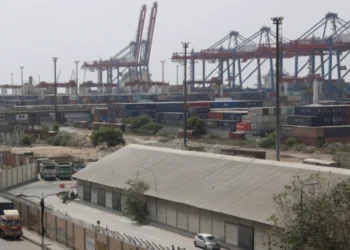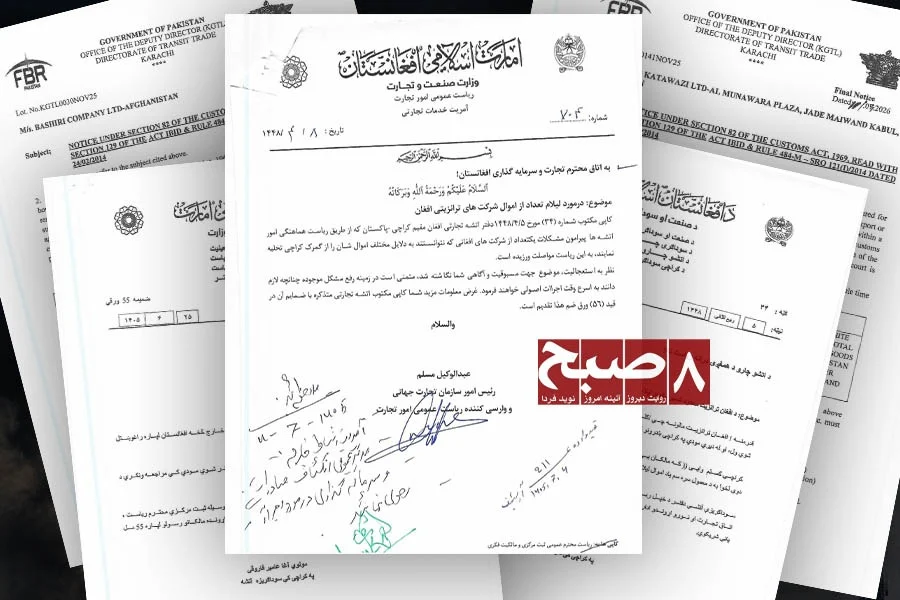
The Hasht-e Subh Daily has obtained 57 pages of documents showing that transit shipments belonging to about 19 trading companies from Afghanistan, totaling more than 140 containers, face the risk of auction at Pakistan’s Karachi port. Fifty-five pages of these documents consist of successive notices from Pakistan Customs issued to Afghanistan’s commercial and transit companies. The documents show that Pakistan Customs has warned these companies that if they fail to come forward and clear their goods within the specified deadline, their shipments will be put up for public auction in accordance with the country’s customs regulations. The goods under threat of auction include sugar, edible and industrial oils, infant formula, raw materials for production, marble products, used vehicles, and other items. The Taliban’s commercial attaché in Karachi, in a letter to the group’s Ministry of Industry and Commerce (MoIC), has requested that the status of these shipments be addressed and has sent the Pakistan Customs notices for administrative follow-up. Meanwhile, one of the traders says that about 345 containers of traders’ goods remained at Karachi port. According to him, container rental fees and delay penalties had risen to such an extent that they exceeded the value of the goods themselves.
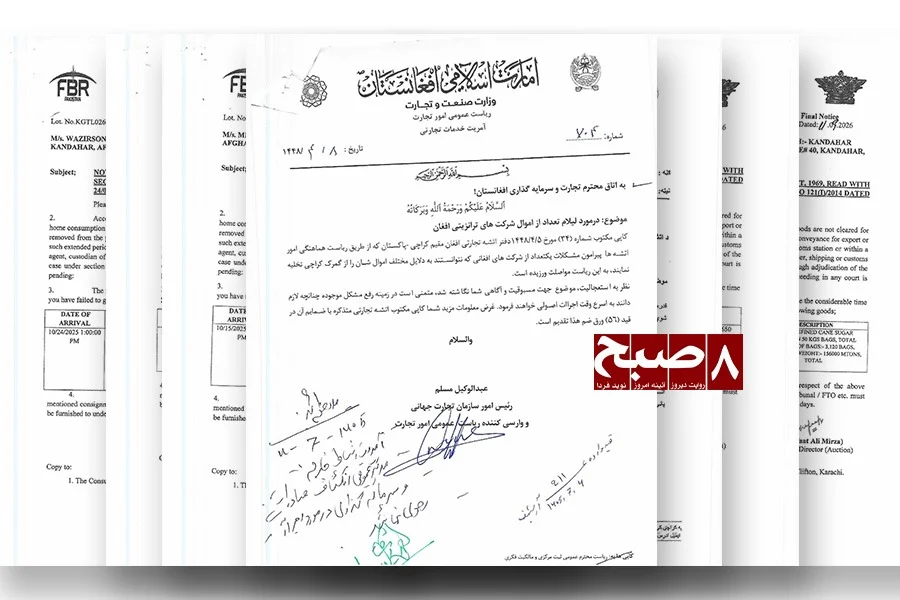
The Hasht-e Subh Daily has obtained 57 pages of documents showing that Pakistan Customs has issued successive notices to traders and merchants from Afghanistan. The documents warn a number of companies that their goods will be put up for auction because Afghanistan’s transit shipments have remained at Karachi port for a prolonged period. The letters show that the Afghanistan Chamber of Commerce and Private Investment (ACCI) has also been kept informed to notify the owners of the goods and follow up on the problem.
The Taliban’s commercial attaché in Karachi, in a letter to the group’s MoIC, wrote that Pakistan Customs has warned several Afghanistan’s trading companies that if they fail to come forward and clear their goods within the specified deadline, their shipments will be put up for auction in accordance with the country’s customs regulations.
The letter states that a significant portion of Afghanistan’s transit goods, purchased in 2025 and earlier, have remained at Karachi port for a long time due to various problems.
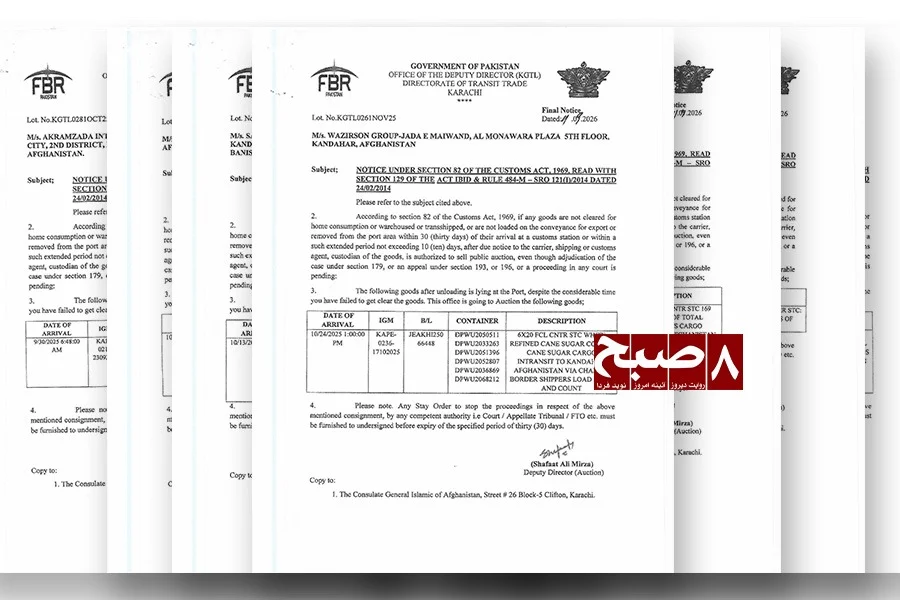
Following this correspondence, Abdul Wakil Muslim, Head of World Trade Organization (WTO) Affairs and Acting Director General of Trade Affairs, referred the matter to the ACCI in letter No. 7034, so that the owners of the goods would be informed and the necessary measures would be taken to prevent their possible losses.
Warnings from Pakistan Customs
The documents show that Pakistan Customs issued its notices under the title “Final Notice,” citing Section 82 of the country’s Customs Act, 1969. The notices also refer to Section 129 of the same act and to Rule 484-M, in line with Statutory Regulatory Order (SRO) 121(I)/2014 dated February 24, 2014.
According to the text of the notices, if the goods are not cleared, stored in a customs warehouse, transferred to another destination, or removed from the port area within the legal deadline after arriving at the customs station, Pakistan’s customs authority can put them up for public auction under the conditions set out in the law.
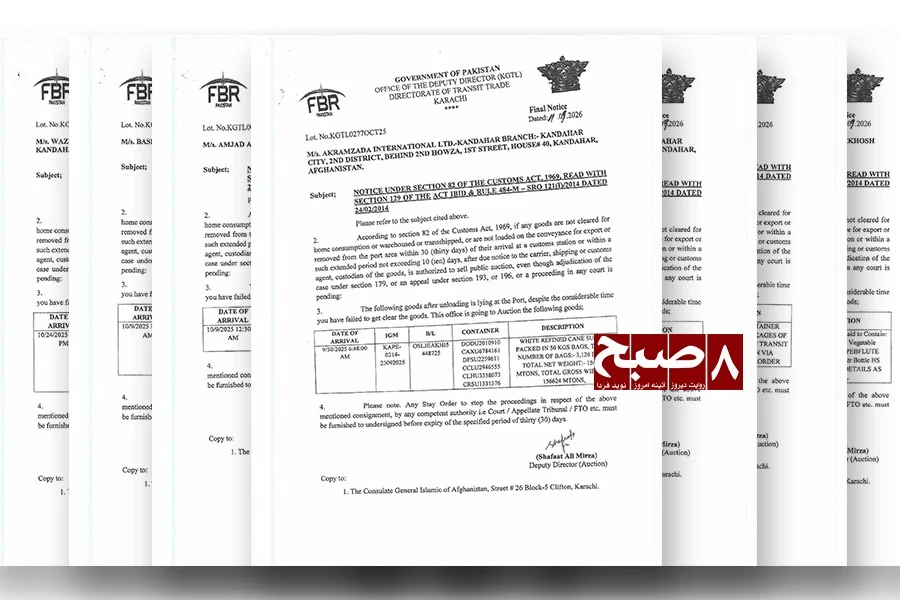
The notices state that the initial deadline is 30 days and, under specific circumstances, it can be extended by a maximum of 10 more days. The letters say that Pakistan Customs has also asked the owners of the shipments, if they hold an order from a competent authority to halt the auction process, to submit it to the relevant office before the end of the specified deadline.
In these documents, the court, the appellate court, and the Federal Ombudsman of Pakistan are named as competent authorities whose orders to halt the auction process can be submitted.
According to the information recorded in the customs documents, the shipment of Mirwais Katawazi company comprises 32 containers of 20 feet, Akbarzada International company comprises 20 containers, and Wazirson Group comprises 24 containers of coarse-grained sugar. Bahir Bahar company also has four containers of sugar. In the industrial oils category, Bashiri company has three containers of 40 feet, Amjad Arman company has 12 containers of 20 feet, and Azmat Safir company has two containers of 40 feet. The shipment of Samee Sadaqat company comprises 14 containers of vegetable oil, and the shipment of Adel Gulzar company comprises 15 containers of edible oil. Tak Setara Pipe Plastic company has two 40-foot containers of polypropylene raw materials, and Al-Kozai Cola company has seven 40-foot containers of production and packaging supplies. Habib Gulzar Motors company has one 40-foot container of engine oil and coolants, and Sarai Sadat Khan company has one 20-foot container of tobacco. Najib Golab company has one container of infant formula, and Aman Ariana company has one 20-foot container of nuts and bolts. In addition, Heshmat Mohmand company has two containers of marble products, and Mutahid Shamal-e Sharq company has one container of livestock feed additives.
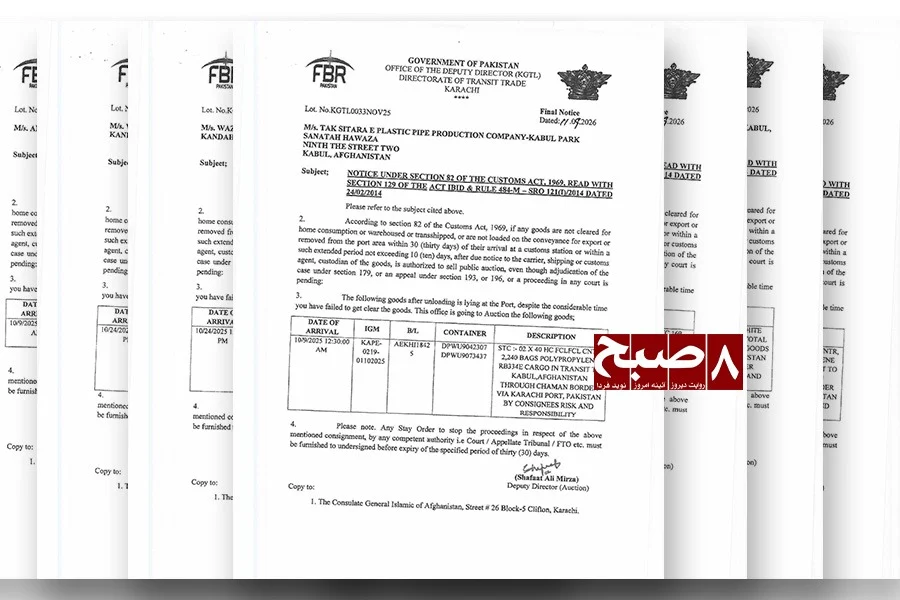
The letters from Pakistan Customs, which were handed to the Taliban’s commercial attaché and sent to the traders through him, state that the shipments under notice belong to about 19 companies from Afghanistan. According to these documents, the goods include foodstuffs, edible and industrial oils, raw materials for production, marble products, livestock feed additives, used vehicles, and other items.
Among the named companies, Mirwais Katawazi, Akbarzada International, Wazirson Group, and Bahir Bahar are among the companies whose shipments of refined white sugar or coarse-grained sugar are mentioned in the documents.
The letters state that the shipment of Mirwais Katawazi company comprises 32 containers of 20 feet and about 15,600 sacks of 50-kilogram sugar. For Akbarzada International company, 20 containers and more than 10,400 sacks of sugar have been recorded. Wazirson Group, with 24 containers of coarse-grained sugar, and Bahir Bahar company, with four containers and about 2,080 sacks of sugar, are also on this list.
In the edible oils category, the shipment of Samee Sadaqat company is reported to comprise about 36,260 ten-liter cans of vegetable oil, and the shipment of Adel Gulzar company about 15,815 cartons of vegetable oil in three-liter bottles.
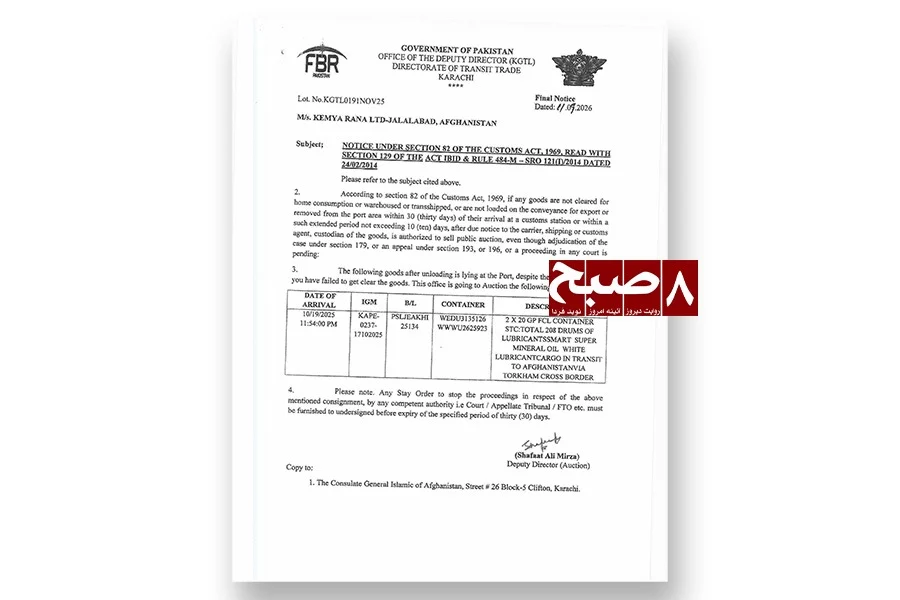
The documents also mention the names of Bashiri, Amjad Arman, Azmat Safir, and Habib Gulzar Motors companies in connection with shipments of lubricating oils, mineral oil, engine oil, and coolants.
Among the other shipments, the documents also refer to infant formula belonging to Najib Golab company, polypropylene raw materials belonging to Tak Setara Pipe Plastic company, production and packaging supplies of Al-Kozai Cola company, livestock feed additives of Mutahid Shamal-e Sharq company, nuts and bolts of Aman Ariana company, and marble products of Heshmat Mohmand company. In addition, shipments of tobacco and used vehicles have also been recorded in the documents.
The documents show that the number of containers under notice is estimated at more than 140. These shipments differ in terms of type of goods, volume, transit route, and owning company, and some of them were supposed to be transferred to Afghanistan through Karachi port and the Chaman and Torkham border crossings.
Zalmai Azimi, one of the traders, says that about 345 containers of traders’ goods remain at Karachi port. According to him, the rental fees for the containers and taxes have risen to such an extent that they exceed the value of the goods themselves. He adds that shipments arriving from China, the Gulf countries, and Malaysia have remained at the port because their owners are unable to pay these costs and the heavy penalties, and that the Pakistani government now intends to auction them.
This development comes as, following escalating tensions between the Taliban and Pakistan, the country closed transit and trade routes in early 2026 and asked traders from Afghanistan to remove their goods from Pakistan’s ports.
At that time, the ACCI had said that about 15,000 containers and shipments belonging to traders from Afghanistan were to be removed from the country’s ports and re-exported to Afghanistan, instead of being transferred to Afghanistan through Pakistan.
You can read the Persian version of this investigative report here:
سرمایه بازرگانان افغانستان در حراج پاکستان؛ بهای سیاستهای طالبان را چه کسی میپردازد؟