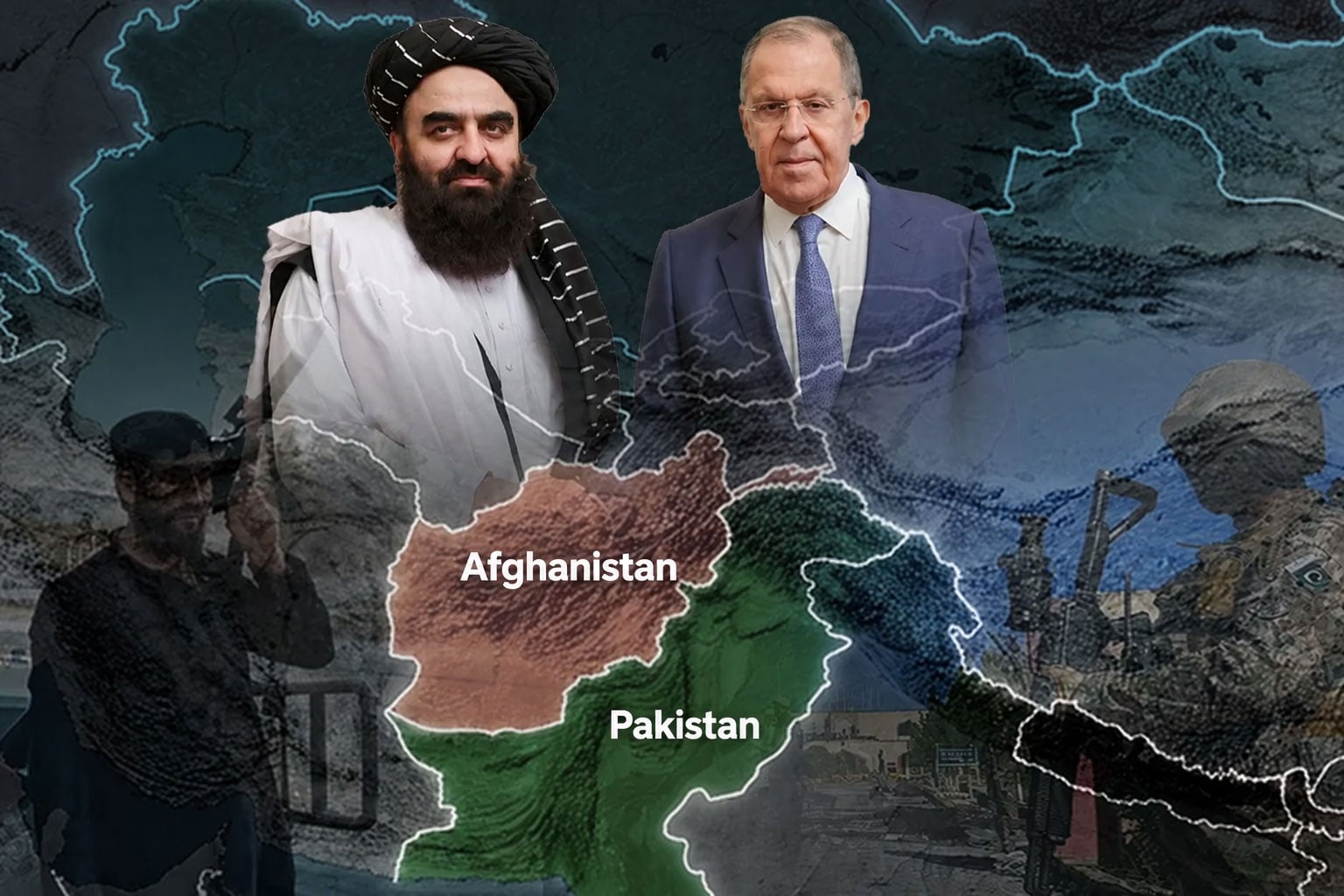
Asif Durrani, Pakistan’s former special representative for Afghanistan, has recently expressed concern over the alliance between the Taliban and Russia in an article published on the Arab News website, calling the shift detrimental to Islamabad. According to Durrani, the growing closeness of Russia, and likewise India, to the Taliban strengthens the group’s position and limits Pakistan’s room for maneuver. In his view, this convergence reduces the Taliban’s responsiveness to Pakistan’s security concerns. Never mind that the Taliban have essentially never been accountable to Pakistan on this matter, let alone that we could speak of that accountability decreasing or increasing.
Regarding what Durrani has written, several points are worth noting:
1) It cannot be denied that the Taliban have supporters in the region, both in the past and at present. At present, there are even more of them. In the past, the triangle of Pakistan, Saudi Arabia, and the United Arab Emirates backed the Taliban, but the number of the group’s supporters has now grown: Qatar, Turkey, Iran, India, Russia, China, most of the Central Asian republics, and others. Of course, the nature and extent of that support also matter. The fact that the aforementioned countries describe the continuation of the “engagement strategy” with the Taliban as constructive and fruitful, do not back a war against the Taliban, and do not consider the group’s removal from the scene to be in Afghanistan’s interest is itself a form of support.
The eighth meeting of the “Moscow Format” showed that Pakistan’s room for maneuver in the region is not very wide. Durrani has even acknowledged this point in his article. For example, Pakistan’s demand at the Moscow meeting was that a clause be included in the “final statement” attributing terrorist activities on Pakistani soil to Afghanistan under Taliban control. However, this proposal was opposed by the Taliban, and the meeting ultimately ended without the adoption and publication of a final text. Moscow also confirmed that the Taliban’s opposition had blocked Pakistan’s proposal and the adoption of the final text. This means there are countries that side with the Taliban in regional forums, even at the cost of disregarding Pakistan’s demands.
This development has worried the Pakistani side, which fears it may not be able to make its narrative of Afghanistan’s Taliban supporting Tehrik-i-Taliban Pakistan (TTP) acceptable to regional governments. Nevertheless, Pakistan is still ahead of the Taliban for now when it comes to attracting regional allies. The fact that the world does not condemn Pakistan’s attacks on Afghanistan’s territory (under the pretext of suppressing the TTP) indicates that Islamabad still has the upper hand over the Taliban in winning the support of regional governments.
2) The support of India and Russia for the Taliban is important in its own right, but it is not very worrying, because this support is “tactical” rather than “permanent.” New Delhi courts the Taliban because of its hostility toward Islamabad, not because it necessarily considers the group worthy of support in itself. Likewise, it seeks to secure its presence in Afghanistan, which is not possible without engaging with the Taliban. Russia also faces constraints, and its engagement with the Taliban depends on resolving them. More importantly, Moscow has been confronted with a fait accompli: the recognition of the Taliban regime. Under such circumstances, Russia has no choice but to speak in praise of the Taliban in some instances; otherwise, on the question of recognizing this group’s regime, it would be disarmed and would find no means of defending itself.
Incidentally, Pakistan and Russia share a concern about Afghanistan under Taliban administration: the export of terrorism. Islamabad is worried about the expansion of TTP activities, while Moscow is concerned about the rise of the Islamic State group (ISIS) and other extremist Islamist groups, as well as the creation of instability in the Central Asian republics. However, the two countries’ tones differ. Islamabad openly calls the Taliban a supporter of the TTP and, more importantly, accuses them of involvement in creating insecurity on Pakistani soil, whereas Moscow tries to speak in a mild tone, which also stems from the formalization of Russia’s relations with the Kabul regime. In addition, because Moscow is tied down by the Ukraine crisis, it does not want to become entangled with the Taliban in another crisis-prone region, a position that requires speaking to the Taliban in diplomatic language and adopting a policy of encouragement and engagement.
3) Membership in the “Mecca Pact,” while highly beneficial for Pakistan, is also harmful in some respects. Of course, its benefits outweigh its harms. Turkey is an active member of the North Atlantic Treaty Organization (NATO) and its only Middle Eastern member. Saudi Arabia is also a major non-NATO ally of the United States. Allying with two allies of the Western world within a “joint defense pact” is evidently sensitive, particularly for countries that are rivals of the West, especially the United States. It seems that Russia may be somewhat disappointed with Pakistan on this front, though not necessarily to a degree that would benefit the Taliban. The same applies to China and the Islamic Republic of Iran. To whatever extent Moscow, Tehran, and Beijing are upset by Pakistan’s tilt toward the West, they will try to distance themselves to the same degree from Islamabad’s position on the Taliban and TTP file.
If the Mecca Pact endures and its joint defense clause, which commits to supporting all three members, is put into effect, Pakistan will slide further toward the West and its regional allies. In this situation, Islamabad will look to the West for help in dealing with the Taliban and the TTP, not to their rivals. Conversely, the Taliban will have no choice but to seek help from Russia, Iran, India, and perhaps China. When that happens, the East-West confrontation over the Afghanistan issue will intensify, a confrontation that could possibly carry this country through the current crisis.
You can read the Persian version of this analysis article here: