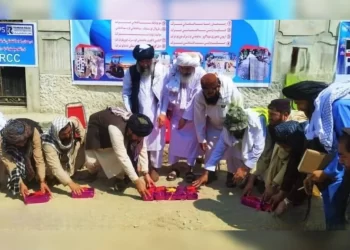
Officials from the Taliban-controlled Department of Information and Culture in Laghman province have announced the discovery of an archaeological site in the Alingar district of the province, dating back more than 2,500 years.
The department stated on Tuesday, December 16, that the site is situated in the Saw Valley, near the village of Situn, and that its earliest remains date back to approximately 1000 to 500 BCE, coinciding with the onset of the Iron Age in eastern Afghanistan.
According to reports, preliminary surveys indicate that the site includes a well-structured stone staircase and up to twelve rock-cut stone chambers carved into the hillside.
Archaeologists have also uncovered a ceramic vessel that was likely used for drinking liquids.
Laghman Province lies along the strategic Kabul Valley corridor in eastern Afghanistan and played a significant role in trade and cultural exchanges around the first millennium BCE.
Evidence suggests that the region was home to early Persian-speaking communities and later formed part of larger political structures, including the Achaemenid Empire.
Archaeologists believe that with further research, the site could provide rare evidence of daily life, architecture, and social organization in eastern Afghanistan more than two millennia ago.