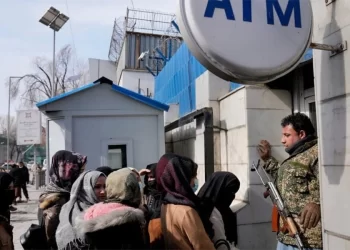
Findings from an investigative report by the Hasht-e Subh Daily reveal that officials of state-owned companies under Taliban control have allocated salaries of up to 360,000 Afghanis for themselves. In contrast, the employees of these same companies face extremely low wages and severe economic hardship. Employees of companies such as Breshna (the national electricity company) say their salaries are not even sufficient to cover daily living expenses. According to the Taliban’s new pay scale, the minimum salary for ordinary employees is only 8,000 Afghanis, while senior officials, in addition to receiving high salaries, also enjoy extra benefits. This version of the “New Pay Scale and Other Benefits” shows that payments are determined based on six categories and five levels, proportionate to each company’s revenue and operational profit.
The General Directorate of State-Owned Companies, which the Taliban refer to as “Emarati,” announced in an official letter dated 9 Mizan 1404 (October 1, 2025), the approval and implementation of the “New Pay Scale and Other Benefits” across all state-owned companies under their control. According to the letter, this decision was made by the Taliban’s Deputy Office for Policy, Monitoring, and Evaluation, and its stated purpose is to “attract professional personnel, motivate employees, ensure fairness in payments, and create efficiency in the operations of Emarati companies.”
In the closing section of the official letter, Mawlawi Mahmood Shahzada, the Taliban’s Deputy for Policy, Monitoring, and Evaluation, requested that companies participate in official meetings with the group’s central company administration and bring with them the relevant documents on salary entitlements for Sunbula 1404 (August-September 2025) as well as their revenue and expenditure reports for the year 1403 (2024-25).
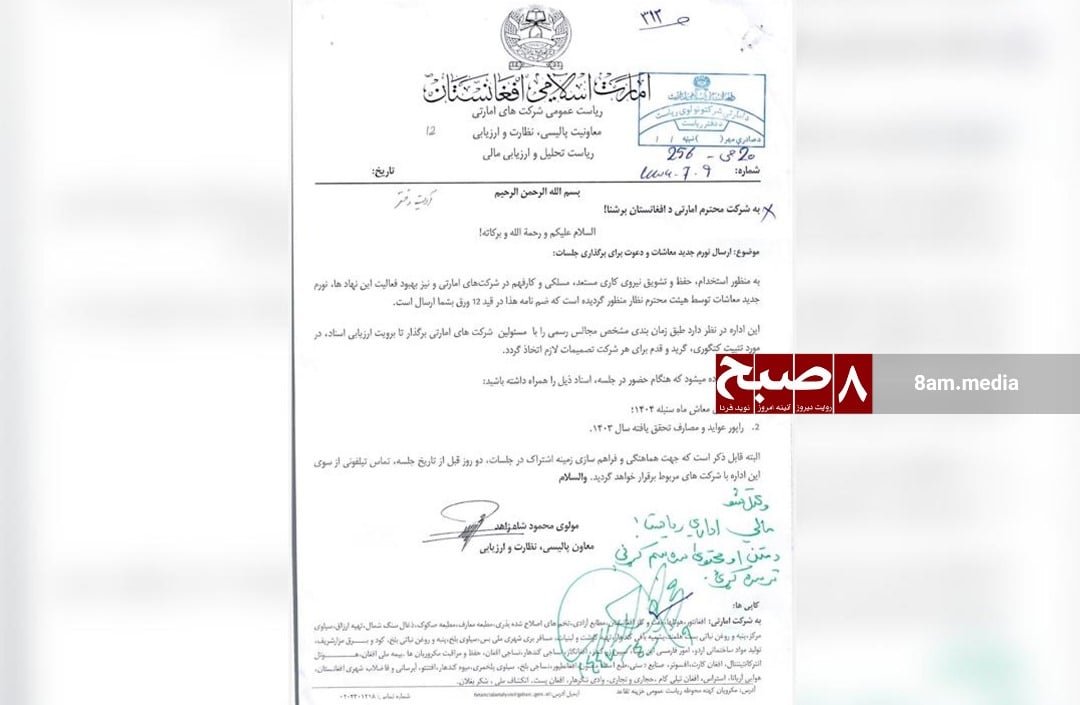
A copy of a letter from the Deputy Office for Policy, Monitoring, and Evaluation of the General Directorate of State-Owned Companies under the Taliban, obtained by the Hasht-e Subh Daily, shows that the group has issued a circular letter notifying all state-owned companies under its control. A version of this letter, titled “New Pay Scale and Invitation to Attend Meetings,” has also been sent to the Breshna Company.
The letter states: “This office intends to hold official meetings with the officials of Emirati companies according to a specific schedule, so that after reviewing and evaluating the relevant documents, necessary decisions regarding the confirmation of each company’s category, grade, and level can be made.”
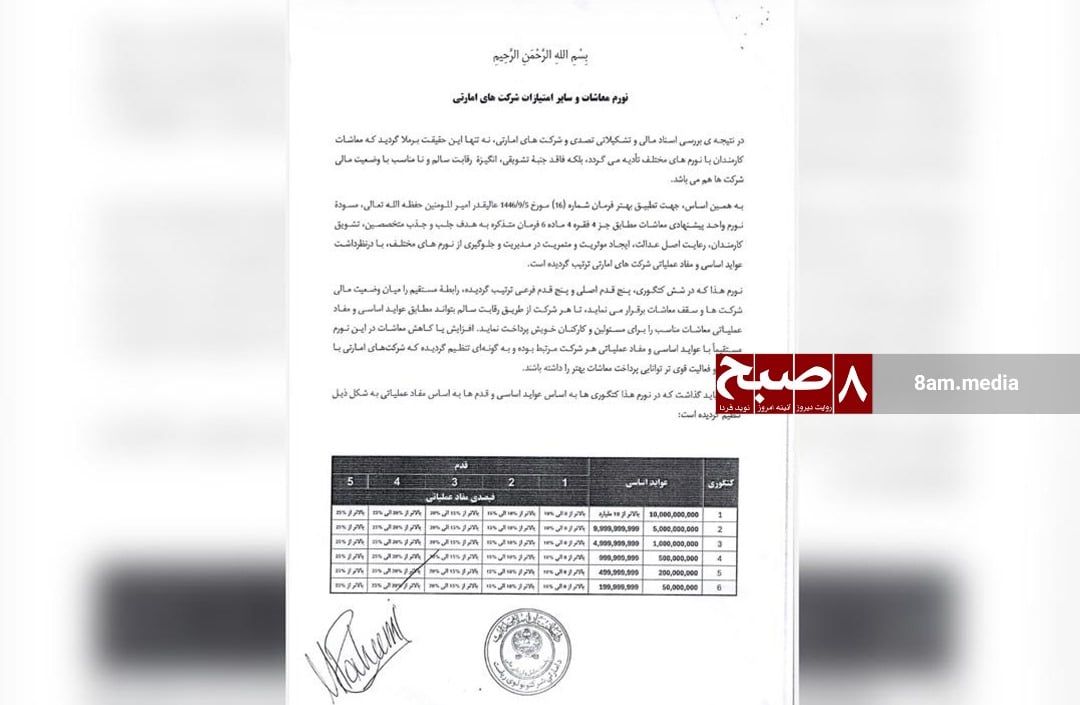
In other letters titled “Salary Standards and Other Benefits of Emarati Companies,” it is stated that the review of financial and organizational documents of enterprises and companies under Taliban control showed that employees’ salaries are not only paid according to different standards but also lack incentive, motivational, and competitive elements suitable to the financial conditions of the companies.
In these letters, the Taliban argue that, to encourage employees and better implement Decree No. (16) issued by Hibatullah Akhundzada on March 6, 2025 (9/5/1446 Hijri Lunar Calendar), a draft of a unified proposed salary scale has been prepared in accordance with Clause 4, Paragraph 6, Article 6 of the mentioned decree. According to the Taliban, this measure aims to attract and recruit professionals, motivate employees, ensure fairness, enhance efficiency and management, and prevent the existence of multiple pay scales, while also taking into consideration the basic revenues and operational profits of these companies.
The Taliban have set this “New Salary Scale” for the following institutions: Afghan Tour, Hotels, Afghanistan Oil and Gas Corporation, Azadi Printing Press, Institute of Improved Seed Production, Islamic financial certificates (Sukuk), Northern Coal Company, Food Supply Authorit, Central Silo, Helmand Cotton and Vegetable Oil Factory, Kandahar Wool Weaving Company, Meat and Dairy Supply, Milli Bus Urban Transport, Balkh Silo, Balkh Cotton and Vegetable Oil, Mazar-e-Sharif Fertilizer and Power Company, Army Construction Materials Production, Ibn Sina Pharmaceutical Affairs, Spinzar Kunduz Company, Afghan Gas, Kandahar Textile, Maintenance of Macroryan Complexes, Afghan National Insurance, Intercontinental Hotel, Afghan Cart, Afsotar, Handicrafts, Balkh Textile, Pul-e-Khumri Silo, Kandahar Fruits, Aftento, Afghanistan Urban Water Supply and Sewerage, Ariana Airlines, Estras, Afghan Telecom, Stone Cutting and Carpentry, Nangarhar Valley, Afghan Post, National Development, and Baghlan Sugar Company.
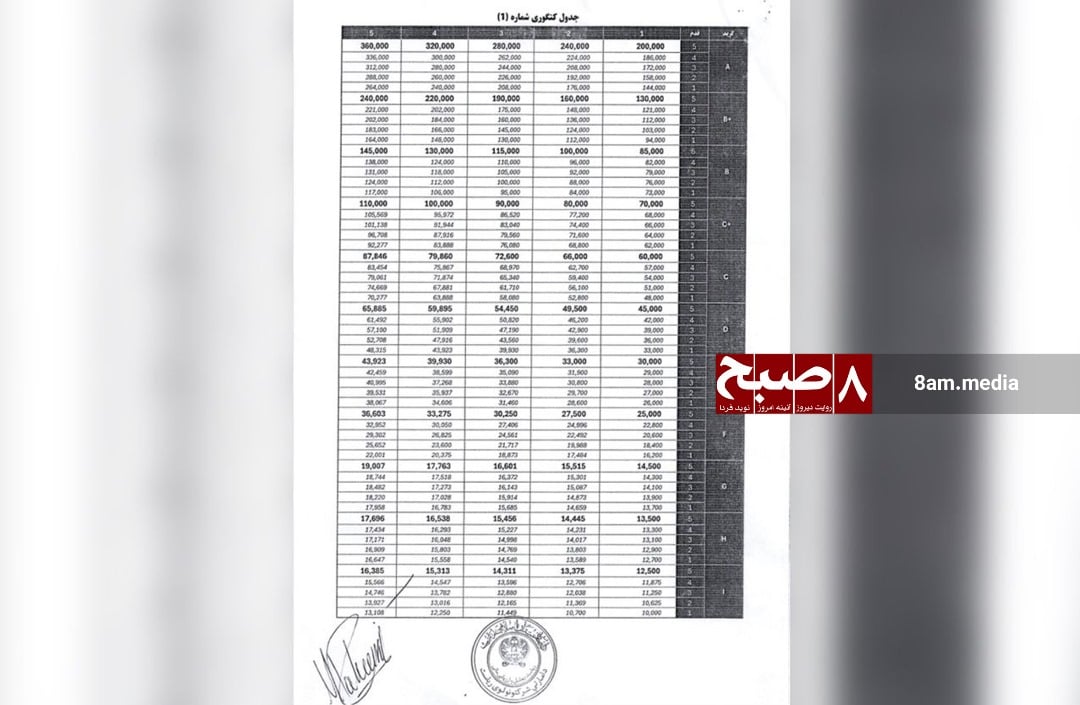
Salaries of Taliban Officials and Employees Under Their Control
In the first salary category table of the Taliban, it is stated that an individual working at Grade A, Main Step 5, receives a monthly salary of 200,000 Afghanis. In the subsequent sub-steps of this level, the salary increases respectively to 240,000, 280,000, 320,000, and 360,000 Afghanis per month.
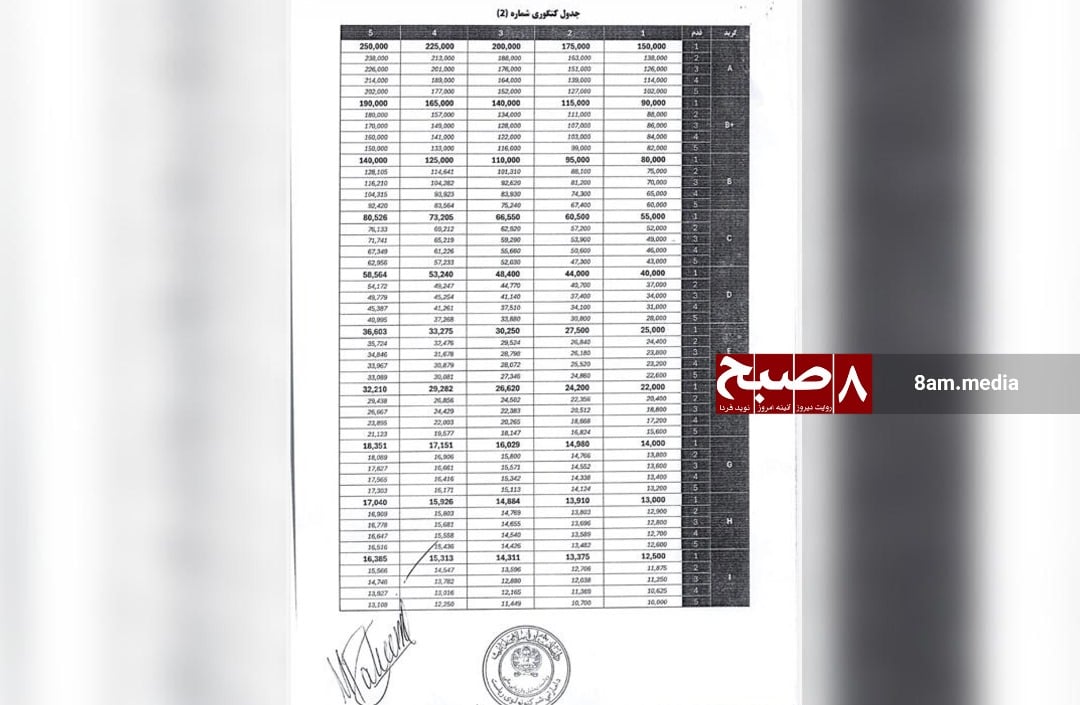
According to this Taliban document, an individual working at Grade A, Main Step 1, Sub-Step 1 receives 144,000 Afghanis per month, and in the following sub-steps of this level, the salary rises respectively to 176,000, 208,000, 240,000, and 264,000 Afghanis per month.
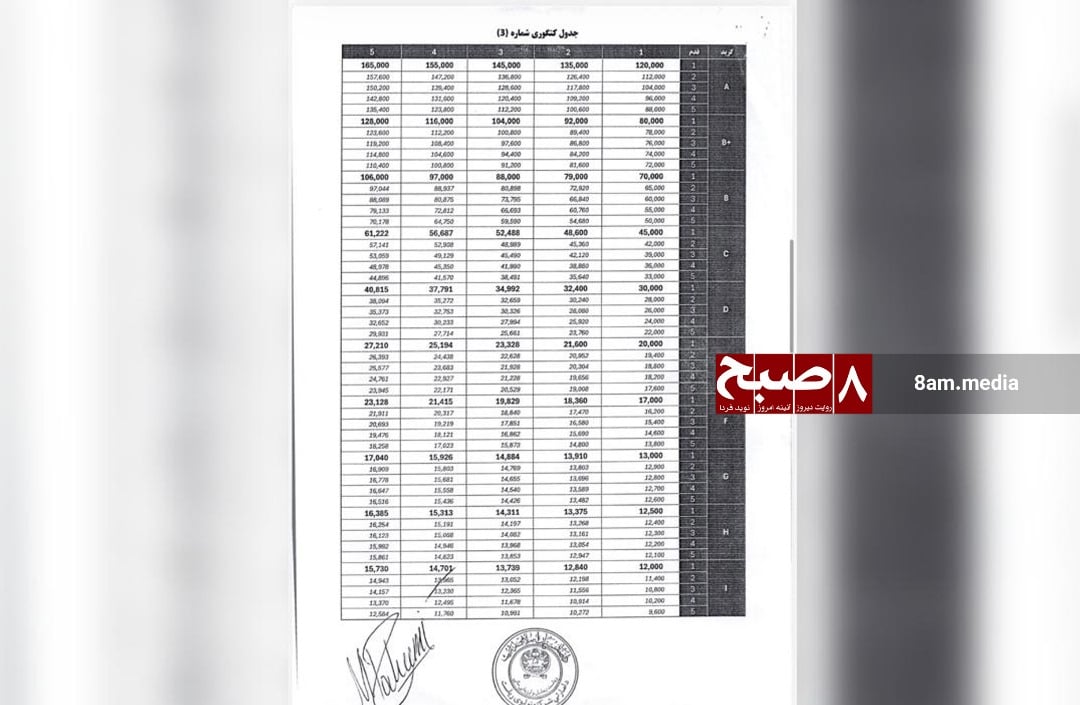
In the same category, an individual working at Main Step 4, Sub-Step 1 earns 186,000 Afghanis per month, and in the subsequent sub-steps, the salary increases respectively to 224,000, 280,000, and 336,000 Afghanis. Similarly, an individual working at Main Step 3, Sub-Step 1 earns 172,000 Afghanis per month, and in the following sub-steps, receives 208,000, 244,000, 280,000, and 312,000 Afghanis, respectively.
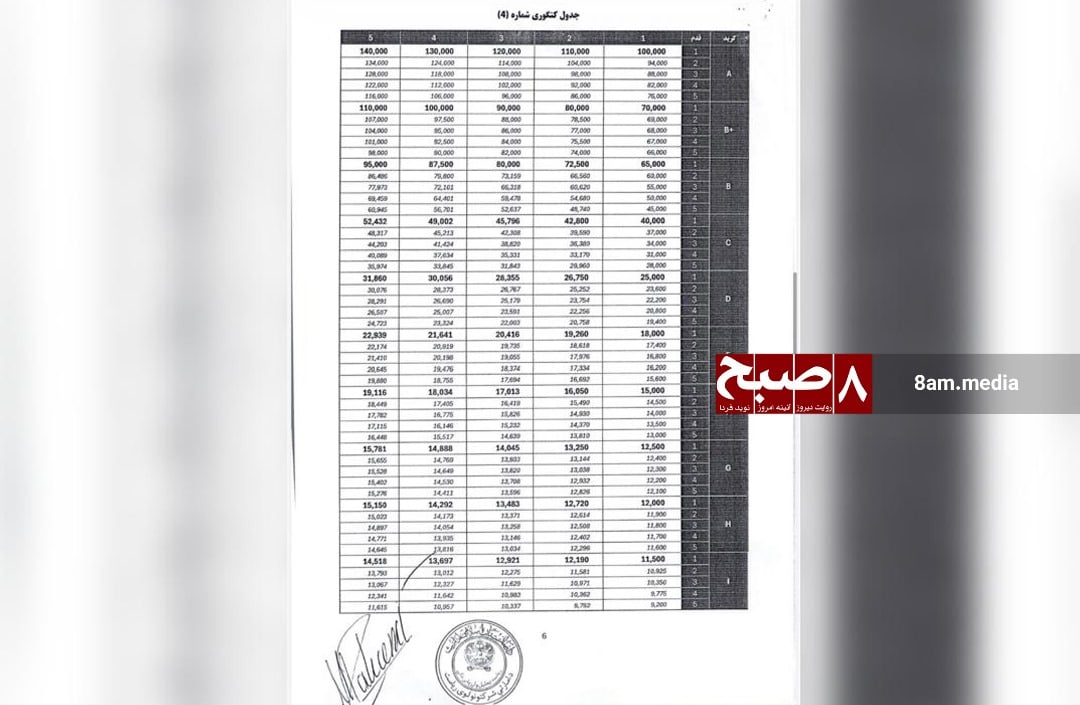
The table further indicates that an individual working at Main Step 2, Sub-Step 1 receives a monthly salary of 158,000 Afghanis, and in the subsequent sub-steps, earns 192,000, 226,000, 260,000, and 288,000 Afghanis, respectively. Meanwhile, an individual working at Grade A, Main Step 1, Sub-Step 1 receives 144,000 Afghanis per month, and in the following sub-steps, earns 176,000, 208,000, 240,000, and 264,000 Afghanis, respectively.
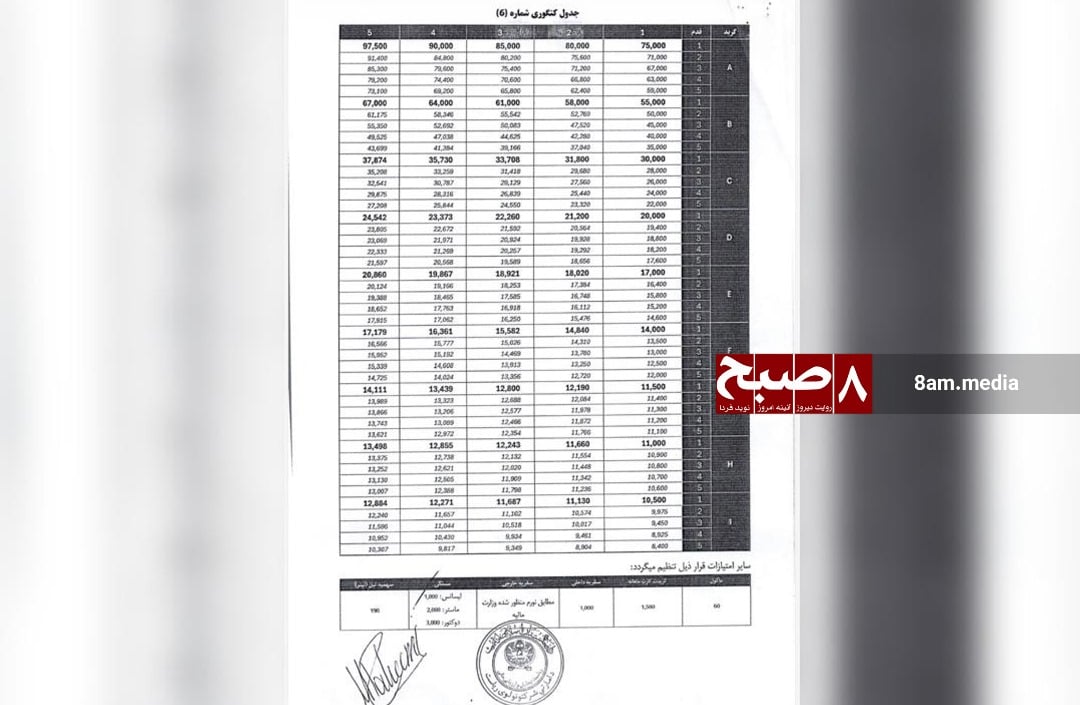
Furthermore, an employee working at Grade B, Main Step 5, Sub-Step 1 receives 130,000 Afghanis per month, and in the subsequent sub-steps, the salary increases respectively to 160,000, 190,000, 220,000, and 240,000 Afghanis. According to the Taliban’s pay scale, if the same individual works at Grade B, Main Step 4, Sub-Step 1, the salary is set at 130,000 Afghanis for the first sub-step, 160,000 for the second, 190,000 for the third, 220,000 for the fourth, and 240,000 Afghanis for the fifth sub-step.
Under this Taliban pay structure, an individual working at Main Step 3, Sub-Step 1, Grade B earns 121,000 Afghanis per month, and in the next sub-steps, receives 148,000, 175,000, 202,000, and 221,000 Afghanis, respectively. Based on the same category, an individual working at Grade B, Main Step 2 earns 103,000 Afghanis in the first sub-step, 124,000 in the second, 145,000 in the third, 148,000 in the fourth, and 162,000 Afghanis per month in the fifth sub-step.
Similarly, an individual working at Grade B, Main Step 1, Sub-Step 1 receives a monthly salary of 94,000 Afghanis, and in the following sub-steps, earns 112,000, 148,000, and 145,000 Afghanis, respectively.
According to this Taliban category, an individual working at Grade I, Main Step 5, Sub-Step 1 earns 12,500 Afghanis per month, and in the subsequent sub-steps, receives 13,375, 14,311, 15,313, and 16,366 Afghanis, respectively. Similarly, an individual working at Main Step 1, Sub-Step 1 of this grade receives a monthly salary of 10,000 Afghanis, and in the next sub-steps, earns 10,700, 11,449, 12,250, and 13,108 Afghanis, respectively.
Furthermore, according to Table No. 6 of the Taliban’s salary structure, employees receive a monthly salary ranging from 8,400 to 10,307 Afghanis, while Taliban officials earn between 55,000 and 97,500 Afghanis per month, based on the same table.
Six Categories, Five Steps, and a Direct Link to Company Revenue and Profit
According to this Taliban directive, the new salary standard has been structured into six categories, with five main steps and five sub-steps. The Taliban state that this classification establishes a direct relationship between a company’s financial standing and its salary ceiling. As outlined in the letter, each company may, through fair competition, determine and pay appropriate salaries to its executives and employees based on its core revenue and operational profit.
The letter further states that any increase or decrease in salaries under this standard is directly linked to each company’s core revenue and operational profit, and it has been designed so that Taliban-affiliated companies demonstrating stronger performance and productivity can offer higher salaries. According to these Taliban documents, Category One includes companies with revenues exceeding 10 billion Afghanis, while Category Six covers companies with revenues ranging from 50 million to 199,999,999 Afghanis.
| Category Number | Annual Revenue Limit (Afghan Companies) | General Characteristics of Companies | Salary Payment Level (Compared to Government Standard) |
| Category One | More than 10 billion AFN | Large and profitable national companies (such as mining, telecommunications, and energy sectors) | Up to 300% of the government salary ceiling |
| Category Two | Between 5 and 10 billion AFN | Large commercial and service companies | — |
| Category Three | Between 1 and 5 billion AFN | Medium-sized companies with stable revenues | Up to 200% of the government salary ceiling |
| Category Four | Between 200 million and 1 billion AFN | Semi-medium companies (construction, manufacturing, transportation) | Up to 150% of the government salary ceiling |
| Category Five | Between 50 and 200 million AFN | Small Emirate-owned companies with limited revenues | Up to 120% of the government salary ceiling |
| Category Six | Less than 50 million AFN | Micro or government-dependent companies | Based on the official government salary norms |
Table: Company Categories and Salary Standards under the Taliban’s New Pay Scale
Regarding the salaries of executives in Taliban-run companies, the maximum salary for a Chief Executive Officer has been set at three times the salary ceiling of the government’s standard pay scale at the first step. In addition to their salaries, certain non-cash benefits have also been provided, including mobile phone expenses, vehicle rent, and fuel allowances. However, these benefits must comply with the government salary standard and adhere to the limits set by the Ministry of Finance.
According to this Taliban Salary framework, the new pay standard includes separate tables for each category, organized by job groups A through J and steps 1 through 5. In the first category, the highest salary is designated for Group A, Step 5, amounting to 360,000 Afghanis, while the lowest salary is set for Group I, Step 1, at approximately 10,000 Afghanis.
| Job Grade (Step) | Percentage of the Company’s Operational Profit | Method of Salary Increase Compared to Category Standard |
| Step 1 | Less than 5% profit | Salary is paid at the lowest level of the category standard. |
| Step 2 | 5–10% profit | Salary is set 5% higher than the base rate of the category. |
| Step 3 | 10–15% profit | Salary is paid 10% higher than the base rate of the category. |
| Step 4 | 15–20% profit | Salary is paid 15% higher than the base rate of the category. |
| Step 5 | More than 20% profit | Salary is paid at the maximum level (ceiling) of the category. |
Table: Job Grade and Salary Adjustment Based on the Company’s Operational Profit
In the Pashto section of these letters, it is stated that companies with core revenues of less than 50 million Afghanis will have their benefits and salaries implemented in accordance with the government salary standard. According to this framework, the salaries of the heads and deputies of such entities are set at two and a half times (250 percent) the maximum salary level of the government pay scale at the first step.
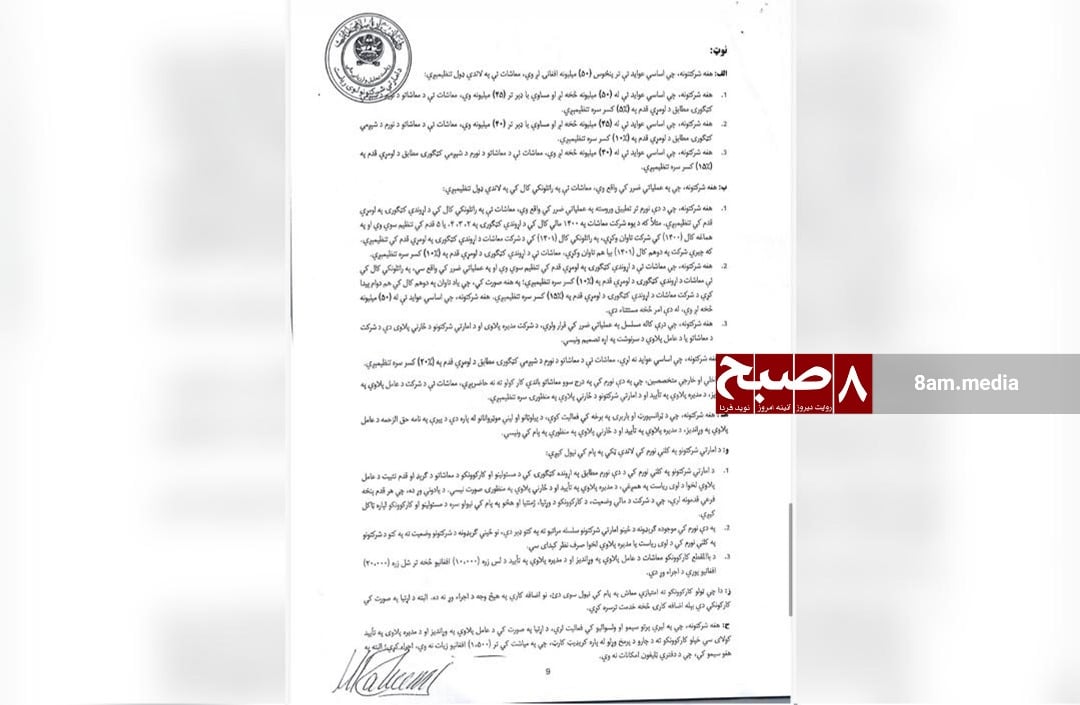
The letter specifies that the payment, renewal, or granting of vehicle rental allowances must be made solely in the name of the company and in coordination with the Deputy Office for Policy, Monitoring, and Evaluation, and under no circumstances should such allowances be registered under individual names. It further states that the renewal or implementation of these benefits must be carried out with the knowledge of the deputy office so that, following review, they can be approved based on the decision of the General Directorate of Companies.
Meanwhile, Mir Shekab Mir, former Director of Financial Services Development at the Central Bank, stated that setting exceptionally high salaries for senior Taliban officials and the significant gap, more than twentyfold, between their pay and that of lower-level employees is not only highly unjust but has also destroyed motivation, creativity, and dynamism in the workplace. He added that this situation ultimately leads to decreased productivity and efficiency within government institutions.
According to the Taliban’s new salary framework, if the mentioned companies fail to submit their actualized quarterly financial reports to the General Directorate, or if their financial results show a 20 percent decline in operational profits compared to the previous quarter, they will not be eligible for any non-salary benefits, and their salaries will be adjusted according to the government pay scale.
The Taliban are raising the salaries of their officials in state-owned enterprises under their control, while employees of these entities complain about low wages, saying that the lowest salaries have been set for managers and workers of Breshna Company, who bear the main workload. These employees describe the Taliban’s plan as unfair and even oppressive, stating that the Taliban allocate salaries exceeding 100,000 Afghanis for themselves from public funds, while lower-level staff who have no direct ties with the group struggle to afford food and remain at constant risk of dismissal.
You can read the Persian version of this investigative report here:
فاصله نجومی معاشها در شرکتهای طالبان: از ۸ هزار تا ۳۶۰ هزار افغانی