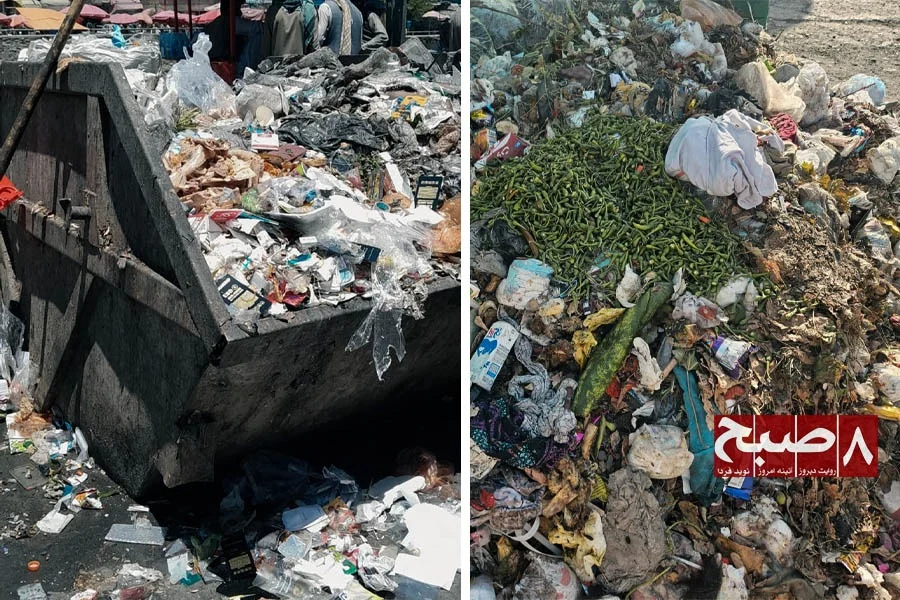
A number of the country’s environmental experts have expressed concern over the lack of management and the open dumping of food waste. They say that the accumulation of this waste, at a time when Afghanistan is already facing the consequences of climate change, could increase the release of greenhouse gases and further intensify this crisis. According to these experts, food waste produces methane gas as it decomposes in oxygen-free environments, a gas that plays a role in global warming. They add that the absence of waste separation in Afghanistan’s cities has resulted in a large portion of food waste being buried or piled up together with other waste.
In interviews with the Hasht-e Subh Daily, these experts emphasized that the continuation of this trend, in addition to its climate consequences, could increase the volume of waste, contamination of soil and water resources, and the number of insects and stray animals. They say that separating food waste from other waste and converting decomposable materials into compost could reduce the volume of buried waste and the rate of greenhouse gas emissions.
Kazem Homayoun, one of the environmental experts, says that the open dumping of bread, vegetables, fruit, and other food items not only increases the volume of waste but also makes waste management more difficult for the municipality. According to him, an increase in the volume of waste requires more manpower and equipment for collection, and the accumulation of food waste in cities also creates conditions for an increase in insects and stray animals.
This environmental expert says: “Food waste is organic waste and is capable of decomposing. When bread, vegetables, fruit, and potatoes are left in open spaces, they first damage the appearance of the city and increase the volume of waste. As the volume of waste increases, the municipality’s work also becomes more difficult, and this department needs more manpower and equipment for collection. On the other hand, when food waste accumulates deep in the ground in places where there is no oxygen, it produces methane gas during decomposition. If this gas collects at waste disposal sites or in areas where waste is used for leveling ground, and there is insufficient oversight, it can create a risk of explosion. For this reason, serious monitoring must be carried out at these sites.”
Mr. Homayoun emphasizes that the accumulation of food waste is not limited to methane production alone, and an increase in insects is also among its consequences. He adds that insects can move from one area to another and, by landing on food items, can directly and indirectly affect human health. According to him, the increase in food waste also contributes to a rise in the number of stray dogs and cats in urban environments.
In the view of this environmental expert, to reduce this problem, surplus and usable food from hotels, restaurants, and event halls could be used for families in need, a method that, according to him, had also been proposed in Kabul in the past.
This environmental expert says: “From my experience working at the Kabul Environmental Protection Department, in the past hotels and restaurants were not allowed to throw their surplus food into garbage bins. A portion of the food that was clean and usable had to be transferred to people in need. This was carried out through the Department of Child Care, and our plan was for the municipality to have a contract and coordination with hotels and restaurants so that surplus food could be collected and delivered to families in need. If such a program were implemented, it would both reduce the volume of food waste and help prevent an increase in insects, dogs, and stray cats, an issue that poses a serious threat in the city of Kabul.”
Sayed Mohammad Sulaiman, another environmental expert, says that food waste continues even as a number of people in Afghanistan face food insecurity. According to him, preparing more food than needed and throwing it away not only wastes food but, if left in open spaces, can also lead to health and environmental problems.
He adds that the absence of a proper composting and recycling process has resulted in usable decomposable materials being discarded along with other waste, when these materials could instead be used to produce fertilizer for use in agriculture and gardening.
This environmental expert says: “Unfortunately, we are witnessing the preparation of more food than is needed, which leads to waste in cooking, while a large portion of the people of Afghanistan face food insecurity. When surplus food is left in open spaces, it begins to rot and creates health and environmental problems. If we look at food waste management from a comprehensive perspective, we can turn this waste into an opportunity. Compost can be produced from discarded food items and used in agriculture and gardening.”
According to him, the process of composting and food recycling is currently not carried out adequately in the country, and as a result, food left in urban areas is consumed by stray animals and creates other problems as well. He adds: “To solve this problem, a balance needs to be created between the amount of food prepared and consumed, and alongside this, families, restaurants, hotels, and food preparation centers need to be made aware of food waste management.”
These warnings come as Afghanistan, despite its minimal contribution to global warming, is considered one of the countries most vulnerable to the consequences of climate change.
The United Nations Development Programme (UNDP) has said that climate change and its resulting events affect approximately 200,000 people in Afghanistan annually. The agency has added that climate change threatens people’s lives and livelihoods by reducing agricultural yields and increasing and intensifying natural events.
The United Nations Assistance Mission in Afghanistan (UNAMA) has also stated that communities across the country are facing growing climate and environmental challenges, challenges that have affected people’s livelihoods, food security, and social stability.
According to this report, drought and water shortage are among the most serious environmental threats facing Afghanistan, and more than half of the country’s population has been affected by their consequences.
Despite concerns over the consequences of food waste, no precise statistics are currently available on the amount of this type of waste produced in Afghanistan.
You can read the Persian version of this report here:
زبالههای غذایی؛ تهدید پنهان برای محیطزیست و اقلیم افغانستان