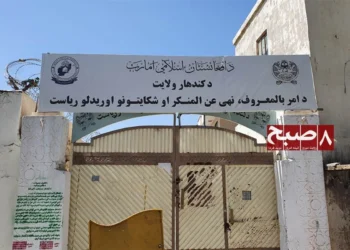
The Taliban’s newly ratified law “Propagation of Virtue and the Prevention of Vice” has sparked widespread reactions. Several political figures, cultural leaders, and human rights activists have described this law as an affront to the human dignity of the country’s citizens. Some cultural commentators have labeled it a “horror manual,” stating that it insults human dignity.
Last week, the Taliban’s Ministry of Justice announced that the law, consisting of one preamble, four chapters, and 35 articles, had been ratified by Hibatullah Akhundzada. Many of its provisions contradict human rights values and pave the way for Taliban interference in the most private aspects of individuals’ and communities’ lives.
Shaharzad Akbar, the former head of the Afghanistan Independent Human Rights Commission (AIHRC), responded to the law’s enactment by stating it “reflects their [the Taliban’s] sick, polluted, and prejudiced worldview.” On her X (formerly Twitter) account, she wrote, “Objectifying women, stripping away their human dignity, imposing restrictions on clothing, recreation, and worship… People are dying from hunger, lack of electricity, and medicine, while they are concerned with measuring hijabs and beards.”
Nazifullah Salarzai, Afghanistan’s ambassador to Belgium, the European Union, and NATO shared the German Foreign Minister’s opinion on X, writing: “I wholeheartedly agree. The imposition of such a draconian law is not just an affront to basic human rights, but a tragic erasure of the voices, dreams, and dignity of the women of Afghanistan. It is a heart-wrenching reminder that we must stand firm against those who seek to oppress and silence in the name of extremism. These are not just laws; they are chains that shackle the very soul of a nation.”
Kawa Jibran, a prominent Afghan writer, referred to the law as the “horror manual of the Propagation of Virtue and the Prevention of Vice of the terrorist emirate,” noting that its rulings are chilling and display the ultimate evil of political Islam and Afghan nationalism, constituting a blatant insult to human dignity and conscience.
Afghan journalists in Europe and North America have also expressed concerns over the law’s implementation, calling on the United Nations to prevent its enforcement. According to these journalists, the Taliban have imposed additional restrictions on the media in Afghanistan through this law. Under the law, the Taliban’s morality police are mandated to monitor all activities of state and private media, compelling them to follow the so-called “propagated virtues.”
The Women’s Movement for Peace and Freedom has similarly urged the UN to block the Taliban’s law. According to the movement, the Taliban’s new law institutionalizes “oppression” and “gender apartheid” against women in Afghanistan.
In a statement, the movement said that over the past three years, the Taliban have committed numerous crimes against women in Afghanistan and are now attempting to legitimize their “crimes” with this new law. The movement has called on international organizations and the global community to understand the current “dire situation” of women in Afghanistan and to avoid continuing any engagement or appeasement with the “terrorist Taliban group.”
Ali Maisam Nazary, head of foreign relations for the National Resistance Front (NRF) of Afghanistan, stated that the Taliban’s law is an extremist ideology targeting women, and it underscores their alignment with terrorist groups like ISIS.
Rina Amiri, the U.S. Special Envoy for Women of Afghanistan, Girls, and Human Rights, said that the Taliban’s enactment of this law indicates that the group has doubled down on the extremist policies it pursued in the 1990s.
On her X (formerly Twitter) account, Amiri wrote that maintaining the international community’s current stance against the Taliban is “a normative, economic, and security necessity.” She emphasized that the global community should not normalize relations with the Taliban until there is a substantial improvement in human rights conditions in Afghanistan.
German Foreign Minister Annalena Baerbock also condemned the implementation of the Taliban law, describing it as “nearly 100 pages of hatred against women.” In her post on X, she stated, “This inhumane rule deprives women of Afghanistan of their dignity, rights, and voice.” Baerbock added that the Taliban, through this law, aims to silence half of Afghanistan’s population. She argued that the Taliban have once again proven that no relationship can be established with radical Islamists.
The Taliban’s “Propagation of Virtue and the Prevention of Vice” law, consisting of one preamble, four chapters, and 35 articles, has been ratified by their supreme leader Hibatullah Akhundzada. The law labels women’s bodies, faces, and voices as “awrah” (indecent or forbidden to be exposed), stating that women are not allowed to sing praises or recite in public and that their voices must not be heard anywhere. The law also bans watching images or videos of living beings on phones, computers, or any other devices. Men are required to grow beards and avoid wearing neckties or adopting Western-style haircuts.
According to the law, drivers cannot transport women without a male guardian (mahram). All forms of entertainment, including marbles and walnut games, are banned and deemed forbidden. Furthermore, all merchants, craftsmen, and farmers are obligated to pay zakat and tithe to the Taliban in addition to taxes. The use of statues of living beings in advertisements is prohibited, and the Taliban’s Muhtaseebs (Morality Police) are authorized to imprison individuals for periods ranging from one hour to three days.
You can read the Persian version of this new here: