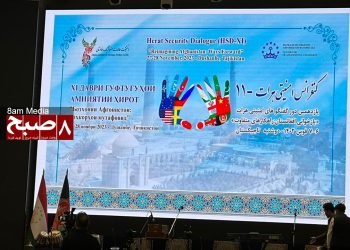
The 12th round of the Herat Security Dialogue (HSD), titled “Afghanistan: Reviving Hope; Synergetic Efforts,” has been organized by the Afghan Institute for Strategic Studies (AISS) in Madrid, the capital of Spain. Political and security experts, advisors from research institutions and international organizations, journalists, and a group of political and civil elites from Afghanistan and around the world are among the participants in this round of the Herat Security Dialogue. The speakers at this meeting exchanged views on terrorism threats, the political landscape, and the status of women. Dr. Rangin Dadfar Spanta expressed support for peaceful negotiations with the Taliban. However, he stated that the primary concern of the people of Afghanistan is saving the country from the “oppressive Taliban regime.” The former government official proposed establishing the “Afghanistan National People’s Assembly” to strive for an Afghanistan free from terrorism, extremism, discrimination, illiteracy, and hostility while simultaneously pursuing peace and resistance. Some speakers warned of terrorism’s presence in Afghanistan and emphasized that if the world ignores Afghanistan’s situation, a catastrophe worse than September 11 could occur. It was also stated that the current Taliban rule is worse than their first regime.
The 12th round of the Herat Security Dialogue commenced in Madrid on Monday with women singing a patriotic anthem and a Sufi dance performance. Shohreh Wakili performed the national anthem, “My Homeland, Your Love is My Pride.” This round of talks, titled “Afghanistan: Reviving Hope; Synergetic Efforts,” was attended by dozens of political activists, researchers from research institutions, diplomats, civil and human rights activists, and journalists.
On the first day of this conference, speakers discussed terrorism, Afghanistan’s political landscape, and the status of women. Additionally, Richard Bennett, the UN Special Rapporteur on Human Rights in Afghanistan, spoke about the conditions of women and girls and the humanitarian situation in Afghanistan. He praised the request for an arrest warrant for the Taliban Supreme Leader and the Chief Justice of the Taliban’s Supreme Court as a step to boost the morale of women and support their ongoing struggle.
Dr. Rangin Dadfar Spanta, the former Minister of Foreign Affairs and National Security Advisor of Afghanistan voiced his support for peaceful negotiations with the Taliban, claiming that many politicians, civil movements, and women’s rights organizations have also raised this issue. However, he noted that no response has been received from the Taliban so far. Spanta added that both the people of Afghanistan and the international community share a common aspiration for stability and peace in Afghanistan. He reiterated that for the people of Afghanistan, the primary concern remains “saving the homeland from the oppressive Taliban regime.”
Mr. Spanta stated that anti-Taliban movements within Afghanistan face significant challenges due to the lack of a coherent and inclusive political alternative with clear objectives such as democracy, the rule of law, and social justice. He argued that the international community, regional countries, and Afghanistan’s neighbors have also failed to adopt a unified policy toward Afghanistan. According to him, geopolitical rivalries and ideological differences have led to the emergence of two opposing forces regarding Afghanistan. He believes that competition among the international community, regional powers, and Afghanistan’s neighboring countries could increasingly hinder peace efforts in Afghanistan.
The former senior government official highlighted that the current crisis under the Taliban’s authoritarian rule underscores the necessity of a unified and coordinated resistance across different segments of society. He suggested that for liberation movements to be effective, they must have clear political programs, organized structures, and strategies aligned with prevailing political and military power dynamics.
Mr. Spanta proposed the decisive and specific establishment of the “Afghanistan National People’s Assembly.” In his view, this assembly should include men and women and all political and social forces that believe in Afghanistan’s independence, freedom, and unity. He stated that this assembly could work towards an Afghanistan free from the scourges of terrorism, extremism, discrimination, illiteracy, and hostility, translating these goals into practical achievements. He further emphasized the necessity of simultaneously pursuing peace and resistance.
Rahmatullah Nabil, the former Director-General of the National Directorate of Security of Afghanistan, warned that if the world continues to ignore the Taliban, a catastrophe worse than September 11 could occur. According to him, Afghanistan remains at the forefront of the fight against terrorism. He also warned of global threats posed by the Taliban regime, stating that ISIS is not just a terrorist group but a ticking time bomb.
Ryan Crocker, the former U.S. ambassador to Afghanistan, stated that the Taliban in their second rule are worse than in their first regime. Expressing concerns over Afghanistan’s security situation, Mr. Crocker emphasized that terrorism remains “alive and active” in the country. He added that the “worst” action the international community could take is to recognize the Taliban.
Meanwhile, Richard Bennett, the UN Special Rapporteur on Human Rights in Afghanistan, stated in the conference that the request for an arrest warrant for the Taliban Supreme Leader and the Chief Justice of the Taliban’s Supreme Court by the Prosecutor of the International Criminal Court has given Afghan women and girls hope to continue their struggle for their rights. He asserted that condemnation and rhetoric are insufficient and that serious action must be taken against the Taliban’s restrictions. According to him, if an arrest warrant is issued for the Taliban Supreme Leader and Chief Justice, it would complicate efforts to normalize relations between the Taliban and the international community, sending a clear message that the Taliban are still far from being recognized.
Mr. Bennett stressed that the situation of Afghan women and girls should be an integral part of any negotiation or peace process regarding Afghanistan. He noted that while the world is generally witnessing a regression in women’s rights, the severity of the situation in Afghanistan is incomparable to any other country. He emphasized that the global community must hold human rights violators in Afghanistan accountable.
Asad Durrani, the former Director-General of Pakistan’s Inter-Services Intelligence (ISI), stated during the Herat Security Dialogue in Spain that after the U.S. and NATO withdrawal from Afghanistan, Islamabad abandoned its regional plans and focused solely on securing its interests.
Mohammad Asif Durrani, Pakistan’s former Special Representative for Afghanistan, stated at the conference that there is a possibility of a recurrence of an event similar to September 11. He also emphasized that he does not view the Taliban as a permanent reality in Afghanistan. He added that the Taliban, by “misusing Pashtunwali,” refused to hand over members of Tehrik-i-Taliban Pakistan (TTP) to Pakistan.
Mohsin Dawar, a former member of Pakistan’s Parliament, stated that the Taliban are a project and should not be normalized. According to him, this project has been imposed on the people of Afghanistan. He further noted that the Taliban could evolve into ISIS and lead to greater instability in Afghanistan. Dawar emphasized that Taliban policies contribute to strengthening extremist groups such as ISIS.
This round of HSD was held in Madrid, Spain, one day after the scheduled date. The conference is taking place from February 25 to 26, 2025, and covers various topics concerning Afghanistan and the regional and global consequences of the country’s current situation.
You can read the Persian version of this daily report here:
دوازدهمین دور گفتوگوهای امنیتی هرات؛ طالبان دور دوم بدتر از طالبان دور نخست هستند | روزنامه ۸صبح