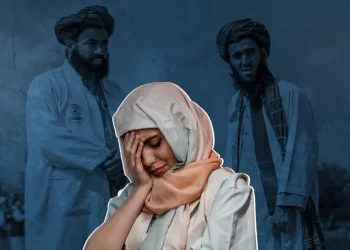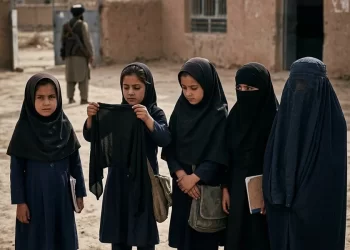

Many women in Herat report that the Taliban’s restrictions have led to an increase in violence against them. Some of these women tell the Hasht-e Subh Daily that the rising violence and social limitations have caused mental and psychological distress, with some even experiencing “shock” and “stroke-like” conditions. These women also stress that, after being laid off by the Taliban, the behavior of their families has changed, subjecting them to both verbal and physical abuse.
Afsana (pseudonym), a woman from Herat, used to work in a government institution in the province before the Taliban’s takeover, but now she is confined to her home. She says that losing her job and remaining at home has altered her family’s behavior, and they no longer treat her as they did before.
Laid off due to the Taliban’s restrictions, Afsana explains that, now that she is staying at home, she must also endure the violent behavior of her husband’s family. She adds, “Under the previous government, I worked in one of Herat’s directorates and earned around 12,000 to 15,000 Afghanis monthly. Because of this job, my in-laws, including my father-in-law and mother-in-law, treated me well; but now that I am unemployed, their behavior toward me has become increasingly hostile.”
Afsana further describes the change in her father-in-law’s behavior, saying, “A year has passed since I lost my job, and the behavior of my family, particularly my father-in-law, has worsened. Every day, they mock me, saying, ‘We spent on you, and now you just sit in the corner of the house.’ As a result, I am in a very bad situation. Their behavior has disturbed my peace of mind to such an extent that I had to seek medical help.”
Several other women in Herat, who have lost their jobs and endured domestic violence, are also in severe mental and psychological distress and have been hospitalized. They say that the Taliban’s rule has worsened conditions for both working and unemployed women, leading to an increase in domestic violence.
Shima, a young woman in Herat, has developed mental health issues at the prime of her youth. She says that losing her job and enduring violence from her husband’s family have led to three hospitalizations over the past year at Herat’s Provincial Hospital.
She explains, “Four years have passed since my marriage, and I had a relatively carefree life. I worked during the day, and when I returned home, even if there was some conversation, it didn’t bother me. But since the Taliban’s arrival, life has become unbearable, and the reason is the violent behavior of my father-in-law.”
Shima emphasizes, “The violent behavior from my husband’s family has resulted in three hospitalizations within one year. The first time, I was in a coma for seven nights and was paralyzed on one side for a while until I gradually regained movement. Doctors said that the high stress led to a stroke. Life at the height of my youth became extremely difficult and shattered my spirit.”
While these women in Herat share their grievances about life under Taliban rule, a recently published 40-page report by a human rights organization named Rawadari states that the situation for women, especially in the education sector under Taliban control, has worsened.
The Rawadari report highlights that some female teachers and girls in schools and religious seminaries under the Taliban’s control face sexual harassment but conceal these incidents due to social stigma and fear of retribution. The report cites the example of the rape of six female students at a religious school in Ghor province, a case that has remained suppressed due to Taliban pressure and threats.
The organization further states that the Taliban’s policies have intensified gender inequality, hatred, and discrimination against women, incorporating gender stereotypes, violence, and discrimination into their policies and educational system.
Meanwhile, since the Taliban’s takeover, women in Afghanistan have endured difficult circumstances, as the Taliban has stripped them of their rights to education and employment. Karen Decker, the U.S. Charge d’Affaires for Afghanistan, recently stated that the Taliban’s restrictions are denying girls and women the opportunity to participate in Afghanistan’s future.
You can read the Persian version of this daily report here: