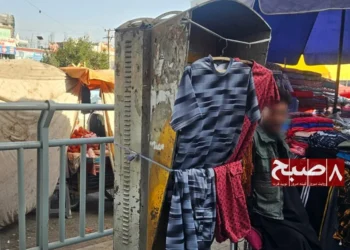
Four days after Eid al-Adha, several Kabul residents are complaining about foul odors from the blood and discarded entrails of sacrificial animals left across various parts of the city. They say hides, intestines, and other unusable animal parts have been dumped in drainage ditches and at scattered points around the city, and that despite several days passing since the holiday, the Taliban’s municipal authority has taken no effective action to clean up the waste. Residents say the smell has severely disrupted their daily lives. Several environmental experts, meanwhile, are warning that if animal remains are not properly managed, the waste will dry out, break down into contaminated particles, and contribute to air pollution and a heightened risk of disease.
Shams, a Kabul resident, says the stench left behind by the Eid al-Adha slaughter has become intolerable. “It is not just our alley,” he says. “The stench follows me through every street and lane I walk. People who performed sacrifices have thrown hides, intestines, and other unusable parts into the roadside ditches. These remains have rotted in the sun, flies have swarmed over them, and the odor is deeply unpleasant.”
He adds that the waste is being moved without any attempt to contain it. “The hides and intestines of sacrificed animals are hauled in open-bed vehicles with no covering whatsoever. The smell spreads the length of the road and is truly nauseating. Sometimes the stench is so overwhelming that I am forced to hold my breath while passing by.”
“Right now, the smell is tormenting us,” Shams says. “But in a few days, once it dries out and mixes with the dust, the wind will carry contaminated particles into the air we breathe, settling on people’s faces and hair. More diseases will follow. Unfortunately, the Taliban pay no attention to this issue, and urban sanitation does not appear to be a priority for them. Even if this behavior could not be prevented beforehand, Taliban municipal officials should at least address the problem now and clean up the waste. We are truly fed up with this stench. If I had the choice, I would rather not leave my home at all.”
Zakaria (pseudonym), another Kabul resident, says that even three days after Eid, the stench from animal waste scattered across the city continues to torment residents. “If this situation continues, it will lead to a rise in various diseases,” he says. “I hope the Kabul Municipality takes action to clean up this waste.”
He also called on residents to take greater responsibility. “Kabul residents need to observe basic civic norms and carry out their sacrifices in designated locations. If they slaughter animals at home, they should bury the unusable parts in appropriate areas far from residential zones, so that neighbors and fellow citizens are spared the stench and the conditions for disease are not allowed to develop. Awareness programs should be launched, and legal action should be taken against violators, so that these norms and rules become embedded in society.”
Roya (pseudonym), another Kabul resident, says the waste left behind from Eid sacrifices has created serious health and environmental problems for people in her neighborhood. “After the sacrifice, our neighbors poured blood and other animal waste into the ditch beside our alley,” she says. “Since water does not flow properly through these ditches, the material has sat there and decomposed. The smell in this hot weather has made life very difficult for us, to the point where we have been forced to keep our windows shut at all times.”
The problem, she adds, extends beyond the Eid period itself. “Even before Eid, livestock brought from the provinces for sale were kept at various points around the city, and after they were removed, those sites remain contaminated and uncleaned. The foul smell from these locations is also troubling residents. On top of that, when the wind blows, dust and pollutants enter our homes, and we are forced to breathe them in. My younger brother has developed allergies because of this contamination, and we have already taken him to a doctor twice.”
Sayed Mohammad Salmankhail, an environmental expert, says Kabul was already facing a serious waste management challenge before Eid al-Adha, and the surge in animal slaughter waste has made it significantly worse.
“If authorities fail to properly manage the waste and remains from the sacrifices, it will eventually dry out and break down into fine dust particles,” Salmankhail says. “The wind will carry these particles through the air, feeding the cycle of pollution. This type of contamination is particularly dangerous because it is of animal origin, and inhaling it can cause a range of health problems, including diarrhea, respiratory disease, and skin conditions.” He adds that the waste degrades not only the natural environment but also the city’s air quality and its urban character.
“Neither culturally, nor socially, nor ethically, nor from an Islamic standpoint, is it appropriate for citizens to behave this way,” Salmankhail says. “Waste must be managed at the source so that disposal does not become a crisis. Unfortunately, in many cases, waste is not sorted at the source, and wet and dry waste are mixed. This practice has not been properly implemented at any level, from individual households to the city as a whole. As a result, responsible institutions collect the mixed waste and either bury it or burn it, both of which create additional problems and lead to soil, water, and air pollution.”
This comes as several Kabul residents living farther from the city center had, in a recent interview with the Hasht-e Subh Daily, complained about the absence of garbage bins in their neighborhoods. They said not a single waste container could be found across long stretches of road, causing significant difficulties for residents. The lack of bins, they said, has led people to dump their waste along roadsides, in alleys, and in ditches, creating widespread health and environmental problems across the city.
You can read the Persian version of this report here:
تخلیه شکم و خون حیوانات در سرکها؛ باشندهگان کابل از تعفن و آلودهگی به ستوه آمدهاند