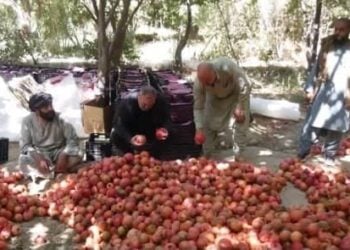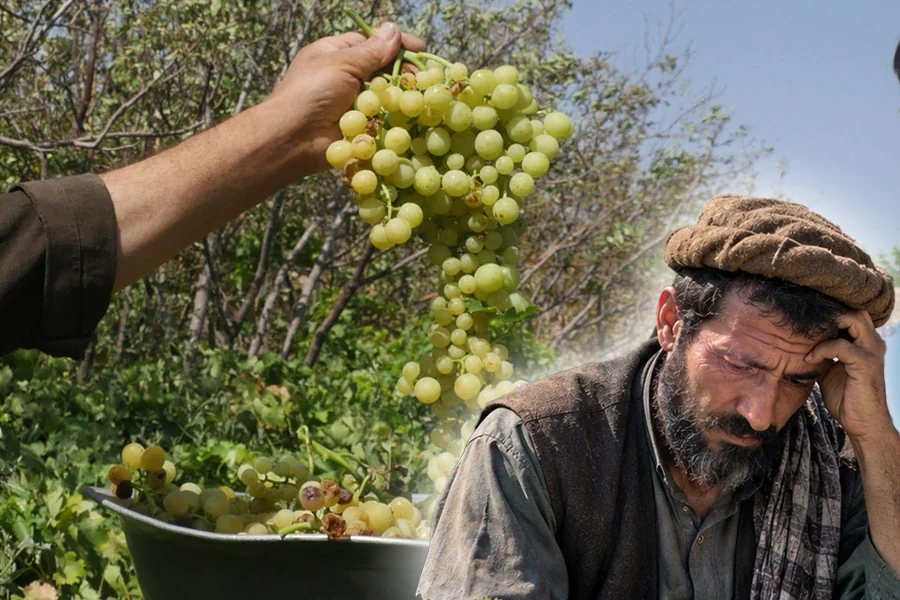
A number of orchard owners in Koh Daman have complained about falling prices for their produce, a lack of cold storage facilities, and limited access to global markets. They say that because of the drop in prices in domestic markets, they have been forced to sell the fruits of their labor at very low prices, to the point that even production costs have not been recovered. Meanwhile, a number of economic experts warn that the shortage of standard cold storage facilities and limited access to global markets have restricted the opportunities to sell horticultural products and have reduced the income of orchard owners in Koh Daman and other parts of Afghanistan.
Gul Ahmad, a resident of Farza district in Kabul and a grape orchard owner, says that in recent years, because of the fall in grape prices in the market, he has been forced to sell his produce to traders at very low prices, to the point that even the costs spent on producing the crop have not been recovered.
The Farza resident adds: “At the beginning of the year, I hired day laborers for my orchard, bought fertilizer, and spent about 400,000 afghanis to dig a deep well to solve the water shortage problem. But now that I have harvested the grapes, I have been forced to sell all 560 kilograms to traders for 4,000 afghanis. This amount does not even cover the expenses I had incurred. If I had not sold the grapes, they would have spoiled. On the other hand, the number of cold storage facilities is limited, and the cost of keeping produce in them is high. One could even say that there is not a single cold storage facility in all of Koh Daman.”
The orchard owner says that in previous years, when trade routes with Pakistan were open, he was able to sell his grapes at a much better price. However, he says the current fall in prices and limited access to markets have left him and other orchard owners facing economic hardship.
The resident of Farza district says: “In the past, when the routes to Pakistan were open, I even sold every Kharwar (560 kilograms) of grapes for 20,000 to 30,000 afghanis. But now, despite all this effort and expense, I sell my produce at a very low price. We have become disheartened by all this fruitless hard work.”
Shir Agha, another orchard owner in Koh Daman, also complains about the fall in prices of agricultural products. He says that low prices, together with high production costs, have reduced orchard owners’ motivation to continue their work and grow crops in the coming years.
Shir Agha adds: “We work hard and spend money, but we sell our produce at very low prices. In the market, 7 kilograms of grapes sell for between 40 and at most 100 afghanis, 7 kilograms of tomatoes for about 50 afghanis, one kilogram of pears for 20 afghanis, 7 kilograms of potatoes and onions for between 50 and 60 afghanis, and 7 kilograms of apples for between 60 and 70 afghanis. And that is if we orchard owners sell directly to people. If we sell to traders, the price is even lower. During the watermelon and melon harvest season, we were also forced to sell our produce at the lowest prices, even 10 to 20 afghanis for each piece.”
The orchard owner says: “The continuation of such a situation has caused serious concern among orchard owners, because given production costs and the low selling prices of produce, it is unclear how they will be able to keep the motivation and financial capacity needed to continue their farming activities next year.”
Sardar, an apple orchard owner in Shakardara district, says that despite a year of effort and hard work, the income from selling his produce does not cover the costs of production and maintaining the orchard. He says that orchard owners spend money throughout the year to grow and maintain their crops and, despite the water shortage, strive in the hope of earning income from selling their produce. However, he says that when the harvest season arrives and the supply of apples on the market increases, prices fall and their produce is not sold at a reasonable price.
Sardar adds: “We orchard owners work hard and spend money throughout the year, especially as we are also facing water shortages. Our hope lies in the income we earn from selling our produce. But at the end of the year, because of the increased supply on the market, the price of apples drops, and our produce does not sell for an amount equal to the effort and expenses we have put into producing it.”
The orchard owner says that keeping produce in private cold storage facilities is very costly, and he calls on authorities to provide government-run cold storage facilities and to create the conditions for exporting agricultural products to international markets.
He stresses: “Using private cold storage facilities is very expensive. What we orchard owners want is for government cold storage facilities to be established and for the conditions to be created for exporting our products abroad, so that we can sell our produce at a reasonable price.”
Ahmad (pseudonym), a resident of Koh Daman, says: “At present, ushr is being collected from people. For every sack of grapes that passes through the Khair Khana Pass, 30 rupees is collected, and another 50 rupees is collected from the gardener. People have turned their grapes into raisins, but no one buys raisins. In this situation, people cannot even afford their own expenses, yet they pay ushr.”
Meanwhile, Seyar Quraishi, an economic affairs expert, says that the lack of cold storage in Koh Daman means orchard owners cannot keep their produce for a long time. According to him, during the harvest season, the simultaneous arrival of produce on the market forces orchard owners to sell their products at lower prices before they spoil.
Mr. Quraishi adds: “Limited access to foreign buyers reduces demand, and as a result, orchard owners’ income falls. For exports, good quality alone is not enough. Standard packaging, health certificates, and cold transport facilities are also necessary. Creating these facilities and establishing direct contact with foreign buyers can lay the groundwork for more reliable and sustainable exports of products.”
Shakib (pseudonym), another economic affairs expert, warns that the shortage of standard cold storage facilities and limited access to global markets have reduced the income of orchard owners in Koh Daman and other parts of Afghanistan.
According to him, because of the lack of adequate facilities to store produce, orchard owners are forced to sell grapes, apples, apricots, and their other products at low prices during the harvest season or lose part of them to spoilage. He says this situation has increased crop waste and reduced the motivation to invest in orchard farming.
He says: “The lack of standard cold storage facilities has led to the loss of export opportunities and an increase in imports of fruit and vegetables from neighboring countries, whereas cold storage facilities can help regulate supply, preserve the quality of produce, and provide better access to regional and global markets.”
The economic affairs expert considers fear of produce spoiling and the sudden, excessive supply of it to the market to be among the factors behind the fall in prices.
He adds: “Transit problems, border closures, a shortage of cold storage facilities, dependence on traditional markets, weak marketing and branding, regional competition, and a lack of investment in processing industries are among the most important obstacles to exporting Afghanistan’s agricultural products.”
This comes as a number of traders in Afghanistan, in conversations with the Hasht-e Subh Daily last month, complained about the lack of standard cold storage facilities in the country. They said that the shortage of suitable facilities for keeping produce causes part of the agricultural harvest, especially fresh fruit, to spoil and go to waste every year, inflicting heavy financial losses on traders and farmers. These traders added that although a number of private cold storage facilities have been established in the country in recent years, the capacity of these facilities does not meet the needs of traders and farmers. According to them, the lack of sufficient storage capacity forces traders to bring their produce to market in a short time and at low prices to prevent it from spoiling.
Note: Local units were converted to kilograms: 1 seer is about 7 kg and 1 kharwar (80 seers) is about 560 kg. These traditional units vary by region, so the figures are approximate.
You can read the Persian version of this report here:
کاهش بهای انگور؛ باغداران کوهدامن زیر فشار عشر طالبان و نبود بازار مناسب