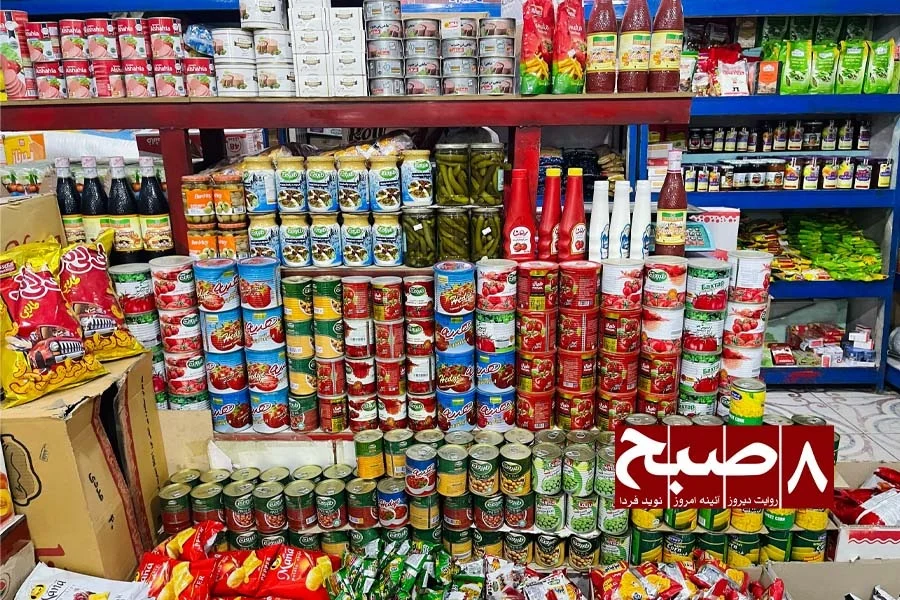
A number of Kabul residents complain about the presence of goods in the market that lack production and expiration dates, manufacturer names, and complete product information. They say that alongside these issues, the availability of counterfeit goods resembling original products has also become a challenge for consumers. These residents add that some food items are not removed from shelves by a number of stores even after their expiration dates have passed, and continue to be sold to customers.
Omar (pseudonym), a Kabul resident, says that the sale of low-quality and expired food items is one of the common problems in Afghanistan’s stores. According to him, some food items whose expiration dates lapse in store warehouses are still sold by the stores. This Kabul resident adds that many customers who cannot read or write purchase and use these food items without paying attention to their expiration dates.
Omar says: “There are even cases where, most likely, after the expiration date of a product has passed, stores stamp a new expiration date on it and sell it again. I myself have noticed several times that expired milk, despite its expiration date having passed, was still placed for sale in the store. Several times after buying it, I noticed that the milk’s date had passed and I returned it. Perhaps the situation is the same with medicines and other goods people need.”
Shahpour, a Kabul resident, expressing concern about the availability of goods that lack production and expiration dates, manufacturer names, and other necessary information, says that despite rising prices of goods, the quality of many products is poor.
He says: “Lately, the shop and store owners themselves stamp the dates of some products onto the packaging. Just yesterday I bought cream, and when I brought it home, I noticed that its date had passed. I went back to the shop and the shopkeeper gave me cream from another package, but since yesterday all members of my family have fallen ill. Doctors also said we have suffered food poisoning.”
Shahpour adds: “Although goods have become more expensive compared to the past, their quality is not good at all. On many products, the name of the manufacturing company and the country of manufacture are not specified, and we do not know where these goods have come from.”
Noor Agha, another Kabul resident, says that the lack of clear information on goods is a serious problem for people, and consumers cannot be certain of the quality and authenticity of products when shopping.
This Kabul resident adds: “When we go to the market, often the information on goods is not accurate or complete. Some goods do not have production and expiration dates, the company name, or the place of manufacture, and we do not know whether they are genuine or counterfeit.”
Noor Agha says: “This issue is especially worrying for us when it comes to food and medicine. Some goods also have packaging similar to original brands, making it difficult for an ordinary citizen to distinguish genuine from fake. In my opinion, there should be stricter oversight so that people know what they are buying, where it came from, and how long it can be used.”
Wazhma complains about the increase in counterfeit cosmetic, hygiene, and cleaning products in the market. She says that even four copies of a single product can be found in the market. She says: “We girls face difficulty finding the genuine version of cosmetics, hygiene, and cleaning products. If we find a genuine product once, we can no longer find that same genuine version again. Sometimes we buy the same product at the original price, but later realize it is a copy. The goods are made so similar that it is not at all easy to distinguish the genuine from the copy.”
This woman adds: “It’s good when we use a cosmetic product once, but when we look for that same product again, we cannot find it. For this reason, skin problems have also increased.”
Meanwhile, Ahmad (pseudonym), one of the shopkeepers, says that some of their products remain in the shop for several months because sales have declined due to people’s poor economic conditions.
He says: “Most of our products have an expiration period of even three or four years, but because people’s economic situation has worsened, no one buys them, and the goods remain in the shop for a long time. We also pay shop rent, and purchasing and transporting these products costs us money. At the very least, we need to recover the original money we spent on buying the goods so that our capital is not lost.”
This comes as the World Food Programme (WFP) recently predicted that food items are available in the markets, but people cannot afford to buy them.
The World Food Programme had said that poverty, unemployment, drought, and rising food prices are factors intensifying the food crisis in Afghanistan. According to the organization, about two-thirds of Afghanistan’s population lives in poverty.
You can read the Persian version of this report here:
کالاهای بیتاریخ و تقلبی؛ باشندهگان کابل در بازار به چه چیزی اعتماد کنند؟