• 8AM.MEDIA
  • ویب‌سایت فارسی
  • پښتو ویب‌پاڼه
  • اۉزبېکچه ویب‌سایت
  • Podcast
Wednesday, October 21, 2026
Hasht-e Subh
  • Home
  • News
    • Afghanistan News
    • World News
  • Opinion
    • Editorial
    • Analysis
  • Reports
    • Daily Reports
    • Investigative Reports
  • Society
    • The story of people
  • Women’s Word
  • Columns
    • Three Years After Afghanistan’s Fall: The Taliban’s Resurgence
    • Towards Equality
    • The Resurgence of the Taliban: Two Years Since Afghanistan’s Fall
    • Hebatullah Report Special Edition
    • Resistance for Education Special Edition
    • Special Column on Taliban’s Education Curriculum
    • Nawroz
  • Interviews
  • Contact Us
    • About Us
    • 8AM MEDIA Annual Awards
    • Submit an Article to Hasht-e-Subh
  • 8am.mediaBack
Subscribe
No Result
View All Result
  • Home
  • News
    • Afghanistan News
    • World News
  • Opinion
    • Editorial
    • Analysis
  • Reports
    • Daily Reports
    • Investigative Reports
  • Society
    • The story of people
  • Women’s Word
  • Columns
    • Three Years After Afghanistan’s Fall: The Taliban’s Resurgence
    • Towards Equality
    • The Resurgence of the Taliban: Two Years Since Afghanistan’s Fall
    • Hebatullah Report Special Edition
    • Resistance for Education Special Edition
    • Special Column on Taliban’s Education Curriculum
    • Nawroz
  • Interviews
  • Contact Us
    • About Us
    • 8AM MEDIA Annual Awards
    • Submit an Article to Hasht-e-Subh
  • 8am.mediaBack
No Result
View All Result
Hasht-e Subh
No Result
View All Result

Shortage of School Buildings and Textbooks Hampers Students’ Education in Tulak, Ghor Province

Translated by Farhad Farhaad | Originally reported in Persian by Ilya

Mohammad Farhaad Mohammad Farhaad
21 October 2026 - Solar Hijri Date: 1405/07/29 [t_time:1792576473]
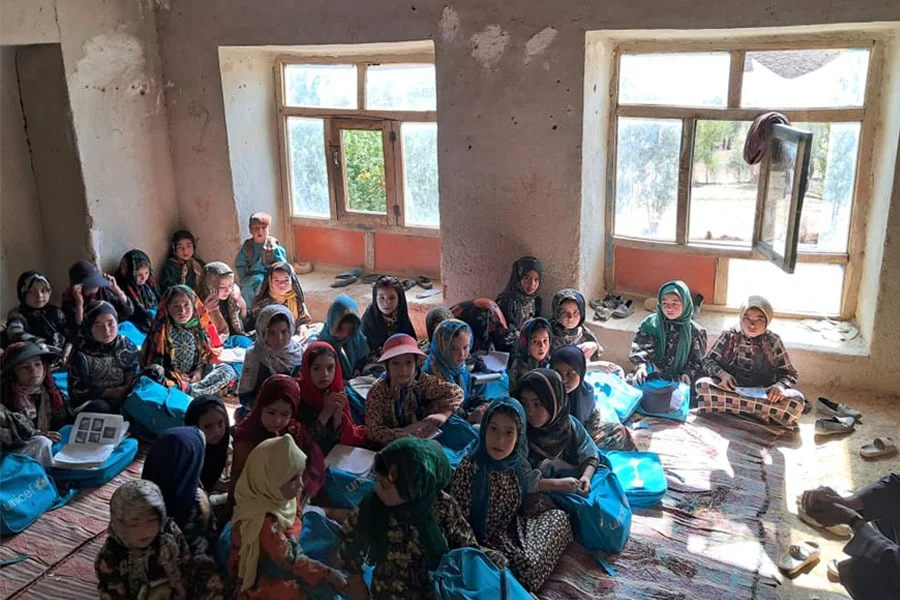
Girl students sit on a carpeted floor in a mud-walled classroom in Tulak district of Ghor amid a shortage of school buildings and textbooks. (Photo credit: Exclusive)

Exclusive

Residents of Tulak district in Ghor province have complained about the lack of buildings for the district’s schools. They say only two or three schools in the district have buildings, while the rest operate out of people’s homes. According to these residents, the buildings of the existing schools also need reconstruction and equipment. They cite a shortage of professional teachers and textbooks, unsuitable classrooms, and a lack of drinking water as other educational problems in the district.

Speaking to the Hasht-e Subh Daily, the residents say most of the teachers in these schools are elderly mullahs who lack the ability to properly convey lessons to students. According to them, the Ministry of Education and the Ghor Provincial Department of Education, both under Taliban control, have not paid sufficient attention to the problem. They also complain about how food aid from the World Food Programme (WFP) is distributed in these schools. According to the residents, children who attend school without formal registration, because no preparatory classes exist, are denied entry to classrooms because of this aid and are forced to follow lessons from outside the classroom.

Yasir (pseudonym), a resident of Tulak district in Ghor province, says the lack of standard school buildings has disrupted students’ education. He adds that most schools in the district operate out of people’s homes and lack the facilities needed to teach students.

Yasir says: “I have seen several schools that have no buildings and operate in people’s homes. Mullahs are present in these schools, and the teachers who taught before are no longer there.”

According to him, the absence of preparatory classes and restrictions on children’s attendance in classrooms have also limited learning opportunities for a number of students in the district. He adds that children who go to school without formal registration in the education system are not allowed into classrooms and must sit at the back until the lesson ends.

The young man continues: “Children who come to school informally [without formal registration in the school system] are not allowed to enter the classroom and sit at the back until the lesson ends. During break time, they are given the biscuits distributed by the WFP and then told to go home. They are not allowed to enter the classroom and learn anything. Those who are in the school think these children come to school for the biscuits, while their families send them to learn something and to be able to enter first grade next year.”

Sajjad (pseudonym), another resident of Tulak district, says most schools in the district are deprived of basic educational facilities, and students study in substandard classrooms. He adds that in a number of schools there are no chairs or desks, and students sit on carpets and on the ground. According to him, in some schools the biscuits donated by the WFP are also not distributed among children as they should be.

Sajjad says: “At the district level, only two or three schools have a proper building, and the other schools operate out of people’s homes. These schools are moved from one place to another every year and have no fixed shelter. In the classrooms, there are not even chairs and desks, and children study on carpets and on the ground.”

Ali Faiq (pseudonym), another resident of Ghor province whose three daughters attend a government school, says the quality of education in a number of schools in the province is also worrying.

The man says: “We have a school where grades one to six are for girls, but its teachers are very old, and the age of some of them reaches around 80. In my view, the children have not learned anything from these teachers’ lessons, and whatever they have learned has come from home. Education officials also say nothing to them because these teachers are mullahs and have work experience. As a result, the educational fate of people’s children has been upended.”

Sulaiman (pseudonym), another resident of Ghor province, says that in addition to the shortage of school buildings, the existing buildings also need reconstruction and renovation. According to him, despite promises to rebuild and equip the local school, no action has been taken since last year.

This resident of Ghor says: “Our school has a six-room building, of which four rooms are used for classrooms and the other two for administration and storage. The school building has been damaged and needs reconstruction and renovation. Although it was promised from last year until this spring that the school would be rebuilt with all equipment, no action has been taken so far.”

Sulaiman stresses that schools in Tulak district and other areas of Ghor province need more support and resources. He says that, given the economic problems of families, many students need food, stationery, and other educational supplies.

He adds: “Our school has a six-room building, of which four rooms are used for classrooms and the other two for administration and storage. The school building has been damaged and needs reconstruction and renovation. Although it was promised from last year until this spring that the school would be rebuilt with all equipment, no action has been taken so far.”

The complaints of Tulak district residents about the lack of school buildings come as, according to figures cited from the United Nations Children’s Fund (UNICEF), at least half of Afghanistan’s government schools lack sufficient space for classrooms, and 58 percent of them have no drinking water or handwashing facilities.

UNICEF has also announced that it has supported four million children in Afghanistan with educational materials and helped rebuild 232 government schools. The organization has described the aim of these measures as providing a safer and more suitable environment for children’s education and development.

Meanwhile, the United Nations Educational, Scientific and Cultural Organization (UNESCO) has warned that Afghanistan’s education crisis is not limited to the exclusion of girls from education, and that the quality of education also faces serious problems. According to figures in the organization’s report, about 2.4 million girls have been deprived of secondary education as of 2026, and about 90 percent of 10-year-old children in Afghanistan are unable to read or understand a simple text.


You can read the Persian version of this report here:
کمبود ساختمان و کتاب؛ چالش دانش‌آموزان در تولک غور

ShareTweetSendSendShare

Related Posts

A young journalist rests his head on his hand while sitting at a laptop in a dimly lit newsroom, as prolonged internships and meager pay weigh on young media workers in Afghanistan. (Photo credit: AI)
Daily Reports

Prolonged Internships and Meager Pay: The Struggle of Young Journalists in Afghanistan’s Media

21 October 2026 [t_time:1792575817]
Two young boys collect water in plastic containers near large water storage tanks (Photo: Reuters) 
World News

UN Warns Water Supplies for 1.6 Million Children at Risk in Yemen

21 October 2026 [t_time:1792571303]
Afghanistan Freedom Front Slogan displayed (Photo: @AfgFreedomAFF/X)
Afghanistan News

Afghanistan Freedom Front: Three Taliban Members Killed in Parwan

21 October 2026 [t_time:1792569958]

Latest

Loading latest news...

Popular stories

  • Donald Trump – U.S. President with Benjamin Netanyahu – Israeli Prime Minister in a gathering of people (Photo: Getty Images) Donald Trump – U.S. President with Benjamin Netanyahu – Israeli Prime Minister in a gathering of people (Photo: Getty Images)

    US Senator Criticizes Netanyahu’s Remarks Justifying War Against Iran

    Share
    Share Tweet
  • Trump Again Says War with Iran Will End “Very Soon”

    Share
    Share Tweet
  • US Defense Secretary Warns Iran of “Destruction”

    Share
    Share Tweet
  • UN Report Reveals Shifts in Family Attitudes and Rise in Domestic Violence in Afghanistan

    Share
    Share Tweet
  • Russian Foreign Intelligence Chief Arrives in Kabul

    Share
    Share Tweet

Podcast

Insights
Insights

Join Lynne O’Donnell for 8AM’s podcast series, Insights.
Lynne talks with generals, diplomats, soldiers, journalists, politicians, activists, people who have front row seats for conflicts around the world, and citizens with a story to tell, happy or sad. For this first series, Afghanistan is the focus. Lynne and her guests talk about the collapse of the republic in August, 2021, and the impact since — for the people of Afghanistan, for the security of the region, for the safety of the world. It’s important, interesting and insightful.

Insights/22: Controlling the Narrative with Mina Sharif
byinsights8am

Controlling the Narrative

Lynne O’Donnell talks with Mina Sharif, author, activist, women’s rights campaigner, educator and mentor. They discuss who controls the narrative and who speaks for Afghanistan’s people when the Taliban appear to have seized control not only of the country but of the message, too.

Have a listen

Insights/22: Controlling the Narrative with Mina Sharif
Episode play icon
Insights/22: Controlling the Narrative with Mina Sharif
Episode Description
Episode play icon
Insights/21: Media Meltdown with Zahra Joya
Episode Description
Episode play icon
Insights/20: Terror Inc with Scott Richards
Episode Description
Episode play icon
Insights/19: Busting Stereotypes with Bushra Gohar
Episode Description
Episode play icon
Insights/18: Media Matters with Waliullah Rahmani
Episode Description
Episode play icon
Insights/17: What Goes Around Comes Around with Sima Samar
Episode Description
Search Results placeholder
Hasht-e Subh

8AM Media, also known as Hasht-e-Subh Daily, stands as Afghanistan's premier independent and non-profit newspaper, resonating as a beacon of journalistic integrity since its establishment in June 2007 by esteemed Afghan journalists and human rights advocates. With a steadfast commitment to citizen journalism and civic education, Hasht-e-Subh Daily has earned its place as the most esteemed publication in the nation.

Publisher: Sanjar Sohail
Email: [email protected]
Executive Director: Parwiz Kawa
Email: [email protected]

Read More

Shortage of School Buildings and Textbooks Hampers Students’ Education in Tulak, Ghor Province

Prolonged Internships and Meager Pay: The Struggle of Young Journalists in Afghanistan’s Media

Trump’s Envoy to Meet Putin

UN Warns Water Supplies for 1.6 Million Children at Risk in Yemen

Afghanistan Freedom Front: Three Taliban Members Killed in Parwan

Editor’s Choice

Every Saturday morning, 8AM MEDIA English Services Department will guide you through the week’s biggest stories from Afghanistan and the international community.

Subscribe

© 2026 - ©Hasht-e Subh Daily

No Result
View All Result
8am.Media
پښتو ویب‌پاڼه
ویب‌سایت فارسی
اۉزبېکچه ویب‌سایت
  • Home
  • News
    • Afghanistan News
    • World News
  • Opinion
    • Editorial
    • Analysis
  • Reports
    • Daily Reports
    • Investigative Reports
  • Society
    • The story of people
  • Women’s Word
  • Columns
    • Three Years After Afghanistan’s Fall: The Taliban’s Resurgence
    • Towards Equality
    • The Resurgence of the Taliban: Two Years Since Afghanistan’s Fall
    • Hebatullah Report Special Edition
    • Resistance for Education Special Edition
    • Special Column on Taliban’s Education Curriculum
    • Nawroz
  • Interviews
  • Contact Us
    • About Us
    • 8AM MEDIA Annual Awards
    • Submit an Article to Hasht-e-Subh
  • 8am.media

© 2026 - ©Hasht-e Subh Daily