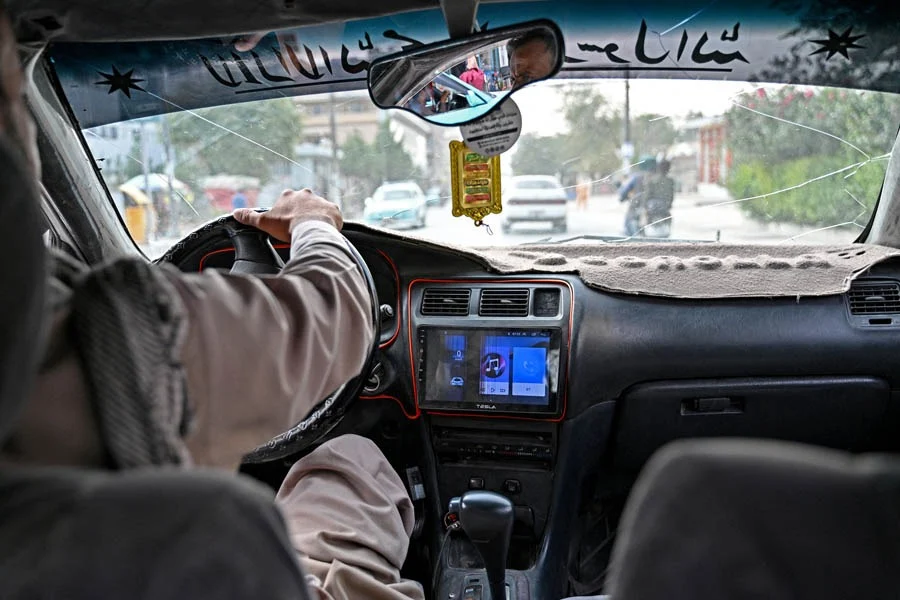
Several women and girls in Kabul have complained about the restrictions and problems they face when using public transport. They say some drivers refuse to pick up passengers because they are women, and in some cases force women to pay the fare for two people.
These women told the Hasht-e Subh Daily that gender-based restrictions are not limited to their access to work, education, schooling, and personal freedoms, but have extended to the use of social services and facilities. According to them, women must pay more and face more restrictions in their daily lives because they are women.
Rukhsar (pseudonym) complained about the difficulties women face in accessing public transport in Kabul. She said women in many cases wait for hours at stations to get a ride in passenger cars, and some drivers refuse to pick them up because they are women. She added that in such circumstances, women are sometimes forced to pay the fare for two people for a single seat.
Rukhsar said, “Women face a great many transport problems at the moment. When women are on their own, unfortunately, many drivers won’t take them. They say, ‘By the time a few more women turn up, we’ve wasted our time. Better to take the men.’ That is why we wait for hours at the station until there are several of us, and only then do we get into a car.” According to her, some drivers charge women the fare for two people, even though the front seat is meant for only one person.
Rukhsar added, “In some cases, the presence of the Taliban’s Morality Police at the stations adds to women’s problems, and several drivers refuse to pick up women who are not accompanied by a mahram, a male guardian.”
Zulaikha (pseudonym) also said one of the serious problems women face in the transport sector is finding a car and paying higher fares. She said, “In many cases, some drivers do not pick up women, or they charge one woman the fare for two people. It has happened to me many times that a driver asked me for the fare of two people, especially in the evening. They cannot make such a demand of men; it is nearly always women who are asked. This situation creates great difficulties for women who use transport every day for work, education, and daily errands.”
This woman added, “To resolve this problem, it would be better if there were more monitoring of public transport, and if legal action were taken against drivers who charge unfair fares or refuse to pick up women without reason.”
Aaya (pseudonym) said her biggest worry when leaving home is transport, and that she sometimes waits up to two hours at the station for a car. She explained, “To begin with, drivers won’t take women, and they say there must be three of you to sit in the front seat. If we are not three, they don’t take us, and if we sit in the front seat, they tell us to pay the fare for two people. On my route there and back, I take six cars. If I pay a double fare of 40 afghanis in each car, my round-trip total comes to more than my salary.”
Aaya added, “When evening comes, drivers pick up men, and women are forced to wait by the roadside. In the evening, women are charged even more than double the fare, 50 or 60 afghanis. Because of their gender, women are not only deprived of human freedoms, work, education, and schooling, but have also been shut out of many social services. Every day, we pay a price in different ways because of our gender.”
Roya (pseudonym) said young girls in Kabul face various problems when commuting. According to her, finding a shared taxi on a fixed route in the morning to get to work is not easy, and girls sometimes have to wait a long time at the stations. The situation becomes more difficult on the way back from work, especially in the evening.
This girl said, “On the other hand, fares sometimes go up, and drivers blame the high price of fuel or gas. In some cases, if a girl wants to sit in the front seat, she is asked to pay the fare for two people. The problem is not limited to fares and finding a car. Some girls, especially when they travel alone, may face inappropriate remarks or behavior. This increases their sense of worry and insecurity.”
Roya added, “For a girl who leaves her workplace in the evening, getting around is more difficult. As darkness falls, fewer cars are available, and sometimes drivers ignore women waiting for a ride and pick up male passengers. As a result, the daily commute has become a constant worry for many girls and can limit their freedom to travel and to be present in the workplace.”
This comes after a number of city taxi drivers in Kabul complained some time ago about the increase in taxes and costs imposed on their vehicles. They had told the Hasht-e Subh Daily that, in addition to renewing vehicle documents, they must also pay various amounts to different institutions every three months. According to them, these costs are being collected at a time when workloads and incomes have dropped compared with the past, while fuel prices and vehicle repair costs continue to rise.
You can read the Persian version of this report here:
کرایه دو تن برای یک زن؛ ترانسپورت کابل و هزینهای که زنان میپردازند