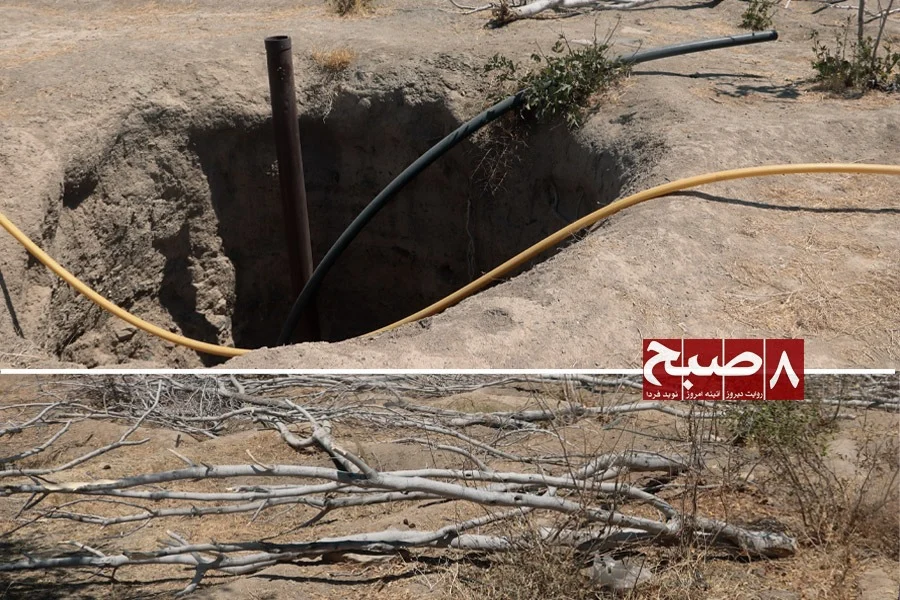
Persistent droughts and the drop in groundwater levels in several districts of Kandahar have had a serious impact on the province’s agriculture and orchard sector. Farmers and orchard owners say that with springs and karezes drying up, hundreds of pomegranate and fig orchards have been destroyed, and they have been forced to dig wells hundreds of meters deep in search of water. Residents of 10 agricultural districts of Kandahar, including Shah Wali Kot, Arghistan, Maruf, Daman, Nesh, Miyanshin, Ghorak, Khakrez, Takhtapul and Maiwand, complain of an unprecedented water shortage. They say that previously groundwater could be found at a depth of just a few meters, but now in some areas the water table has dropped to 200 to 300 meters. Most of the fig and pomegranate orchards in these districts, which serve as the main source of income for residents, are located in these areas.
Syed Agha, an orchard owner in Shah Wali Kot district, says he has attempted to dig a well twice in search of water, but both attempts have failed. He says: “Previously we would find water at a depth of 50 to 60 meters, but now it is at a depth of 250 to 300 meters. This water is neither easy to extract, nor is digging a well at this depth a simple task.” According to him, digging deep wells requires the use of “screw augers,” which are very costly, with the cost of digging a single well reaching around 500,000 Afghanis.
Abdul Salam, a resident of the Khoshk Ab area, says that due to the water shortage, his entire fig orchard has dried up and he has been forced to uproot the trees. He says that extracting water from deep wells requires dozens of solar panels, which imposes a heavy economic burden on families.
Orchard owners say that trees which have been a source of income for their families for several generations are now being uprooted due to the water shortage. They warn that if this situation continues, rural areas will become depopulated.
Dadullah, a resident of the Chinah area in Arghistan district, says that previously springs and karezes were active and groundwater was found at a depth of only two or three meters, but now these sources have dried up. He adds: “Now those who have the means to dig deep wells are doing so, but those who lack the financial means see their orchards dry up and are migrating from the area.”
Weak infrastructure to control water
Residents of Maruf district consider the absence of dams and water reservoirs to control water flow as the main reason for the drying up of orchards.
Fatah Mohammad, a resident of this district, says there is no large dam in the area to store and control water, and the small dams or check dams that have been built also have no significant impact on agriculture and orchard cultivation.
In Khakrez district as well, farmers complain about the quality and capacity of the small dams built to store water.
Allah Nazar, a resident of this area, says that millions of afghanis have been spent on some of these dams, yet they are unable to store water, and a number of them have also become filled with silt sediment.
Climate change and water shortage in Kandahar
Water experts consider climate change to be one of the major factors intensifying the drought.
Mohammad Aref, an expert in this field, says the drought problem in Kandahar is not limited to reduced rainfall alone, but that rising temperatures, irregular rainfall, unchecked extraction of groundwater, and a lack of water control infrastructure are among the main causes of this crisis. According to him, in addition to the decline in agricultural production, the livestock sector has also suffered significant damage. This expert warns that as the unprecedented water shortage continues, the likelihood of increased conflicts and disputes among people over water resources will also rise.
More than 30 percent of orchards face risk of drying up.
Officials from the Taliban’s Directorate of Agriculture, Irrigation and Livestock in Kandahar say that water shortages and climate change have put more than 30 percent of the province’s orchards at serious risk of drying up. According to them, pomegranate and fig orchards in Shah Wali Kot, Maruf and Arghistan districts have been affected more than other areas.
Meanwhile, orchard owners and farmers are calling on the Taliban, instead of empty promises and imaginary projects, to take practical steps to address this major humanitarian crisis. They are demanding an increase in the storage capacity of the Dahla Dam, the construction of small dams, and the provision of facilities and training related to drip irrigation in order to reduce water consumption and make effective use of existing resources.
Experts emphasize that controlling rainwater and floods, regulating groundwater extraction, promoting low water consumption farming systems, protecting karezes and natural springs, and providing economic assistance to orchard owners affected by the drought are among the essential steps needed to prevent this crisis from spreading.
Various United Nations agencies have previously expressed concern about the drought, saying that for the fifth consecutive year it has negatively affected orchard owners’ crops, causing a 10 percent decline in pomegranate production.
You can read the Persian version of this report here:
خشکسالی در قندهار؛ ۳۰ درصد باغها با خطر خشکشدن روبهرو هستند