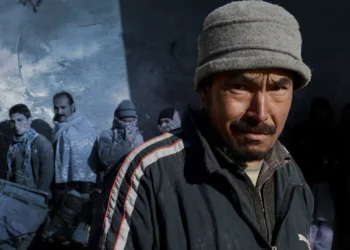
With the arrival of cold weather, life has become increasingly difficult for residents of Kunduz Province. Many daily wage laborers, street vendors, and shopkeepers report facing mounting economic and social pressures. They say that beyond financial hardships, the Taliban’s stringent regulations and constant monitoring have further constrained their ability to engage in economic and social activities.
Some daily wage laborers and small-scale tradespeople in Kunduz explain that as winter approaches, the rising cost of fuel has made it nearly impossible for them to heat their homes. They worry that the harsh cold may endanger their children’s lives.
Abdullah, a daily wage laborer in Kunduz city, remarked, “Finding work was already challenging during the warmer months. Now, with the cold weather, most days we’re unemployed. On some days, I manage to earn 200 to 300 Afghanis, which only covers the cost of dry bread. We can’t take care of other needs.”
Laborers in the city admit they are entirely unprepared to heat their homes for the winter. They also lament their inability to buy warm clothing for their children.
Jan Mohammad, another laborer, said he goes to the streets every morning in search of work but returns home empty-handed most days. “There’s no work now that it’s cold. I spend all day wandering the city, hungry and thirsty, and go home at night with nothing,” he said.
He added, “Today, I worked from morning until evening and earned just 80 Afghanis. I have 11 family members to feed. When I get home, the first thing I do is buy dry bread for them because most nights, we have nothing to cook. I haven’t bought warm clothes for my children, but if I can save some money, I’ll get second-hand winter clothes for them from the flea market.”
Mobile vendors and pushcart operators face similar struggles. They complain of cold weather, fewer customers, and harassment from the Taliban’s municipal employees. Vendors say they are forced to operate discreetly because the Taliban ban street vending on sidewalks and roadsides. Some admit they pay bribes to municipal officials to continue working, while those who can’t afford to pay must stay on the run to avoid being caught.
Farhad, a pushcart vendor, explained, “People don’t have money to buy things. Every morning, we leave home hoping for work, but there are fewer customers now. On top of that, the Taliban don’t let us work freely, and we’re forced to pay them bribes.”
Shopkeepers in Kunduz are also grappling with reduced consumer spending power and the burden of unofficial taxes imposed by the Taliban. They report being required to pay substantial taxes, sometimes in advance. Rising prices, driven by increased taxes and customs duties, have worsened the situation, leaving shopkeepers unable to control costs.
Haroon (pseudonym), a shopkeeper in Kunduz city, explained, “Our sales have dropped drastically. People can’t even afford basic goods. On top of that, the Taliban collect extra taxes from us. If we don’t pay, they threaten to close our shops, and some have already been shut down for a week.”
Beyond economic challenges, the Taliban’s strict security measures and pervasive surveillance have further strained daily life in Kunduz. One resident, speaking anonymously, remarked, “We have neither freedom nor peace here. Poverty weighs on us from one side, and the Taliban’s pressure from the other. We can’t even raise our voices in complaint.”
Residents also report a decline in humanitarian aid. They allege that the Taliban interfere in distributing aid and that neighborhood leaders and their relatives often dominate the list of recipients, depriving the most vulnerable and needy people of assistance.
As Kunduz residents continue to grapple with unemployment and unrelenting economic hardships, the World Bank has highlighted Afghanistan’s deepening economic crisis. The country faces significant challenges, including financial restrictions, trade imbalances, and limited capacity for public investment. The report stressed that poverty remains widespread, with vulnerable groups such as women, children, and internally displaced persons bearing the brunt of the crisis.
In addition, the Pakistan Afghanistan Joint Chamber of Commerce & Industry (PAJCCI) recently reported a sharp decline in trade between the two countries, plummeting from $2.5 billion to $700 million.
You can read the Persian version of this daily report here: