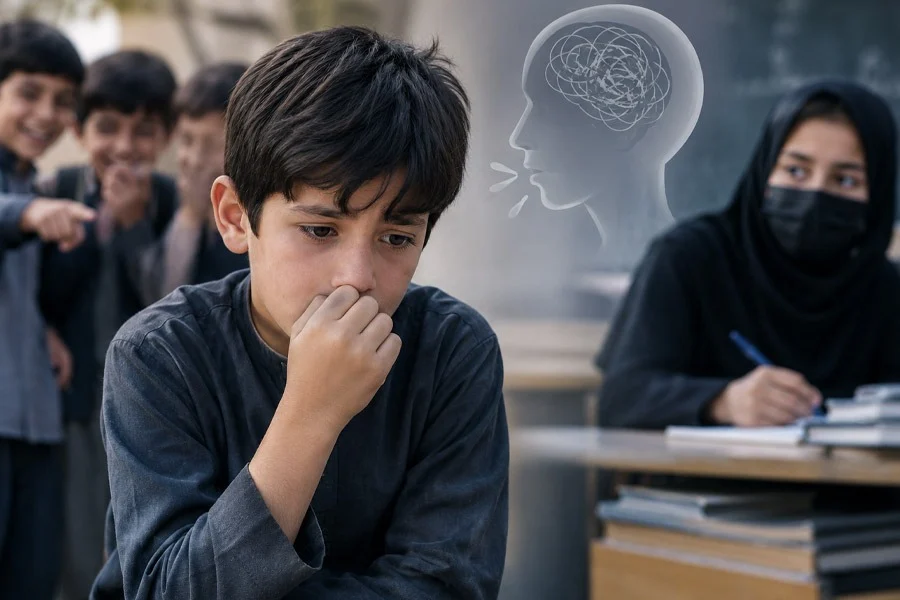
A number of psychologists are warning about the psychological and social consequences of mocking people who stutter. According to them, such treatment can lead to reduced self-confidence, social isolation, and psychological harm. These psychologists stress the need to expand awareness programs through the media and educational institutions. They say that raising public awareness and promoting a culture of respect and acceptance of differences can play an effective role in preventing ridicule and discrimination against people who stutter.
Samira Sediqi, a psychologist, says that mocking people who stutter can have a deep and negative impact on their mental health and emotional state. She says: “People who are ridiculed for stuttering may develop fear and anxiety, withdraw from social settings, and avoid gatherings to prevent encounters with others.”
Sediqi adds: “Being mocked by others can cause feelings of shame and even depression in these individuals. Such behavior lowers their self-confidence and may lead to isolation and withdrawal. Moreover, ridicule can affect their education and schooling and prevent them from achieving desirable academic results. In some cases, these behaviors may also provoke anger and aggression in the person.”
Zakaria Barakzai, a psychologist, says stuttering can have genetic causes, but in some cases it may also be linked to traumatic life experiences, whether in childhood or adulthood. According to him, experiences such as psychological trauma, fear, harassment in childhood, and suppressed memories that are difficult for a person to talk about are among the factors that should be taken into consideration.
Mr. Barakzai says: “In some cases, disruptions in the functioning of mental processes or problems related to the activity of hormones in the body may also play a role in the onset of stuttering. Unfortunately, due to a lack of sufficient awareness in society in Afghanistan, some people attribute stuttering to divine punishment or fate and believe that a person has developed this problem because they were cursed. Others regard stuttering as a source of amusement and a means of mocking others. However, stuttering is not a disability in the sense of limiting a person’s abilities, and people who stutter can also grow, make progress, and achieve success.”
He adds: “More attention should be paid to the abilities of people who stutter, particularly their writing abilities, and they should be treated with respect and appreciation. Likewise, extensive awareness-raising should be carried out through the media and teachers so that the grounds for ridicule and discrimination against these individuals in society are reduced.”
Mohammad Hanif Hashemi, a doctor, says stuttering is a speech disorder, not a neurological one, which usually appears among children but may also occur at older ages. The doctor says: “The causes of stuttering can be genetic, and in older people, strokes and neurological attacks can also lead to stuttering. There is no specific treatment method or medication for stuttering.”
Hashemi adds: “Children who stutter should be given time, and their words should be listened to patiently. During conversation, they should not be interrupted, and the child should not be forced to repeat what they have said. Speech exercises and encouragement to speak can, over time, help improve a child’s stuttering. If stuttering suddenly appears in an older person, it may be accompanied by symptoms such as paralysis of body parts and a drooping mouth. In such a case, the person should be taken to the emergency department of a hospital as soon as possible.”
Jawid (a pseudonym), who has a stutter, says he often avoids speaking, particularly in the company of people he has not met before. According to him, his stutter began after the death of his brother, and since then it has affected his daily life and social relationships.
He says: “When I speak, my tongue keeps getting stuck, and I myself suffer from this condition. I am a pharmacist and deal with many customers during the day. When talking to them and explaining how to use medicines, my tongue gets stuck several times. I did not have such a problem before, but after my brother died and I stood beside his body, I developed this problem.”
Shoab, a 12-year-old boy who stutters, says that being mocked by his peers because of his speech problem has led him to speak less and stay away from other children. He says: “When I speak, my classmates and other children make fun of me because of my stutter. For this reason, I have no friends, I do not talk, and I do not play football. At school, I have never been able to read a lesson aloud. I wish this problem of mine would go away and that I could speak easily like everyone else.”
It is worth noting that October 22 marks International Stuttering Awareness Day. The day is observed every year to draw society’s attention to the challenges faced by people who stutter, to counter prejudice, and to promote informed and supportive treatment of them.
Stuttering is a type of speech fluency disorder marked by repetitions, prolongations, or involuntary pauses while speaking. It may begin in childhood and continue into adulthood.
You can read the Persian version of this report here:
تمسخر افراد دارای لکنت زبان؛ از کاهش اعتمادبهنفس تا انزوای اجتماعی