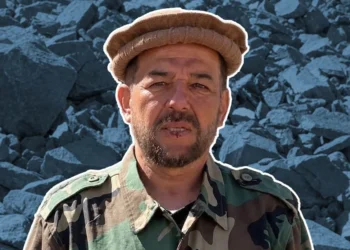
Mullah Hibatullah Akhundzada, the supreme leader of the Taliban, has maintained his distance from the public, following the example of Mullah Omar, who kept himself hidden for certain reasons. Although before ascending to the leadership of the Taliban, he served as a cleric at the “Haji Mohammad Hassani” mosque and later at the “Al-Hujjaj” mosque near Quetta, Pakistan in 2015, where he trained young people for suicide attacks and bound their waists, he kept himself away from public view after he became the supreme leader of the Taliban in 2016, following Mullah Akhtar Mansour’s death. After the Taliban’s resurgence in Afghanistan, Akhundzada moved to Kandahar and continued his practice of remaining hidden. Hibatullah, who has been promoted by Taliban lobbyists as the supreme leader of the “changed Taliban,” follows Mullah Omar so closely that not only does he imitate Omar in his overall policies, but also in choosing Kandahar as the leadership center and maintaining the leader’s concealment. In the past three years, apart from a few instances where it is said that the group’s officials were summoned to Kandahar for meetings, he has not shown himself to the public. Even when the Taliban claimed that their supreme leader gave a speech during Eid prayers, it was unclear to the people who were speaking, as the speaker had his back to the audience. Recently, however, this hidden supreme leader has begun traveling to several provinces. It was recently reported that he traveled to Nimruz province, and last Thursday, he went to Badghis and subsequently visited Faryab, Jawzjan, and Balkh. Some media outlets have also reported his visit to Sar-e Pol. There is speculation about his imminent travel to Badakhshan and Takhar as well. Why has Mullah Hibatullah started these travels?
It is said that during his visit to Jawzjan, Mullah Hibatullah also visited Dasht-e-Laili. This visit might serve as a message to the Taliban’s opponents, suggesting that the group has not forgotten the events of the early 21st century and may continue to seek revenge. In essence, Hebatullah’s visit to Dasht-e-Laili is a political display.
Just as Mullah Hibatullah keeps himself hidden from the public, his travels and presence remain out of the media’s view and, consequently, from the Afghan public. If any domestic media has information or details about his travels or actions, they cannot publish them. Now that Mullah Hibatullah has started traveling, he remains elusive, taking the curtain with him. Nonetheless, media reports indicate that he emphasized the strict implementation of his orders by local officials during his visit to Faryab. Although Taliban-controlled media have added that he has encouraged his officials to avoid prejudice, discrimination, and arrogance, and to cooperate with the families of victims, or that he has dismissed some officials in Balkh, these matters do not seem to be of great importance to him as reasons for his provincial visits. Reports also state that Hibatullah Akhundzada has emphasized the enforcement of Sharia laws and the implementation of the Ministry of Propagation of Virtue and Prevention of Vice, which he regards as more crucial than avoiding prejudice and discrimination. Despite the domestic and international backlash against this law, the pressures have not been strong enough to worry the Taliban leader about its non-implementation.
It seems Mullah Hibatullah has started these travels to compel his officials in the northern regions to complete obedience if they had not fully complied, and to establish his presence in the northern regions. Given that he resides in Kandahar rather than the capital, he has limited insight into the northern situation. Additionally, reports, including those from the United Nations, have noted increased attacks from the National Resistance Front of Afghanistan and the Afghanistan Freedom Front (AFF), while active across various regions, have significantly targeted northern provinces. Traditionally, those involved in the National Resistance Front of Afghanistan and managing the Afghanistan Freedom Front have greater access to the North. Mullah Hibatullah’s trip to the north allows him to manage minor administrative tasks, personally assess the situation in these provinces, and gauge the strength of anti-Taliban fronts.
Although there are speculations about Mullah Hibatullah meeting with the supreme leader of the East Turkistan Movement in Faryab, certainly, he would not travel from Kandahar to meet someone seeking refuge. Therefore, Mullah Hibatullah appears to be traveling to the north to solidify his presence in these regions and simultaneously manage internal group conflicts. Internal conflicts within the Taliban are escalating due to ethnic biases. Some commanders who are not ethnically aligned with Mullah Hibatullah have been suppressed, while others seem to be sidelined. This situation has angered Taliban members from the north, who are generally from non-Pashtun backgrounds. The weakening of northern commanders inevitably increases internal tensions. Meanwhile, the ISIS group, as a rival to the Taliban in the north, is also active and recruiting. Attracting disillusioned Taliban fighters could be an unintended success for ISIS.
You can read the Persian version of this analysis here:
سفر ملا هبتالله به شمال؛ نمایش قدرت و تلاش برای یکدست نگهداشتن گروه