Previous part:
Part I: What Made the Peace Last? Lessons from Northern Ireland’s Good Friday Agreement
Key Actors and Their Roles in the Success of the Peace Agreement
The Northern Ireland peace process involved both domestic and foreign actors, a feature regarded as one of the key indicators of the hybrid peace approach. The roles of domestic and foreign actors in this process are examined separately below.
Civil Society
The Opsahl Commission, established in 1993, and the non-partisan “Yes” Campaign were two important initiatives that highlighted the role of civil society in the Northern Ireland peace process. Professor Torkel Opsahl, a human rights activist, led the commission. Its main goal was to gather proposals from the public and political parties on the way forward in the Northern Ireland peace process. According to Elliott (2013), who worked directly with the commission, some politicians initially criticized it. In the end, however, all the main parties to the conflict engaged with it, and the principle that ordinary people should also be consulted came to be accepted.
The commission proposed that confidential talks be held between Sinn Féin, the political wing of the Irish Republican Army (IRA), and the government, since Sinn Féin had been barred from taking part in discussions. The proposal drew strong criticism, but it was carried out during the peace process and produced positive results. In addition, the Opsahl Commission’s recommendations on power-sharing and decision-making based on the consent of the people were reflected in the Good Friday Agreement: “Provided that Irish nationalism in Northern Ireland is legally recognized [Recommendation 1.3] … a government should be established for Northern Ireland based on the principle that each community has an equal voice, or a veto, over the making and implementation of laws, and that executive power is shared equally” (Elliott, 2013).
The “Yes” Campaign, which aimed to win public votes in support of the Good Friday Agreement in the May 1998 referendum, was the second major civil society initiative. Its advocates believed the Good Friday Agreement was a turning point for peace in Northern Ireland, so winning public support and persuading people to endorse the agreement was essential. Through research, public education, and other related activities, the campaign sought to spread and reinforce this message across society. The “Yes” Campaign played a fundamental role in the success of the referendum and the approval of the Good Friday Agreement (Hancock, 2011; Couto, 2001).
Religious Leaders
According to Sandal (2018), religious leaders made a significant contribution to the success of the Northern Ireland peace process. They supported the process by organizing joint marches and workshops, condemning violence, holding dialogue, and offering counsel to key leaders who had played a part in escalating the conflict. Several key figures in the conflict and the peace process, including Gerry Adams, president of Sinn Féin from 1983 to 2018, and Albert Reynolds, then Prime Minister of Ireland, have acknowledged and praised the influence of religious leaders on the peace landscape.
In addition, religious leaders worked to persuade other paramilitary groups to support peace. After the Good Friday Agreement, they also continued their constructive involvement by offering counsel, visiting conflict-affected and war-torn areas, and paying attention to global issues that could affect the peace process.
Domestic and Foreign Politicians
The Irish government, representatives of nationalists and unionists, and some independent parties, including the Alliance Party and the Northern Ireland Women’s Coalition (NIWC), were among the most important domestic actors in the peace talks. The United States and the United Kingdom also took part in the process as foreign actors. Sinn Féin, together with the Social Democratic and Labour Party (SDLP), represented the nationalist camp, while the Ulster Unionist Party (UUP), the Progressive Unionist Party (PUP), and the Democratic Unionist Party (DUP) represented the unionist camp.
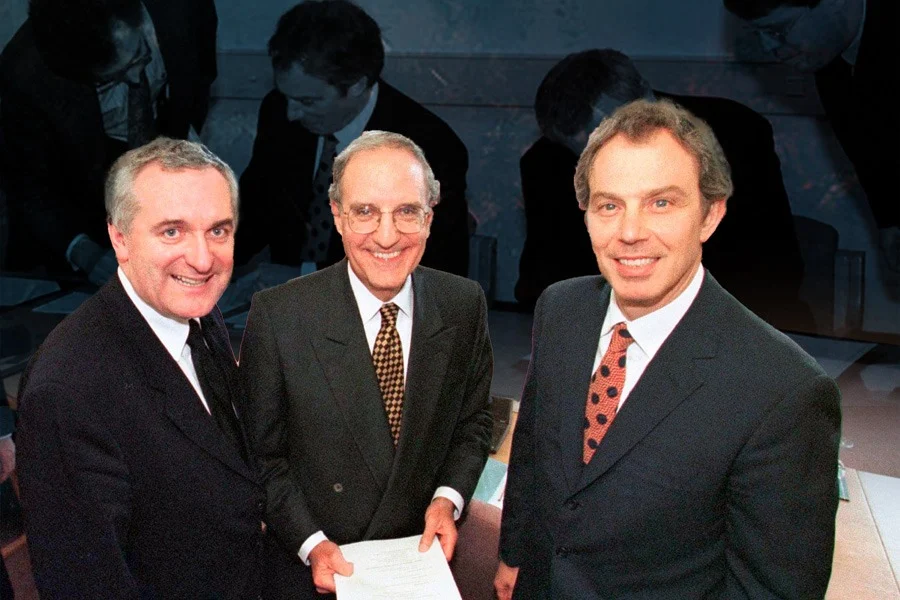
On the role of the United States in the peace process, Archick (2019) argues that the Clinton administration played a vital role in helping the parties reach the Good Friday Agreement, and that the George W. Bush administration also strongly supported its implementation. Shortly after Clinton’s victory in the 1993 presidential election, Democratic Senator George Mitchell was appointed as the US special envoy for the Northern Ireland peace process (Rubiera, 2018). Mitchell played a vital role in reaching the agreement. In an interview published by the United States Institute of Peace (USIP), he explains the “Mitchell Principles,” which called on all parties involved to use democratic and peaceful means to achieve their political goals. This principle is also reflected in the Belfast Peace Agreement, or Good Friday Agreement.
The United Kingdom was another important actor in the process. The British government demanded the disarmament of the IRA and presented it as a precondition for Sinn Féin, one of the main nationalist parties, to enter multi-party negotiations on the future of Northern Ireland. In response to this demand, the IRA broke the 1994 ceasefire, and this situation continued until governments changed in the United Kingdom and Ireland. This reaction ultimately forced the United Kingdom to drop the precondition. As a result, Sinn Féin entered the negotiations and resumed the ceasefire in 1997 (Guelke, 2003). This experience shows that setting preconditions, depending on the context and circumstances of a conflict, can affect the chances of success of negotiations.
On the role of domestic actors in the peace process, Nozell’s (2023) interview with a Northern Ireland minister, someone who has spent many years implementing the Good Friday Agreement, is also significant. In the interview, the minister stresses the vital role of political leadership, religious leaders, and civil society, as well as the interest of all parties in ending the conflict.
Conclusion and Lessons for Afghanistan
The overall findings of this article can be divided into three categories.
First, the article considers consociationalism, together with the “top-down” approach, useful for understanding the Northern Ireland peace process. At the same time, it argues that the process also had some features of hybrid peace and can be studied from that perspective as well. Attention to this dimension partly fills one of the gaps in the literature on the Northern Ireland peace process.
Second, the peace agreement addressed the roots of the conflict, which essentially included political power, ethnicity, religion, and issues related to the constitution, institutions, and political structures. In other words, the Belfast, or Good Friday, Agreement recognized and reflected the demands of all parties involved, especially unionists and nationalists, regarding the fate of Northern Ireland. The agreement left the determination of Northern Ireland’s fate, whether to remain within the United Kingdom or join a united Ireland, to the people. The agreement also incorporated some civil society proposals and emphasized the protection of human rights for all. In addition, by amending laws, restructuring the police and justice systems, and establishing new executive and legislative institutions, it addressed some dimensions of structural violence.
Third, there was strong political will for the peaceful resolution of the conflict among both foreign and domestic actors. Introspective political leadership and the involvement of religious leaders and civil society effectively strengthened the peace efforts. Importantly, there was no fundamental and lasting precondition for the parties in the peace negotiations, and the one precondition that was raised was dropped shortly afterward. This experience shows that preconditions are not necessarily essential for the success of peace negotiations, and that their effectiveness depends on the circumstances and context of each conflict.
Overall, the Northern Ireland experience shows that lasting peace requires a combination of power-sharing institutional mechanisms and positive hybrid peace approaches, attention to the political and structural roots of the conflict, guarantees for the rights and demands of the parties involved, and the political will and inclusive participation of domestic and international actors. The success of negotiations also depends less on absolute reliance on preconditions than on how well peace strategies fit the circumstances and context of the conflict.
If we connect the Northern Ireland experience with Afghanistan, we find that the conflicts in both cases, despite historical and political differences, share some similarities. These include the long duration of the conflict, more than thirty years in Northern Ireland and more than forty years in Afghanistan, as well as identity-based disputes and the issue of power-sharing. This provides an opportunity to examine the conflict resolution mechanisms of Northern Ireland more deeply and to assess the possibility of using some of their elements in Afghanistan’s circumstances.
For example, in Northern Ireland, the absence of rigid preconditions in the negotiations, cooperation among political elites, domestic ownership of the peace process, the participation of civil society and religious leaders, the genuine will of the parties to compromise, and serious cooperation from foreign actors all contributed to reaching the peace agreement. By contrast, in the Doha peace talks on Afghanistan, divisions among political elites, the lack of agreement on power-sharing, the avoidance of discussion on the structure of the political system, the constitution, and institutions, the setting of preconditions, and the imbalance between domestic and foreign actors created conditions for the negative influence of outside actors and contributed to the failure of the peace process.
As the author of this article found in another study, titled The Intersection Between False Readiness Theory and Negative Hybrid Peace: The Case of Afghanistan, the mutual interaction between the false readiness of the conflict parties for reconciliation and negative hybrid peace contributed to the failure of Afghanistan’s peace process. Negative hybrid peace refers to a situation in which domestic actors and factors, owing to weakness and incapacity, pave the way for the demands of foreign actors to be imposed during the peace process, and thus domestic ownership and leadership of the process are undermined. As stated, in the Northern Ireland experience, this issue was managed well because a domestic balance of power was established through cooperation among political elites, the parties to the conflict, and civil society, and the role of foreign actors also took shape mainly in a constructive form that served the success of the peace process.
Therefore, the fundamental lesson of the Northern Ireland experience for Afghanistan is that achieving a lasting peace agreement requires cooperation among elites, the creation of strong structures and institutions for power-sharing, and the inclusive participation of social groups. In particular, it requires launching efforts by religious scholars to encourage the conflict parties to reconcile and, where necessary, to challenge their non-conciliatory positions under current circumstances. It also requires maintaining domestic ownership of the peace process while pursuing meaningful engagement with foreign actors.
Of course, the aim is not to transfer the Northern Ireland experience to Afghanistan as it is. Rather, it is necessary to examine the mechanisms used in that experience in light of Afghanistan’s specific historical, political, social, and institutional conditions, and to learn from its transferable elements.
References
- Agreement, G. F. (1998). The Northern Ireland Peace Agreement. Agreement reached in the multi-party negotiations. UN Peace-making:
- Archick, K. (2019). Northern Ireland Peace Process: Background and Challenges. Congressional Research Service.
- Belloni, R. (2012). Hybrid peace governance: Its emergence and significance. Global Governance, 21-38.
- Bir.B. (2023), UN chief says world needs spirit of Northern Ireland’s Good Friday Agreement more than ever. Anadolu Ajansi:
- Couto, R. A. (2001). The third sector and civil society: The case of the “YES” campaign in Northern Ireland. Voluntas: International Journal of Voluntary and Nonprofit Organizations, 12, 221-238.
- Darby, J. (2003) Northern Ireland: The background to the peace process, CAIN. Available at: https://cain.ulster.ac.uk/events/peace/darby03.htm (Accessed: 12 January 2024).
- Democratic Progress Institute (2013), the Good Friday Agreement – An Overview. London, United Kingdom.
- Elliott, M. (2013). The role of civil society in conflict resolution: The Opsahl commission in Northern Ireland, 1992–93. New Hibernia Review/Iris Éireannach Nua, 17(2), 86-102.
- Guelke, A. (2003). Civil society and the Northern Irish peace process. Voluntas: International journal of Voluntary and non-profit Organizations, 14, 61-78.
- Hancock, L. E. (2008). The Northern Irish peace process: from top to bottom. International Studies Review, 10(2), 203-238.
- Hancock, Landon E. (2011) ‘There is No Alternative: Prospect Theory, the Yes Campaign and Selling the Good Friday Agreement’, Irish Political Studies, 26: 1, 95-116
- HistoryExtra. (2023, April 7). A brief history of the Good Friday Agreement.
- Ireland (n.d) 25 years of the Good Friday Agreement, Available at: https://www.ireland.ie/en/25-years-of-the-good-friday-agreement/ (Accessed: 12 January 2024).
- Kalb, M. (n.d). George Mitchell Transcript. United States Institute of Peace. https://www.usip.org/public-education-new/george-mitchell-transcript
- Northern Ireland Assembly (n.d.), Consociationalism explained, [Video], available: https://education.niassembly.gov.uk/video-gallery/consociationalism-explained. Transcript of the Video: https://education.niassembly.gov.uk/sites/default/files/video-transcripts/consociationalism-explained-transcript.pdf
- Nozell, M. (2023). What can we learn from Northern Ireland’s 25 years of peace? United States Institute of Peace. https://www.usip.org/publications/2023/04/what-can-we-learn-northern-irelands-25-years-peace (accessed on 16 January 2024)
- Qayumi, S., & Coşkun, E. R. (2026). The Intersection Between False Readiness Theory and Negative Hybrid Peace: The Case of Afghanistan. Uluslararası İlişkiler Dergisi, Advanced Online Publication.
- Rubiera C.L. (2018). Good Friday Agreement: Ten key people who helped bring about peace in Northern Ireland 20 years ago. The Conversation. https://theconversation.com/good-friday-agreement-ten-key-people-who-helped-bring-about-peace-in-northern-ireland-20-years-ago-94613 (Accessed on 16 January 2024)
- Sandal, N. (2018). Religious leaders and the Northern Ireland Peace Process. Berkley Center fo Religion, Peace and World Affairs. https://berkleycenter.georgetown.edu/responses/religious-leaders-and-the-northern-ireland-peace- (Accessed on 16 January 2024).
- Snyder, E. M. (2022). The troubles: Root causes of tension in Northern Ireland.
- The National Archives UK (n.d), From Conflict to Peace – The Belfast (Good Friday) Agreement – 25 Years On, [Video],You Tube: https://www.youtube.com/watch?v=VQXBpt5RArY
- Wagner, L., & Druckman, D. (2017). Drivers of durable peace: The role of justice in negotiating civil war termination. Group Decision and Negotiation, 26(1), 45-67.
You can read the Persian version of this analysis here:
بخش دوم و پایانی – عوامل پایداری صلح با تمرکز بر توافقنامه جمعه خوب در ایرلند شمالی