Abstract
This qualitative case study focuses on the peace negotiations in Northern Ireland in the 1990s, particularly the Good Friday Agreement signed in Belfast in 1998, and seeks to explain the factors that led to a lasting peace. The paper combines consociationalism, the top-down approach, and Hybrid Peace theory as a theoretical framework for analyzing the Northern Ireland peace agreement. The main difference between this paper and the works the author has briefly reviewed lies in this theoretical framework.
The data used in this study were collected from secondary sources. These include statements by negotiators and participants in the Northern Ireland peace process, the text of the Good Friday Agreement, academic journals, English-language online articles, news reports, videos, and interviews.
The findings of this study show that the durability of peace in Northern Ireland resulted from a combination of factors: strong political will at the domestic and international levels to resolve the conflict peacefully, significant reflection of the demands of the conflicting parties in the provisions of the agreement, the planning and implementation of reforms, the establishment of new institutions for power-sharing and legislation, the revision of existing laws, respect for the principle of majority consent, and the active participation of religious leaders and civil society.
Keywords: sustainable peace, Good Friday Agreement, Northern Ireland, Unionists and Nationalists, consociationalism, hybrid peace
Introduction
Why do some peace agreements succeed in ending conflict while others fail? This paper examines the question by focusing on the Northern Ireland peace process in the 1990s. Several secondary questions also arise in this context: How did the Northern Ireland conflict take shape, and how did it end? What factors made the peace agreement in this region durable?
Before addressing these questions, it is necessary to present a clear picture of the subject under discussion. To that end, the paper first briefly introduces Northern Ireland and the background of the conflict in the region, and then defines the concepts and scope of the study. Subsequently, the main question, the paper’s argument, and the theoretical framework of the research are set out in detail.
The population of Northern Ireland is estimated to be roughly 45 percent Catholic and 55 percent Protestant. These two communities held different and at times contradictory views of the roots of the conflict. Emphasizing the historical unity of the island of Ireland, Catholics regarded the conflict as a nationalist struggle for the right to self-determination. In addition, a group of Catholics believed that the roots of the conflict lay in the corruption and persistent injustice of the Protestant-dominated systems of governance. According to this group, if those systems were dismantled, an open and pluralist society would emerge in which all segments, both Protestants and Catholics, could live side by side peacefully.
In contrast, Protestants, who are also called Unionists, insisted on maintaining the link between Northern Ireland and Britain, and regarded the Nationalist understanding of the conflict as a threat to their own conception of union with Britain. They therefore resisted Catholics, that is, Nationalists, in various ways (Darby, 2003). Thus, the main parties to the conflict were divided into two camps: Nationalists, who wanted separation from Britain and the unification of Ireland, and Unionists, who emphasized maintaining Northern Ireland’s link with Britain.
Eventually, the conflict between Nationalists and Unionists reached a period known as “The Troubles.” This term refers to a period of violence and conflict that began in the late 1960s and continued until the peace process and the end of large-scale hostilities in the 1990s. Inspired by the American Civil Rights Movement, a similar movement, with the participation of mainly Catholics, emerged in Northern Ireland in the 1960s. Violence peaked in 1972, when 496 people were killed. The intervention of the British Army to confront the Nationalists and the civil rights movement further intensified the conflict. In total, about 3,600 people lost their lives during the conflict (Hancock, 2008).
From the above explanations, it can be understood that the distribution of political power, religion, and identity, of which territory is also a part, were among the main factors of the conflict in Northern Ireland. Therefore, conceptually, this conflict can be described as “ethno-nationalist” and a “protracted conflict.” One of the characteristics of protracted conflicts, in addition to their duration, is their complexity and their connection to issues of identity and territory.
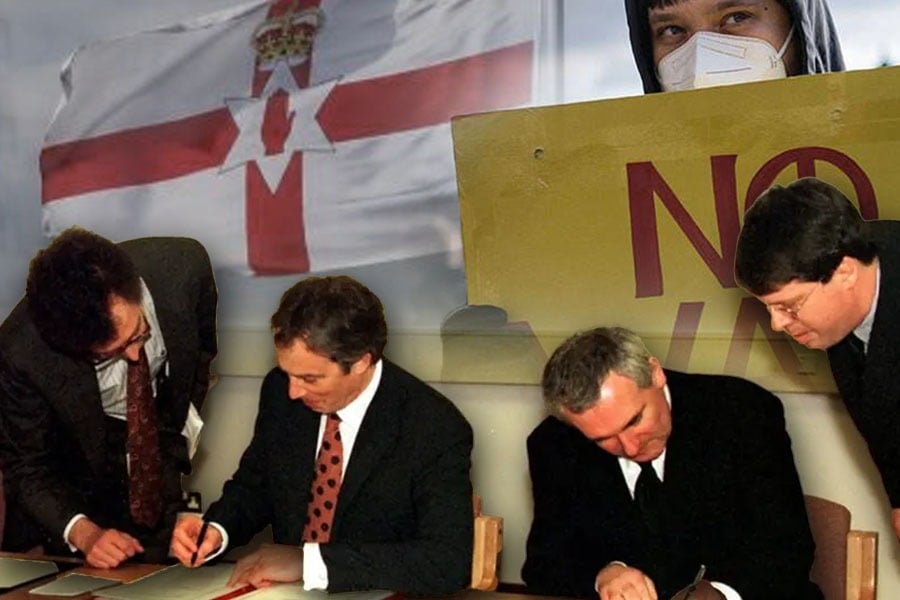
Finally, on April 10, 1998, a peace agreement known as the “Good Friday Agreement” was signed in Belfast, providing a framework for ending a violent conflict that had lasted several decades. The Belfast Agreement created democratic and inclusive structures for power-sharing and allowed the conflicting parties to pursue their aspirations and demands through political means. The agreement is regarded as a turning point in the history of Northern Ireland (Ireland, n.d.; History Extra, 2023).
Scope, Question, Argument, and Significance of the Paper
As noted in the abstract, this study seeks to examine the reasons for the durability of peace agreements by focusing on the Good Friday Agreement in Northern Ireland. In other words, the paper seeks to answer the question of how the 1998 agreement between Unionists and Nationalists ended a violent conflict that had lasted three decades, and how its provisions contributed to the durability of peace in Northern Ireland.
Examining these questions in the context of Northern Ireland can help provide a better understanding of the factors that affect the durability or failure of peace agreements. The main argument of the paper is that cooperation between domestic and external actors, wise political leadership, and the provisions of the peace agreement all played a role in the durability of peace in Northern Ireland.
The Good Friday Agreement included power-sharing mechanisms, balanced recognition of the demands of the conflicting parties, namely Unionists and Nationalists, regarding the future of Northern Ireland, legal reforms, and the principle of popular consent regarding any change in the political status of the region.
In addition, to avoid conceptual ambiguity, this paper uses the definition of “sustainable peace” offered by Wagner and Druckman (2017): sustainable peace relates to the degree to which a conflict is resolved and is measured over a relatively long period of time. Sustainable peace emerges when the conflicting parties settle their differences and rebuild security, governance, and economic institutions.
As will be examined in later sections, this understanding of the durability of peace largely corresponds to the experience of Northern Ireland, particularly in terms of the reduction of violence, the creation of new governing institutions, and the continuation of the peace process for nearly three decades after the signing of the Good Friday Agreement. Nevertheless, before introducing the theoretical framework of the study, it is necessary to note that a comprehensive examination of the factors that led to the formation of the conflict, or of the future prospects of the Good Friday Agreement, falls beyond the scope of this paper. The paper focuses solely on the factors affecting the durability of this agreement.
Explaining the factors behind the durability of peace, with a focus on the Belfast Agreement, also known as the Good Friday Agreement, is important because it offers an opportunity to better understand the mechanisms that are effective in turning protracted conflicts into sustainable peace. Examining the Northern Ireland peace process can show how addressing the root causes of the conflict in the text of a peace agreement helps establish peace. This includes power-sharing, the participation of the conflicting groups, the guarantee of the fundamental rights of various segments of society and citizens, and the presence of strong political will at the domestic level together with serious support from international actors.
Moreover, this study can offer valuable lessons for designing sustainable peace agreements in societies where the roots of conflict lie in issues related to participation in political power and identity, including Afghanistan.
Theoretical Framework
After a brief review of the relevant literature, the author of the paper concluded that the Northern Ireland peace agreement has mostly been analyzed through consociationalism and the top-down approach. Consociationalism was developed by Arend Lijphart in the 1960s. This theory emphasizes the use of democratic power-sharing mechanisms and institution-building to stabilize societies that are divided along religious, ethnic, and linguistic lines.
The top-down approach emphasizes establishing peace through negotiations among elites. Put simply, this approach holds that the state or elites can create peace and then present it to society. This view stands in contrast to the bottom-up approach, which assigns a fundamental role to individuals and society in the peacebuilding process (Northern Ireland Assembly (NIA), n.d.; Hancock, 2008).
Although this paper accepts that each of the aforementioned theories provides an important framework for understanding the Northern Ireland peace process, it also considers hybrid peacebuilding theory suitable for analyzing this process. Because domestic and external factors and actors participated simultaneously in the negotiations, the Northern Ireland peace process can be considered an example of hybrid peacebuilding. This understanding is also consistent with Belloni’s (2012) view of hybrid peace. He defines hybrid peace as the simultaneous use of local and global, and liberal and non-liberal, norms, institutions, and actors.
In Northern Ireland, Britain and the United States played the role of external actors, while the Irish government, the conflicting parties, and civil society and religious leaders were among the domestic actors in the peace process. Moreover, although the power-sharing arrangements were more closely tied to the local context, the adoption of the “principle of consent” in the peace agreement was rooted in liberal thinking and in a relatively inclusive, cross-border value. Under this principle, Northern Ireland could remain part of Britain or unite with the Republic of Ireland if the majority of its people consented.
Consequently, this paper draws on these three theoretical perspectives to arrive at a relatively comprehensive understanding of the Northern Ireland peace process, though its main focus is on hybrid peace theory. Based on a brief review of the existing literature, the author concluded that the Northern Ireland peace agreement has not yet been examined from this perspective. Of course, this claim may be refuted if the scope of the review of published literature in this field is expanded.
The Good Friday Agreement and Its Content
In order to reach an agreement that could end the Northern Ireland conflict, more than six attempts were made between 1974 and 1994. Although these efforts focused on power-sharing between Nationalists and Unionists, the local actors in the conflict opposed them because all these efforts were led by a single external actor, namely Britain. The British government, which had acted without sufficient regard for the views of the people of Northern Ireland, acknowledged its failure to create a political solution and concluded an agreement with the Republic of Ireland known as the “Anglo-Irish Agreement.” Under this agreement, lasting cooperation between Britain and Ireland was established for managing the conflict.
This agreement showed that the British government had realized it could not, on its own, create an effective political solution to end the conflict. One reason for its failure was its lack of sufficient legitimacy among the Nationalist, or Catholic, population of Northern Ireland. The Anglo-Irish Agreement is considered an important preliminary step on the path to the Good Friday Agreement (Darby, 2003).
Nevertheless, finding a solution to the conflict was not merely a concern of the British and Irish governments, as the conflicting parties also wanted it. They recognized the suffering and cost that the conflict had imposed on the people, a point also reflected in the text of the Good Friday Agreement. A shared understanding of the costs of the conflict made the conflicting parties more determined to reach a political agreement. This process also benefited from behind-the-scenes negotiations and the assistance of international third parties, including the United States of America (Democratic Progress Institute (DPI), 2013).
Religious leaders, representatives of civil society, and political elites also took part in the peace process. Finally, on April 10, 1998, Bertie Ahern, then leader of the Irish government, and Tony Blair, then Prime Minister of Britain, together with representatives of the conflicting groups and leaders of civil society and religious communities, played a role in reaching the Belfast peace agreement, also known as the Good Friday Agreement. Cooperation among elites and political leaders has been regarded as one of the most important factors in this success (The National Archives UK, n.d.).
In addition, given the diversity of the participants in the peace talks, the Good Friday Agreement took shape within the framework of multiparty negotiations. This shows that, in addition to having the support of external actors, the agreement enjoyed a significant degree of local ownership, a point that makes it possible to examine the Northern Ireland peace process from the perspective of hybrid peace.
Under this agreement, new institutions were established, including the following:
- Northern Ireland Assembly (NIA)
- North/South Ministerial Council (NSMC)
- British-Irish Council (BIC)
- British-Irish Intergovernmental Conference (BIIC)
According to Snyder (2022), the NIA ended direct British rule over the region and paved the way for the transfer of some power to the representatives of the people. Both Unionists and Nationalists had representatives in the NIA. Britain and Ireland amended their contentious laws and accepted that Northern Ireland would remain part of Britain for as long as the majority of its citizens did not wish to join the Republic of Ireland. In other words, any change in the political status of the region required the approval of the majority of the citizens of Northern Ireland.
It was also agreed that the Protestant and Catholic communities of Northern Ireland would share power jointly. The reform of the police and judicial institutions, the protection of human rights for all, the release of prisoners from the conflict period, disarmament, and the establishment of new institutions to strengthen cooperation among Ireland, Northern Ireland, and Britain were other elements of this agreement. In the May 1998 referendum, the people of the Republic of Ireland and Northern Ireland supported the Belfast peace agreement (Good Friday Agreement, 1998; The National Archives UK, n.d.).
In sum, the Good Friday Agreement recognized power-sharing, the right to self-determination, and the right of the people of Northern Ireland to choose between joining a united Ireland and remaining in Britain. This shows that the demands of the two main parties to the conflict, namely Nationalists (mainly Catholics) and Unionists (mainly Protestants), regarding the future of Northern Ireland were addressed within the framework of the agreement. The agreement also covered issues such as police reform, human rights, discrimination in employment, and shortcomings in the judicial system. In this way, the Good Friday Agreement addressed a number of the main roots of the conflict in Northern Ireland.
“We recognize the legitimacy of whatever choice the majority of the people of Northern Ireland freely exercise regarding its status, whether they prefer to continue the link with Great Britain or a sovereign united Ireland… The parties affirm their commitment to mutual respect, and to the civil rights and religious liberties of everyone in the community, given the history of the conflict.”
– From the text of the Good Friday Agreement
Furthermore, by emphasizing the creation of new institutions, the amendment of laws, and the restructuring of the police and judicial systems, the Good Friday Agreement also addressed some of the roots of structural violence. According to one of the accepted principles in peace and conflict resolution studies, resolving a conflict requires that its roots first be identified and recognized, and that action then be taken to eliminate them. Evidence shows that the Northern Ireland peace agreement paid considerable attention to this principle. Cooperation between local and international actors to identify the roots of the conflict and reach a political agreement was part of this process. As Antonio Guterres, Secretary-General of the United Nations (UN), says, the Good Friday Agreement opened up a “brighter future” for Northern Ireland (Bir, 2023).
You can read the Persian version of this analysis article here:
بخش نخست – عوامل پایداری صلح با تمرکز بر توافقنامه جمعه خوب در ایرلند شمالی