Part One: Rumi Versus Khayyam, Two Ways of Facing the Tragedy of Existence
7. Is Rumi’s Thought Superior to Khayyam’s Thought?
This question is one of the most important parts of the discussion. If by superiority we mean the ability to offer a spiritual and hopeful horizon for life, it can be said that Rumi’s thought, compared with Khayyam’s thought, offers broader possibilities for freeing a person from existential anxiety. Khayyam tells human beings that the world is impermanent, death is certain, and the mystery of existence may never be unlocked. Consequently, one must seize the brief opportunity of life and make use of it. Rumi, however, invites people to a horizon beyond this. He says the world is not only what we see on the surface. Suffering, death, and extinction exist, but from within them one can arrive at love, meaning, transformation, and a kind of spiritual peace. From this perspective, Rumi’s thought not only confronts the tragedy of existence but also strives to interpret it within a wider horizon. This approach can have greater capacity for a person who is searching for meaning, hope, and a bond with the world. But philosophical fairness requires that we not reduce Khayyam to a dead end and Rumi to a definitive answer. Khayyam is not necessarily a denier of meaning; rather, he is cautious and questioning in the face of definitive claims about truth. Rumi, too, in offering a mystical answer, speaks of the experience of faith and intuition, an experience that is neither the same for all people nor provable.
Therefore, it is better to look for Rumi’s superiority in his power to give meaning, his capacity for inner transformation and the possibility of reconciling human beings with existence, not in the claim that he has solved all philosophical questions. Khayyam teaches us not to deceive ourselves in the face of impermanence; Rumi teaches us not to lose hope and the possibility of transformation in the face of impermanence. Khayyam highlights vigilance in the face of death; Rumi highlights the possibility of living in the light of love.
These two views differ existentially, but both can play a role in understanding human beings and the world.
8. Khayyamian Joyful Living and Rumi’s Joy: Two Different Meanings of Life
One of the most important differences between these two ways of thinking lies in the concept of joy. Khayyamian joy can be regarded as a kind of acceptance of the limited and impermanent reality of life. Since a person cannot bring back the past or guarantee the future, they must take the present moment seriously. This joy is a kind of resistance against the anxiety of death and the impermanence of the world.
But Rumi’s joy is not merely making use of the moment; it is a change in a person’s relationship with the moment. Rumi speaks of a joy that springs from love, presence, knowledge, and spiritual experience.
In the Khayyamian view, a person strives to make use of the moment of life because life is limited. In Rumi’s view, a person strives to be present in the moment because life can carry a meaning beyond its outward appearance.
This difference can be expressed as follows:
- Khayyamian joyful living: Life is short; therefore, seize the moment.
- Rumi’s joy: Experience life more deeply, because within it lies the possibility of love and meaning.
Of course, these two approaches should not be regarded as completely opposed. Both attend to the value of life, and both grapple with human heedlessness and suffering. Their difference lies in the ultimate horizon: Khayyam emphasizes the value of the limited moment; Rumi emphasizes the possibility of spiritual experience and of moving beyond one’s limited self.
9. The Danger of Heedlessness: Can Reading Rumi Also Become an Escape?
One of the important points in the writing of Mohammad Amin Morovati is the problem of heedlessness. To escape the heaviness of existence, a person may take refuge in various entertainments and activities, but these refuges are not always liberating. Even mysticism, philosophy, poetry, and reading Rumi may turn into a kind of entertainment and an escape from truth. Sometimes, instead of experiencing an idea in their own life, a person turns it into a subject for display, boasting,g or cultural consumption. Someone may speak of Rumi’s love yet be caught, in everyday life, in selfishness, bigotry, violence, and cruelty. They may speak of the unity of existence yet remain indifferent to the suffering of other people. They may memorize Rumi’s poems yet remain far from moral and inner transformation. In such a situation, mysticism becomes not a path of liberation but a new form of heedlessness. This point is of great importance, because it shows that Rumi’s thought is not realized by reading the Masnavi, attending mystical gatherings, or repeating beautiful sayings. Rumi’s thought takes on meaning only when love, awareness, and transformation become visible in a person’s conduct and life. In other words, Rumi should not be turned into a cultural commodity or a collection of beautiful sentences. He should be tested in the experience of life, in the confrontation with suffering, in relations with others and in one’s way of looking at the world. If mysticism distances a person from the responsibilities of life, it has come close to heedlessness; but if it makes them more sensitive, kinder, more aware and more responsible, it can become a kind of existential awakening.
10. The Third Rumi: Dance, Music and Reconciliation with Existence
In the stage of love and spiritual transformation, Rumi experiences the world not only from the perspective of suffering but from the perspective of passion, movement and renewal. Dance, sama, and music, in this horizon, are symbols of a kind of liberation from stillness and mental limitations. Dance here is not merely bodily movement; it is a metaphor for life. Life, in Rumi’s view, flows; the world is in motion; forms are transformed, and a person, too, can move beyond their closed and fixed states. Rumi reminds people that the world is not only a place of sorrow and death; the world is also the possibility of experiencing beauty, love, connection, and joy. In this sense, the third Rumi can be regarded as the Rumi of dance and music, a Rumi who, in the face of the heaviness of existence, instead of stopping in complaint, turns toward movement and the experience of love. This view holds special importance for contemporary human beings. Today’s world, despite scientific and technological progress, still faces loneliness, anxiety, a crisis of meaning, war, violence, and humanity’s alienation from nature. A person may, amid abundant possibilities, grow distant from real life and be caught in a cycle of consumption, competition, and worry. In such a situation, Rumi can be a reminder of a kind of life in which a person reconnects with nature, the body, music, love, and others. But reconciliation with existence does not mean overlooking injustice, social suffering or the bitter realities of the world. Rumi’s love must not become a justification of injustice or a passive acceptance of suffering. Reconciliation with existence, in a deeper sense, is reconciliation with reality and finding the strength to live responsibly within it. A person who reconciles with existence is not necessarily dissatisfied with the world, but this reconciliation should not prevent them from changing an unjust world. Love can also be a force for confronting violence and injustice.
11. Rumi’s Thought and Pragmatism: Which View Is More Useful for Life?
If we look at these two approaches from a pragmatist perspective, we can ask: which thought has greater capacity, in a person’s practical life, to reduce suffering, increase hope, and create meaning? Here, Rumi, particularly for his ability to turn suffering into a spiritual and constructive experience, offers a broad horizon. He does not invite a person to passively accept their situation but calls them to inner transformation and to reconstruct their relationship with the world. From this perspective, Rumi’s thought can be useful for life, because it helps a person move beyond feelings of isolation, fear and meaninglessness and toward connection, love and awareness. Nevertheless, pragmatism does not allow us to consider an idea a definitive truth merely because it is appealing. A belief may be soothing but not necessarily true. Therefore, a distinction must be made between the practical value of an idea and its philosophical validity. Rumi can help a person existentially and psychologically, but this usefulness does not amount to proof of all his mystical claims. Likewise, the Khayyamian view may be more bitter, but sometimes this very bitterness saves a person from mental deceptions and unrealistic hopes. Consequently, from the standpoint of practical life, Rumi’s thought can have a more hopeful horizon, provided it does not turn into a mirage, self-deception, or an escape from reality.
12. Nietzsche and the Question of Spirituality: Can Love Be Removed from the World?
Nietzsche is one of the most important critics of traditional values and of some forms of religious morality and spirituality in modern philosophy. By criticizing established values, he tries to free human beings from dependence on values that weaken life. But this critique should not be regarded as a simple attempt to destroy love or all spirituality. Nietzsche himself speaks of the passion for life, the creation of values, beauty, art, and a kind of affirmation of existence. Therefore, if we speak of the “killing of spirituality,” we must distinguish between religious spirituality, traditional mysticism, and the non-religious experience of transcendence and meaning.
The important point is that love, beauty and the experience of meaning are not limited to one tradition or specific belief system. A person can have deep and transformative experiences in mysticism, art, nature, human relationships and creation. For this reason, the survival of spirituality should not be regarded only as a defeat for Nietzsche or other critics of religion. Spirituality, in its various forms, is human beings’ response to deep existential needs: the need for meaning, connection, beauty, transcendence, and moving beyond one’s limits. Rumi is one of the greatest representatives of this experience in the Persian tradition. He regards love not as a doctrine but as a living force for human transformation. For this reason, his thought can still draw attention in the contemporary world, a world in which the question of meaning, suffering, and the possibility of life remains standing.
13. Must We Choose Between Khayyam and Rumi?
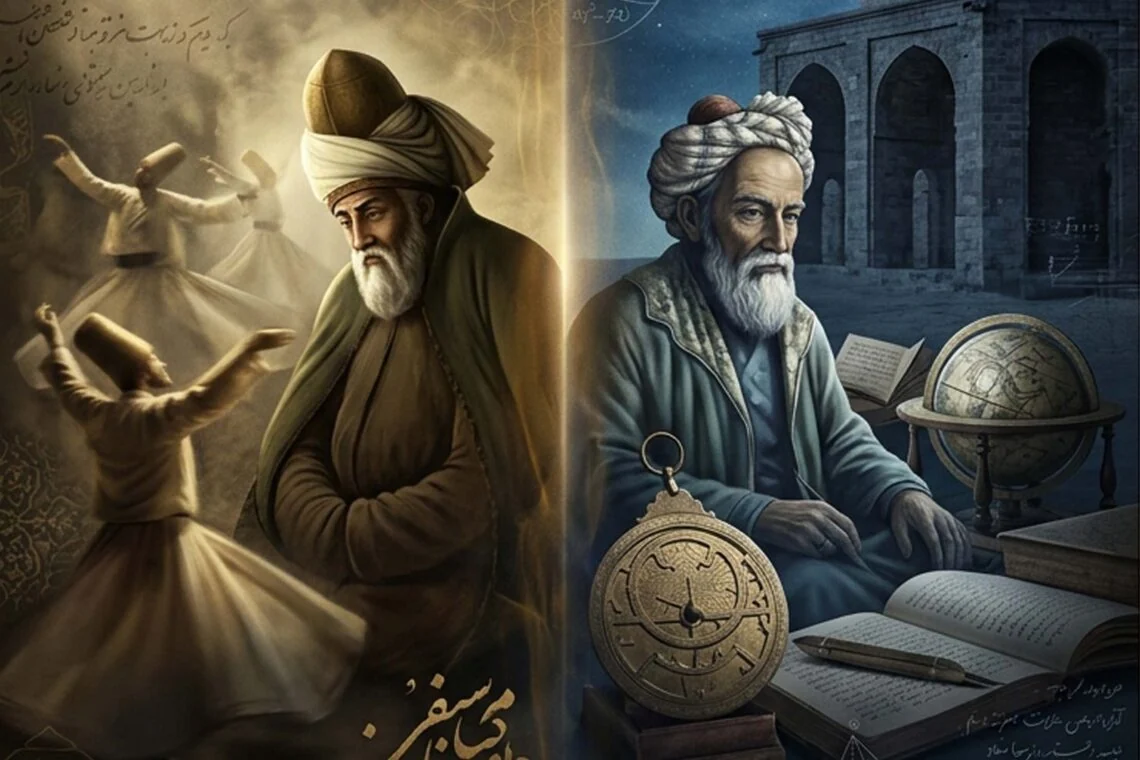
The opposition of Khayyam and Rumi, if it becomes an absolute choice between doubt and faith, despair and hope, or death and life, loses part of the complexity of both ways of thinking. Khayyam warns us not to make definitive claims or offer simplistic consolations in the face of the mystery of existence. He confronts people with the limits of knowledge, the impermanence of life and the value of the present moment. Rumi, by contrast, reminds us that the limits of knowledge do not mean that all horizons of meaning are closed. A person can discover, in love, art, spiritual experience and connection with the world, a different way of living. If we read Khayyam and arrive only at sorrow and death, we may have lost part of the value of his thought, because he invites us to live within this very limited opportunity. If we read Rumi and arrive only at joy and dance, we may again have overlooked an important part of his thought, because Rumi’s love passes through awareness, suffering, extinction and transformation. From this perspective, Khayyam and Rumi can be regarded as two different answers to one fundamental question: how should one live in an impermanent world? Khayyam says: with awareness of limits, seize the moment. Rumi says: by moving beyond the limited self, experience love and the deeper meaning of life. And perhaps contemporary human beings need both: Khayyamian vigilance to avoid self-deception and Rumi’s love to prevent falling into despair and meaninglessness.
Conclusion
The opposition between Rumi’s thought and Khayyam’s thought is, ultimately, an opposition between two ways of confronting the tragedy of existence. Khayyam, from awareness of extinction, impermanence,e and the limits of knowledge, arrives at seizing the moment and at the value of a brief human life. Rumi, too, begins from this same awareness but does not stop there; he tries to discover, from within suffering, love, and from within extinction, the possibility of renewal and meaning. In the Khayyamian view, a person should learn to be humble before the mystery of the world and not squander the opportunity of life. In Rumi’s view, a person must, in addition to this humility, take the possibility of transformation and of moving beyond their own limits. Khayyam teaches us not to waste life in hope of an unknown tomorrow; Rumi teaches us not to reduce life to fleeting pleasures and temporary relief. If we regard Khayyam’s thought as a kind of vigilance in the face of death, Rumi’s thought can be regarded as a kind of vigilance in the face of the limits of human beings’ view of life. Khayyam pulls aside the curtain of heedlessness so that a person may see the impermanence of the world; Rumi pulls aside another curtain so that a person may realize that impermanence is not the whole truth of the world.
From this perspective, Rumi is for us not merely a poet of love and mysticism; he is the teacher of a kind of life in which a person becomes aware of suffering but does not allow suffering to occupy the whole horizon of their being. He reminds us that one can make peace with the world without ceasing to think; one can be in love without denying reality; and one can live in an impermanent world without spending all of life waiting for death.
Today, more than at any other time, we need the third Rumi, a Rumi who experiences love, hears music, dances, moves beyond himself and breathes in harmony with existence. But this Rumi has meaning for us only when his love turns into conduct, awareness, responsibility and life. Khayyam’s thought teaches us how to bear the heavy burden of existence; Rumi’s thought enables us to find, within this same existence, a meaning for life. Perhaps this is also the secret of Rumi’s lasting power: he does not promise human beings that the world will become free of suffering; rather, he reminds them that even in a world mixed with suffering, one can still love, still create, still dance, and still love life.
References
- Morovati, Mohammad Amin. “The Difference in the Approaches of Rumi and Khayyam to Life.” The blog I Think, written on December 13, 2010, published on January 30, 2011, at 18:39.
https://amin-mo.blogfa.com/post/388
- Naraghi, Arash. “The Experience of Nonexistence in Rumi and Khayyam.” 3Danet, lecture at the Iranian Culture Enthusiasts Conference, Chicago, August 31, 2018.
https://3danet.net/none-existence-from-the-prespectives-of-rumi-and-khayyam
- Naraghi, Arash. “Existence and Nonexistence in the View of Khayyam and Rumi,” Part One. 3Danet, March 2, 2016.
https://3danet.net/existence-and-nonexistence-in-khayyams-and-rumis-view-1
- Naraghi, Arash. “Existence and Nonexistence in the View of Khayyam and Rumi,” Part Two. 3Danet.
https://3danet.net/existence-and-nonexistence-in-khayyams-and-rumis-view-2
- Adib, Morteza. “Spiritual Wisdom and Tragedy.” Simareh, issue 598, October 28, 2021. A summary and re-reading of Arash Naraghi’s article on the experience of nonexistence in Khayyam and Rumi.
- Abedi, Sayed Noor Mohammad. “An Examination of the Concept of Death in the Wisdom of Khayyam and the Mysticism of Rumi.” Cheragh-e Hikmat Scientific and Research Journal, 2025, Volume 12, Issue 28, pp. 114-133.
https://rctmis.mohe.gov.af/article/3894
- Mawlana Jalaluddin Muhammad Balkhi. The Masnavi.
- Mawlana Jalaluddin Muhammad Balkhi. The Complete Works of Shams Tabrizi (Kulliyat-e Shams-e Tabrizi).
- Khayyam of Nishapur, Omar ibn Ibrahim. The Rubaiyat of Khayyam.
You can read the Persian version of this article here: